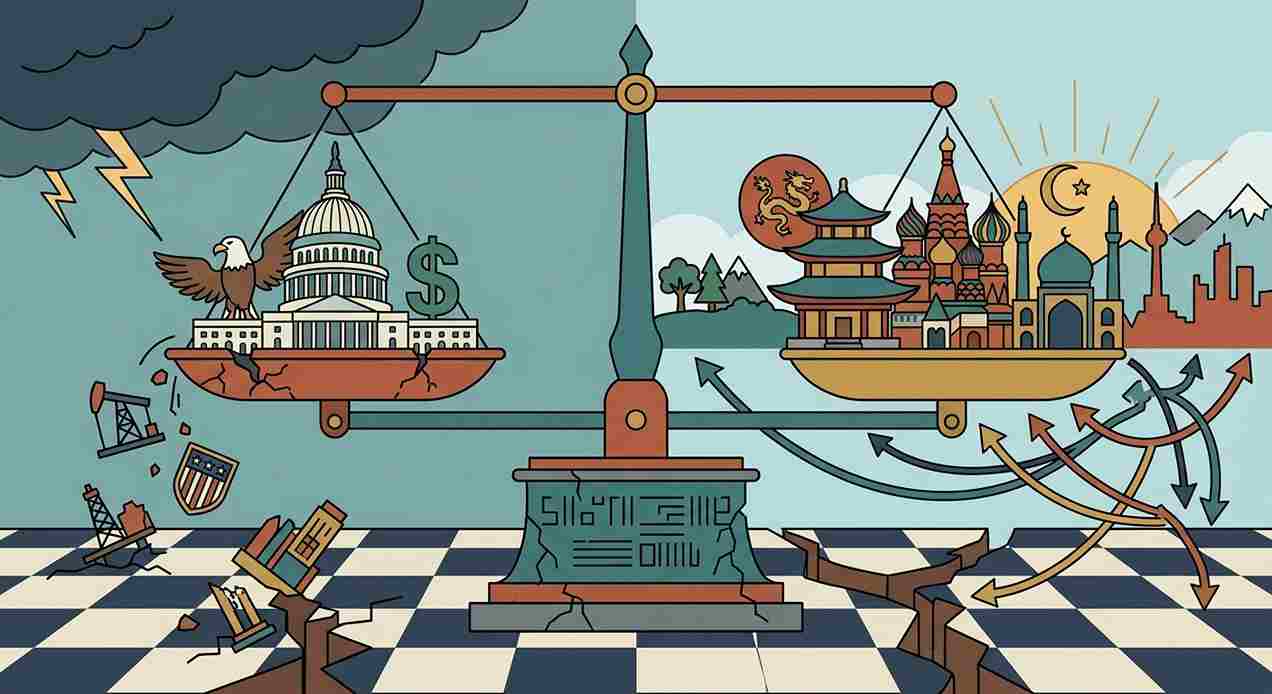
Since 2017, when China became a global economic power, realist scholars like John Mearsheimer have argued that the global order is shifting from unipolar to multipolar. During Trump’s first term and Joe Biden’s presidency, neither administration placed much emphasis on this shift — both were fixated on containing China.
Trump’s second-term administration still has not worked out how to handle the challenges of multipolarity. The current US administration remains fixated on the dream of unipolarity, believing itself to be the world’s predatory hegemon.
The US-Israel war against Iran has shattered Israel’s geopolitical ambitions. Israel, alongside Uncle Sam, is in deep trouble, having been decisively defeated by Iran. Washington’s biggest setback in the Middle East is the erosion of trust among its allies.
This raises a question: why did the Trump administration fail to manage the crisis in the Middle East? The Israeli-led war on Iran has spilled over across the Gulf.
Moreover, Saudi Arabia, the United States’ closest regional ally, is now searching for alternatives for its security and well-being. The tit-for-tat retaliations between the Houthis and Saudi Arabia are a direct result of the war on Iran.
Washington misjudged Iranian power. It thought it could quickly remove the Iranian regime and strike an agreement with a new pro-Western government, motivated by its experience in Venezuela. Here, however, it failed drastically, and the crisis is spreading like wildfire.
During the unipolar period after the cold war, Washington held a dominant position globally and expanded its sphere of influence wherever it wished, without facing pressure. Its failure to achieve its goals and steer the conflict toward a desirable end reflects a lack of strategic decision-making.
As Stephen M. Walt notes, “the real reasons that the United States keeps losing wars are strategic and structural. The problem is that it is usually fighting the wrong wars for the wrong objectives.” Washington’s habit of building narratives around its hegemonic position has led to tragic consequences. American leaders must understand global multipolarity in order to restore peace and prosperity.
Recently, Pakistan, Saudi Arabia, and Turkey signed the Makkah Joint Defense Alliance (MJDA) to safeguard their security and survival. It is a NATO-like military structure under which an attack on one member is treated as an attack on all.
Saudi Arabia, long reliant on the US for its security, is now searching for alternatives, since Washington has failed even to protect its own military bases in the region. Vali Nasr, a well-known scholar of Iranian strategy, argues that “the MJDA is a punch to Trump’s Abraham Accords.” The pact will spread across the Muslim world, with regional states eager to join — Egypt, Bangladesh, Kuwait, and Qatar are expected to be next.
The key global powers are the USA, China, Russia, and India — though Robert Pape ranks Iran fourth in place of India, arguing that the dynamics of global power have shifted. Iran, in his view, now holds substantial sway in both regional and global power domains. Some scholars, however, do not consider Iran a great power at all.
While Iran has demonstrated considerable military strength, this has not shaken the broader multipolar structure. Mearsheimer maintains that the war has not altered the underlying order of great-power politics.
More than seven months into the conflict, Iran arguably holds greater leverage than the US and has seriously — if not completely — degraded American military bases in the region.
In June, the two rivals signed a Memorandum of Understanding (MoU), mediated by Pakistan — a document widely seen as a win for Iran. “The MoU is a surrender document for America,” Mearsheimer said. The US later tore up the MoU and attacked Iran again.
Now the ball is in Iran’s court, and wherever it leads, Tehran holds considerable leverage; any future deal is likely to be shaped largely on Iran’s terms.From the earliest days of the war, Iran has controlled the Strait of Hormuz — the only maritime route for Middle Eastern nations, and the corridor through which Gulf crude oil, food, and agricultural and fertilizer products pass.
Trump has repeatedly claimed to control the strait, but this amounts to little more than bluster; Iran remains firmly in the dominant position. As Fareed Zakaria has noted, “a weapon that is far more usable than nuclear weapons, which is the Strait of Hormuz, choking off global oil supplies, essentially disrupting the global economy.”
Trump’s strategic failures have pushed the other global powers onto the same page. China, Russia, and Iran have coordinated closely since the war began. The power vacuum left by the US inevitably invites other powers — Russia and China chief among them — to seek greater influence in the region, a development that will create lasting trouble for Washington. At the recent Shanghai Cooperation Organisation (SCO) summit in Bishkek, Kyrgyzstan, member leaders signed a declaration collectively condemning US attacks and economic pressure on Iran.
Notably, India — a strategic US ally for decades — also signed on to the condemnation. In a podcast with Tom Switzer, Rosemary Kelanic argued that “President Trump to launch a disastrous war that has strengthened Iran’s hand while bogging down the U.S. in yet another aimless Middle Eastern conflict. ”
The Trump administration has failed to grasp the demands of a multipolar world. These setbacks — in the Middle East and in Ukraine alike — are punches delivered by that emerging order. Trump must recognize that in today’s multipolar world, states have options: if Washington fails to serve their interests, they will find others willing to offer a better deal. The US is no longer a benevolent hegemon; it must now settle for a lion’s share rather than the whole pie.
The current US administration is mired in a leadership crisis, marked by internal gaps and divisions. Vali Nasr has noted that “there is more division within American leadership today than among Iranian decision-makers.” Washington should therefore work toward a better deal and come to terms with its diplomatic and military failures — it is the least-bad option left for Trump to end the war.
In sum, since the start of his second term, Trump has treated both allies and rivals in an exploitative manner. A regional power cannot get away with such predatory behavior in a multipolar world. It irritates friendly nations and leads to a fragile alliance structure.
For a better and more prosperous world, the USA, along with other global powers (Russia, China, and India), should emphasize cooperation rather than confrontation. This is a war of survival for Iran. Tehran may allow its civilization to be devastated, but it will not surrender. Existential wars are not won by conceding — they are fought to the last bullet.

Islam Azum
The contributor holds a graduation in International Relations from the Islamia University of Bahawalpur Punjab, Pakistan. His BS research categorically identify Climate Politics and U.S-China Cooperation and Competition. Currently enrolled in B.Ed at Allama Iqbal Open University Islamabad.