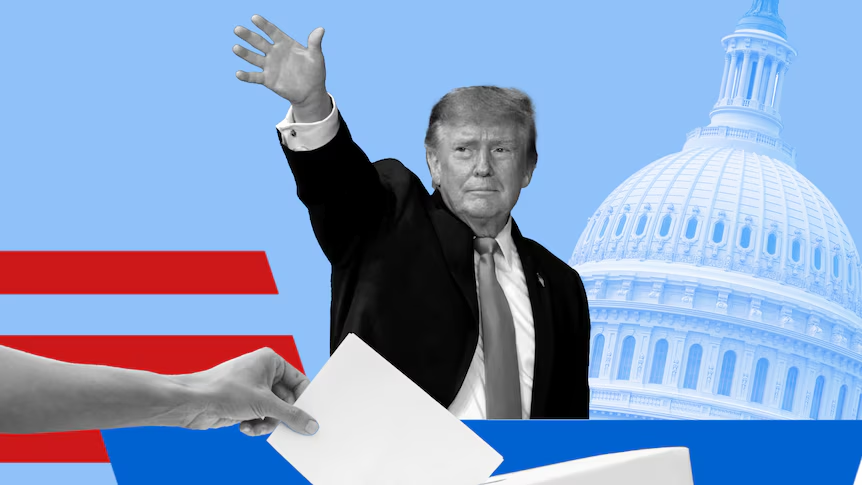
Today, the American people deliver their verdict on Donald Trump. He is not on the ballot himself, yet his tariffs, his prices and his war with Iran are. Every one of the 435 House seats, 35 Senate seats and 36 governorships is up for grabs, and the results will determine who controls Congress through the last two years of his presidency.
The mood across the country is grim. Inflation has risen to 3.7 per cent. In the most recent New York Times/Siena poll, 53 per cent of likely voters described the economy as poor — the weakest reading since July 2022. The Pew Research Center found that 84 per cent of registered voters regard the economy as very important to their vote, and polling by the Council on Foreign Relations indicates that 81 per cent of Americans think Trump’s tariffs have driven up their cost of living. Even 62 per cent of Republicans concur.
Forecasters detect a wave building. On Election Day, Decision Desk HQ put Democrats’ chances of taking the House at 80 per cent and the Senate at 57 per cent, while the last NBC News poll found voters favouring Democratic control of Congress by 52 to 45. Trump wrapped up his campaign with a final appeal delivered from the Reflecting Pool in Washington. Now it is voters who will have the final say.
A verdict, not a reversal
For Asian capitals, the temptation will be to interpret a Democratic win as the close of the tariff era. That would prove an expensive error. Congress is granted authority over tariffs by the Constitution, yet any repeal bill is subject to a veto, and overturning that veto demands a two-thirds majority in both chambers. As Chatham House notes, for ten years Congress has been unable to forge a cross-party trade policy, and Democrats are themselves deeply divided over what tariff levels ought to be.
What a Democratic-controlled House would deliver is scrutiny: hearings, subpoenas and investigations into the way Trump’s trade deals were negotiated and how tariff exemptions came to be granted. That translates into pressure on the White House. It does not amount to the end of the executive’s trade power.
The courts made the first move, and the White House answered in kind
The gravest blow to Trump’s tariff edifice came not from voters but from the Supreme Court. On 20 February 2026, ruling 6-3, the Court determined that the International Emergency Economic Powers Act does not grant the president authority to impose tariffs. Some $160 billion or more in duties turned refundable, yet months on many refunds are still trapped between Customs and the courts, with the Justice Department challenging parts of the process.
The administration did not pull back. It reloaded. A 10 per cent global surcharge under Section 122 came into force on 24 February. When that tariff lapsed by law on 24 July, Section 301 forced-labour tariffs of 10 or 12.5 per cent on 60 economies replaced it that same day. A new Section 301 investigation into industrial overcapacity is already under way, and fresh Section 232 duties on semiconductors are still being considered. Sever one legal head of Trump’s tariff policy, and another grows back in its place.
China: a truce on a short leash
When Xi Jinping reached Washington in September, Treasury Secretary Scott Bessent announced that the US-China trade truce would be extended only until 10 January 2027. Bessent conceded that he was not certain a larger deal could be secured by that date. Each side has identified roughly $30 billion of non-sensitive goods for tariff cuts, a helpful beginning but far from a settlement.
A truce counted in weeks cannot serve as the foundation for a factory built to last for decades. The January cutoff also arrives just days after a newly elected Congress takes its seats. A president wounded at the ballot box may go looking for a foreign-policy victory, and Beijing will factor that eagerness into every concession it makes.
India: perpetually at the finish line
India’s tale is one of endless nearness. A framework agreed in February lowered the US reciprocal tariff on Indian goods from 25 to 18 per cent and scrapped the additional 25 per cent duty tied to purchases of Russian oil. Still, on 31 October, US Ambassador Sergio Gor admitted that the deal had been “at the finish line for a very long time.” Commerce Minister Piyush Goyal maintains that the deal is in its final phase and will fully safeguard Indian farmers, though access to the dairy market remains the chief stumbling block. New Delhi would do well to seal the deal before Washington’s post-election mood stiffens.
Pakistan: limited exposure, high stakes
For Pakistan, the numbers are brutal. Each year the country ships roughly $6.2 billion in exports to the United States, about $4.7 billion of which is textiles and apparel. The 19 per cent reciprocal rate Islamabad secured in July 2025 has disappeared along with the emergency tariffs, yet a 10 per cent Section 301 duty has been in force since 24 July, added to standard duties of as much as 16.3 per cent on apparel. According to US data, the average effective tariff on Pakistani goods stood at 20 per cent in August 2026, compared with a US overall average of 6.9 per cent.
No midterm outcome will alter those figures. Only a bilateral agreement will. Over the coming months, Islamabad must secure a waiver or reduction for its value-added apparel and make its case not just at the White House but also on Capitol Hill.
What Asia must do now?
Asian governments and exporters should follow three rules. First, trade on what is signed, not on what is said. Second, keep a closer eye on the legal dockets than on the opinion polls; Section 301 and Section 232 actions now carry more weight than campaign slogans. Third, go straight to Congress and engage it directly. A Democratic-controlled House will convene hearings, and Asian perspectives ought to be represented in them.
The results tonight are going to reshape Washington’s political landscape. They won’t reshape the tools Trump has at his disposal. For Asia, the key question is no longer who prevails in America, but whether anyone there can produce a trade framework that survives beyond a truce. Until that answer arrives, prudent capital will hedge, diversify, and commit to nothing it cannot defend once the next tariff lands.

Qazi Zaheer Ahmad
The author is a retired BS-21 civil servant of the Government of Pakistan with over three decades of public service. He writes on geopolitics, economic strategy, and regional security, and is engaged in international trade and advisory work.