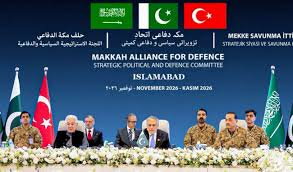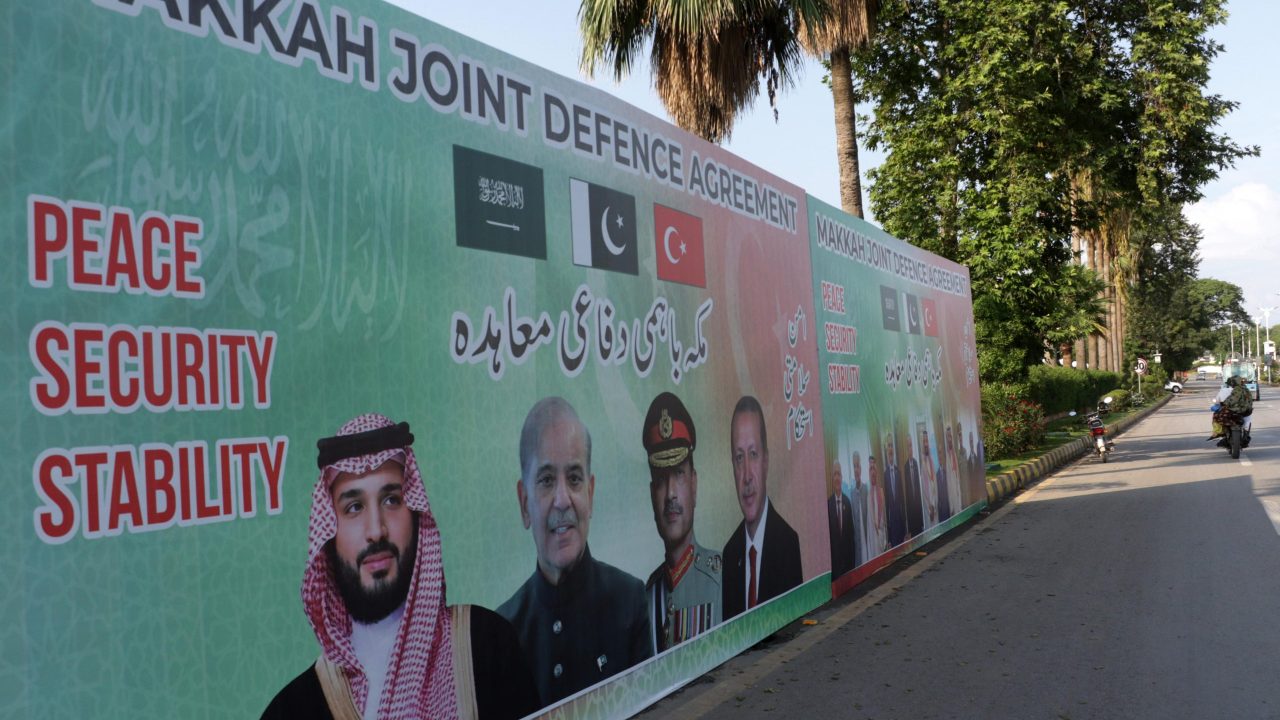
Pakistan has recently had a positive role in avoiding a conflict between Iran and the USA. Originally it was believed that there would be trilateral meetings (between Pakistan, Saudi Arabia and Turkey) on both the 27th and 28th November. However, in fact these took place on Friday 27th November. It has strongly disapproved terrorist attacks on Saudi Arabia and has been able to analyse the consequences of a possible Turkey-Iran conflict.
It was agreed that whilst all Governments will endeavor to further their own interests, the Saudi Government has a special responsibility to protect its people and facilities. Pakistan’s ‘Invincible’ defence capability sat at the center of trilateral talks in Islamabad. Also, Ankara has extensive global links and previously has co-operated in defence. Therefore as well as being at least equal to Saudi Arabia and Turkey in this field, Islamabad analysed the implications for the region of a developing Turkey-Iran conflict.
War and Praise
Since Pakistan has been very successful in its involvement in the India issue since May 2025. Usually Pakistan is highly praised for its performance. President, Donald Trump, has recognized Pakistan’s success. Pakistan is already strategic partner of China. This is because Pakistan has successfully improved its defence and is currently highly regarded by Governments in the Gulf, Central Asia, Chinese, Russian, Turkish and Saudi Arabia. In fact, all of these regions depend on Pakistan.
When we further dived in depth Pakistan’s ‘Invincible’ defence in Drawing on its global links, Islamabad was able to exchange information. It has excellent relations with China, the Gulf and Washington. Furthermore, as the trilateral host, Islamabad was able to successfully engage in diplomatic co-operation and to again make use of its global links.
Innovative improvements
Pakistan has innovatively managed its defence. Globally, the defence industry has been greatly impressed by this. Until recently, Pakistan often contrarily received predominantly, not especially positive media reports from the US and West about its economy and apparent economic problems. However, Pakistan has successfully shifted its focus to defence and as a result there has been considerable change to the strategic environment in South Asia.
Global reaction to Islamabad’s defence innovation
As is also the case with Indian and Pentagon defence forces, the world defence industry has been greatly impressed by Islamabad’s defence innovation. Remarkably, Islamabad has largely successfully and swiftly been able to refocus itself in just the last couple of weeks.
Whilst typically innovation is driven by a country’s desire to efficiently handle its foreign exchange, Governments then need to determine which defence areas should continue to be heavily funded and which defence co-operation is likely to be most advantageous in this regard. However, Pakistan analyses its capacity to use defence as a tool to influence and continues to invest in the most important areas of its economy and society for security purposes.
Sea forces and Air defence
Pakistan is innovatively managing its air defence and is using advanced technology such as the HQ-17 and long range HQ-9P.
Sea being economical, Gulf and South Asia trade is of major economic importance and all three trilateral countries are involved in this. Governments will however, wish to optimally facilitate sea trade. Again, Governments can co-operate in this area.
In addition to the conventional Hangor class submarines Pakistan has secretly introduced highly sophisticated Hangor class submarines into the Arabian Sea. These are equipped with the most up to date air independent propulsion and so have considerably undermined previously neighboring more formidable navy.
Missile testing
Pakistan has openly announced that it has successfully tested a long range version of its Fatah-4 land attack cruise missile. Undoubtedly, Pakistan is highly keen not only to be an expert but also to properly use defence so that it can efficiently manage various issues. Primarily, Pakistan is also likely to use artificial intelligence (AI) and ‘edge’ technology in air and satellite areas.
Good technology use
Contrary to usual practice, Pakistan is effectively employing state of the art technology.
In spite of its economic problems, Pakistan has shown the world that it has the foresight and capability to innovatively use technology in a manner which can significantly affect the strategic environment for the whole region. That it achieved in days.
Undoubtedly, Pakistan has in a relatively short time moved from conventional military technology. It has innovatively combined cyber-space, AI and drone technology and has substantially improved its defence.
World analysis
The world should analyses how a country which, until recently, predominantly received from the US and West not especially positive media reporting about its economy and which was globally discussed for its foreign exchange situation, has so easily and secretly successfully incorporated some of the region’s most innovative technology into its defence in such a short period. In view of Pakistan’s Secret strategic innovation the world should analyse how a country which, until recently, had only been economically analysed, has so secretly successfully innovatively managed its military and technology strategy
What Pakistan is supposed to do?
As all three trilateral countries are concerned for people and for diplomacy. Having analysed regional issues, the trilateral should review its consultation processes. It should then analyse whether or not an issue is pertinent to the trilateral and disseminate this information to neighboring countries. These aspects will affect the extent to which the trilateral can further enhance confidence during periods of heightened Government decision making. Increased Gulf military activity will affect Pakistanis (both in Pakistan and overseas). Thus it is pertinent to analyse the effectiveness of the shipping and energy industries in relation to regional security. Again, Islamabad can co-operate with non-trilateral countries in this area.
Being a trilateral member, Pakistan can consult, rely on and encourage de-escalation through Islamabad. Therefore there are good reasons for that country to continue to co-operate with Islamabad after the trilateral delegation has left. This will guarantee that the trilateral legacy is upheld.
Building on the trilateral, Islamabad can further develop its ‘military diplomacy’. It can continue to consistently consult other Governments, whether or not there is a regional issue. Regular Government consultation enhances mutual comprehension of each other’s position, dispels misinformation and enables common responsibilities to be recognized. Moreover, each capital can also gain further knowledge of non-trilateral countries’ positions and is therefore even better placed to do so ahead of renewed regional concern.
It is now crucial that a continuing trilateral consultation process is put in place, comprising of Islamabad, Riyadh and Ankara. An agreement can then be reached about when consultation should occur, the level of Government commitment and the most appropriate means of sustaining contact with other capitals. Islamabad’s defence military diplomacy was involved in the process which resulted in the formation of the trilateral. Thus, it will be of fundamental importance to discover how the three countries intend to use this.

Qazi Zaheer Ahmad
The author is a retired BS-21 civil servant of the Government of Pakistan with over three decades of public service. He writes on geopolitics, economic strategy, and regional security, and is engaged in international trade and advisory work.