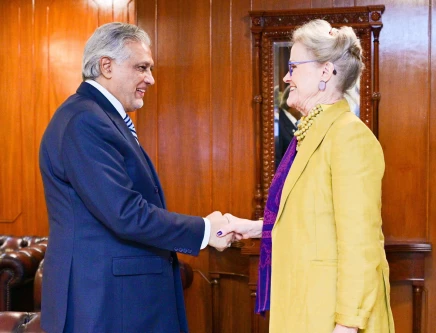
According to Foreign Office, Pakistan and the United States have agreed to promote closer exchanges between think tanks and academic institutions to deepen mutual understanding and encourage dialogue on regional and international issues. The understanding was reached during a meeting between Deputy Prime Minister and Foreign Minister Senator Ishaq Dar and former US assistant secretary of state for South Asian affairs Ambassador Robin Raphel, according to a statement issued by the Foreign Office.
Pakistan and the United States should make direct investments in understanding each other, rather than relying exclusively on diplomatic channels to manage their relationship. For this purpose, both the countries could jointly establish a Pak-US Strategic Dialogue forum to facilitate interaction between leading think-tanks in both the countries, strategic experts, former diplomats and former military officials.
The meeting of such a forum could be held alternatively in Washington and Islamabad. The forum should facilitate the interaction between independent scholars and security experts, not just between government officials from both sides. It should not be restricted to government-to-government contact. It should provide a vibrant forum for regular meetings between intellectual and security experts.
Islamabad has think-tank and research organizations including Pakistan Institute of International Affairs (PIIA), Islamabad Policy Research Institute (IPRI), Institute of Strategic Studies Islamabad (ISSI), and Institute of Regional Studies (IRS).
These Pakistani institutions should form partnerships and collaborations with Americans think-tanks such as RAND Corporation, Brooking Institute, Council on Foreign Relations, Wilson Center and Stimson Center.
The discussions at the government level are mostly constrained by political considerations. The think-tanks and academic institutions could provide an informal but substantive environment for exchange of views on international and regional issues where the governments don’t have to commit anything.
There are several issues about which Pakistani and US experts could have fruitful regular discussions to search for ways to move forward and avoid misunderstandings at the government-to-government level. Pakistani and American experts could regularly exchange views on sensitive subjects such as Pakistan’s relations with two superpowers including US and China.
They can also discuss US-Pakistan relations in the context of great power rivalry. The nuclear and strategic issues in South Asia could also be discussed on this forum. Now Pakistan has become an important player in Western Asia region and perhaps American and Pakistani experts could discuss the strategic situation in this region.
Obviously, these discussions would be at the non-government level and they would not seek immediate agreement. Rather these talks should be held to enhance understanding of each other’s perceptions, concerns and strategic calculations.
American think-tanks have conducted some very substantive research on issues confronting the South Asian region and Afghanistan during the past three decades. Pakistani research organizations should try to learn from the experience of American think-tanks.
For instance, Pakistani experts working on Afghanistan research should be afforded the opportunity to spend some time with American research organizations to learn their techniques, methods and experiences of conducting research in and on Afghanistan.
Similarly American experts working on Pakistan or regional research topics should be allowed to spend some time in Islamabad, Lahore, Karachi and Peshawar and meeting foreign policy experts, political analysts, policy makers, military officials and government leaders.

Your go-to editorial hub for policy perspectives and informed analysis on pressing regional and global issues.