Glacier Retreat, Hydrological Uncertainty, Food-System Shocks and Climate Mobility in a Region of Strategic Rivalry
South Asia’s next security crisis may not begin with a border clash, but with a glacier, a monsoon or a missing flood warning. This brief shows how melting glaciers, floods, food shocks and climate migration magnify the region’s political and strategic vulnerabilities, and why early warning and cooperative water diplomacy, anchored in a Treaty that remains in force, matter more than ever.
Executive Summary
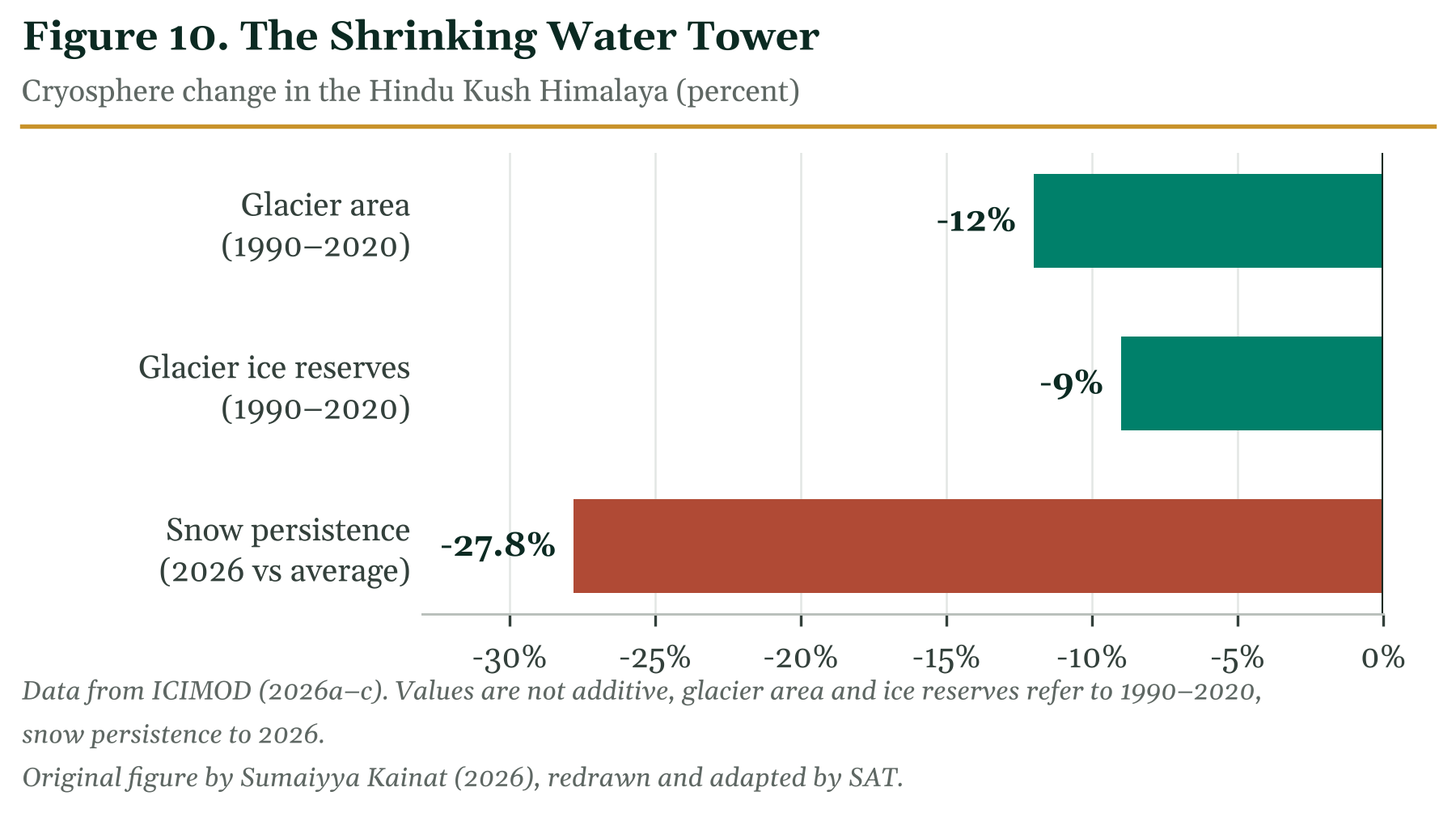
- Hindu Kush Himalaya (HKH) glaciers lost about 12 percent of their area between 1990 and 2020, ice is now melting twice as fast as before 2000, and snow persistence in 2026 was 27.8 percent below average.
- India has held the Indus Waters Treaty (IWT) in abeyance since April 2025. On 31 August 2026, the Court of Arbitration ruled that the Treaty remains in force and cannot be suspended unilaterally. The risk now lies in the gap between law and practice.
- Pakistan’s 2025 floods affected 6.9 million people and took 1,037 lives. The brief proposes a minimum climate-security compact, starting with a technical hydrological hotline and the regional platforms that already exist.
Introduction
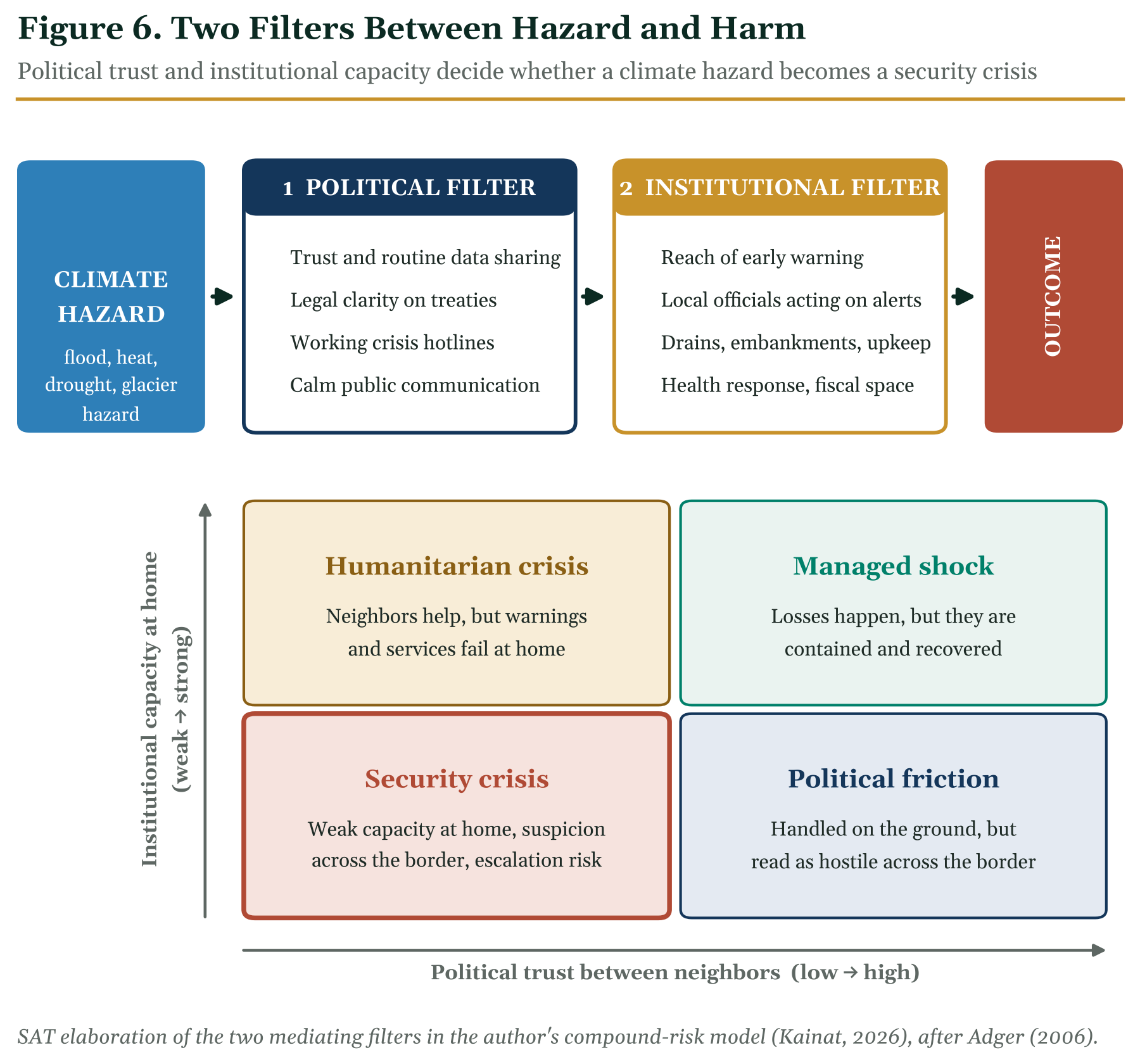
Territorial disputes, military rivalry and nuclear deterrence have long defined South Asian security. Sumaiyya Kainat argues that the conditions affecting state stability are now changing. Climate change is putting river flows, harvests, urban water, public health and disaster response under pressure, and because the region shares its rivers, those risks ignore borders. Climate hazards become security threats, she writes, only when they meet political distrust, weak water governance, exposed infrastructure and inadequate early warning.
Why call climate a security issue?
By Richard Ullman’s classic test, anything that sharply degrades people’s lives in a short time, or narrows the choices open to a government, is a security threat. Pakistan’s floods of 2022 and 2025 meet both tests, and Pakistan’s own National Security Policy already places climate, water and food under human security.
The shrinking water tower
ICIMOD’s 2026 assessments show that the HKH, which feeds rivers serving nearly two billion people, is losing ice twice as fast as before 2000. The danger is not only that rivers dry up, but that they become volatile and harder to predict.
Legal continuity, political breakdown
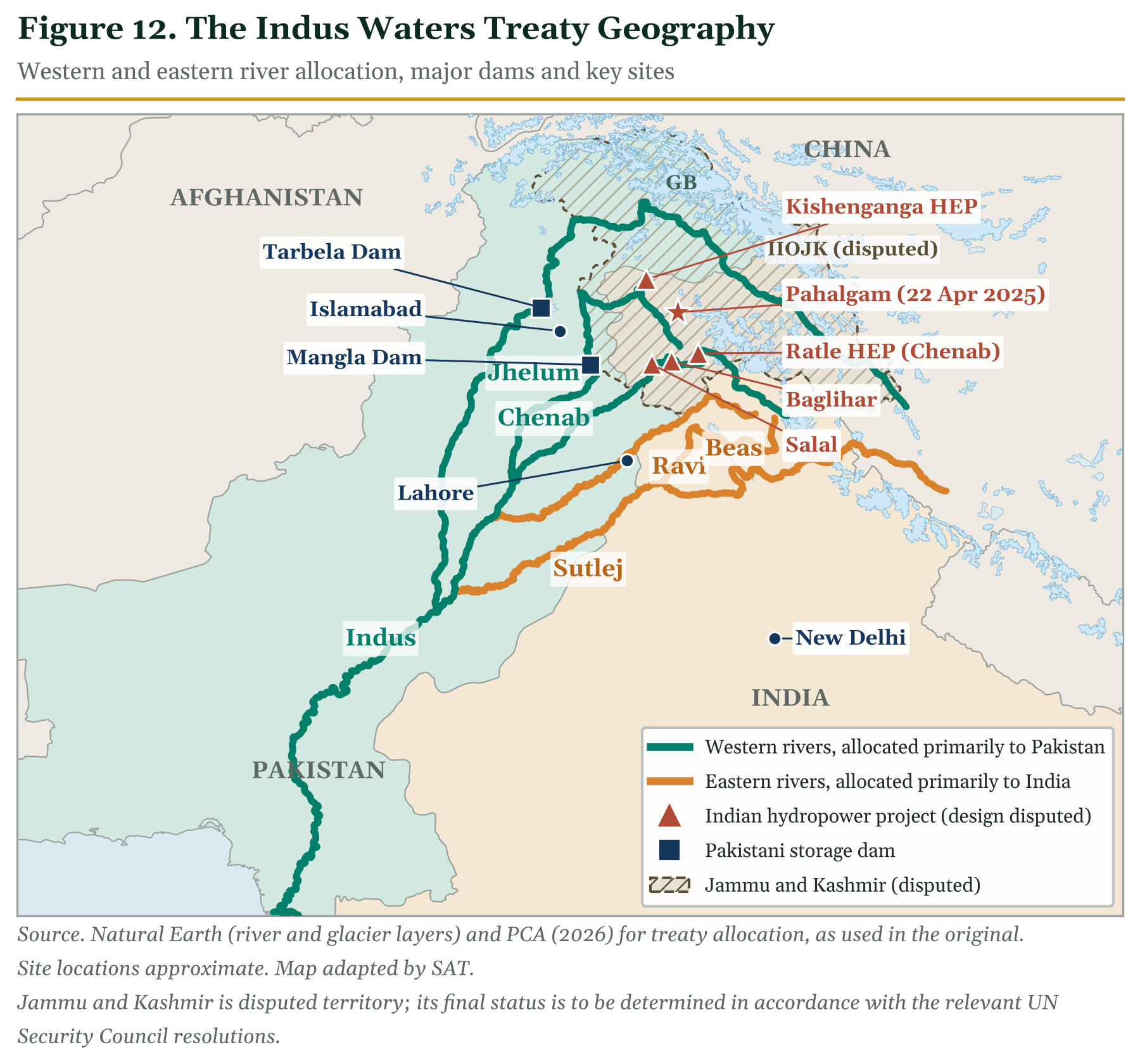
India announced on 23 April 2025, a day after the Pahalgam attack, that it would hold the IWT in abeyance. Pakistan’s National Security Committee warned that any attempt to stop or divert Pakistan’s water would be treated as an act of war. The Court of Arbitration has since confirmed that the Treaty remains in force, but India rejects the ruling. In May 2025, India flushed the Salal and Baglihar reservoirs without notifying Pakistan, which shows that unilateral reservoir operations, rather than a complete cutoff, are the most immediate instrument of pressure.
The people behind the numbers
In Swat in June 2025, a family from Daska stopped for breakfast by the river and was swept away within minutes, barely 100 meters from safety, even though a flood alert had been issued. In Buner in August 2025, a cloudburst dropped more than 150 millimeters of rain in an hour, and Noor Muhammad lost his mother and 23 relatives two days before his wedding.
Beyond water
Climate security also has an air dimension. Lahore was again the world’s most polluted major city in late November 2026, with an Air Quality Index of 451. UNICEF has warned that more than 11 million young children in Punjab breathe toxic air during the smog season.
After Antalya
COP31 closed in Antalya on 22 November 2026 without consensus on its main decision, the first such failure since 2009, after a text without any mention of fossil fuels was rejected and a US$120 billion adaptation finance figure was dropped. The brief sets out what this means for Pakistan, for South Asia and for the world, and argues that it makes regional and national action, and the minimum compact it proposes, more urgent.
How climate stress can be exploited
Water can be turned into leverage, relief gaps can be filled by militant-linked groups, and floods can be turned into blame narratives. The brief maps these channels and argues that climate resilience is also a form of deterrence.
What should be done?
Key Policy Options
- Close Pakistan’s last-mile warning gap, since 85 percent of families surveyed in Buner, Shangla and Swat received no warning of the 2025 flash floods.
- Prioritize water-use efficiency over supply expansion, and build a national cryosphere and glacial lake outburst flood (GLOF) hazard framework.
- Launch a technical hydrological hotline and protect humanitarian data exchange from retaliatory cuts.
- Use ICIMOD, the Shanghai Cooperation Organisation (SCO) and the Economic Cooperation Organization (ECO) as platforms for technical cooperation on water, air and glaciers.
Read the Full SAT Brief
Policy Research · 39 Pages · PDF Format
Full 39-page policy brief including charts, data audits, and policy options.
↗ Open PDF in FullscreenWrite for SAT Briefs
South Asia Times invites researchers, scholars and practitioners to write forthcoming SAT Briefs: rigorous, well-sourced policy research on consequential questions in regional and international affairs. Contributors are paid. Send a working title, a 300-word outline, and a note on your expertise to submission@southasiatimes.org. Terms are discussed after review.

Sumaiyya Kainat
Sumaiyya Kainat is an MPhil Scholar at the National Institute of Intelligence and Security Studies (NISS), Quaid-i-Azam University (QAU), Islamabad. Her research interests include international relations, geopolitics, regional security, strategic affairs, and emerging security challenges.