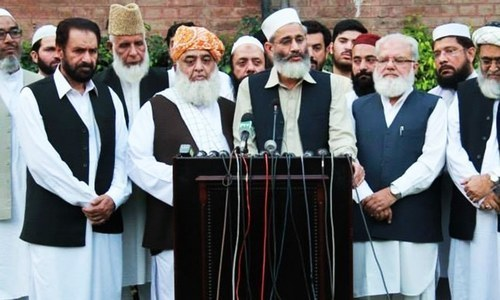
Pakistan’s religious leaders who engage in active politics constitute a distinct class. After dominating ideological politics for more than four decades in the post-Zia period, they have been pushed off the center stage by militant Islamists. With the militancy and terrorism making the headlines in Pakistani society since 2007, the religious inspired groups like TTP have become more prominent in the public discourse. In such a situation religio-political groups like Jamat-e-Ulema Islam (JUI) and Jamaat-e-Islami (JI) are the most dis-oriented political groups in the country.
On the one hand these religio-political groups failed to completely dissociate themselves from militant and terrorist violence that Pakistani society experienced between 2007 and 2018. On the other hand, these religio-political groups lost their relevance in the electoral politics of the country after successive defeats in parliamentary elections.
The result was religious-political leadership with a frustrated mindset. The declaration of Osama Bin Laden as a martyr and even more disturbing assertions that those military personnel who have laid down their lives in the fight against TTP are not Shaheed, are products of such a frustrated mindset.
This frustrated mindset is a product of two-way pressure that the religio-political groups have been facing in the way of post-911 security and political situation in the country. First pressure these groups faced was from the rise of more aggressive and militant/terrorist groups in the wake of 911. Groups like TTP pushed religio-political groups off the center-stage of public life in the country. The other side of the pressure came from the rise of right-wing political groups like PMLN and PTI which chipped off from religio-political groups’ vote-banks with their religious and populist rhetoric.
Consider this: Jamaat-e-Islami candidates secured votes in the tens of thousands in 1993 and 2002 general elections when JI contested parliamentary elections on their own or with a coalition of religious parties. But then JI’s vote banks in 2008 and 2013 parliamentary elections were reduced to a few hundred in the urban constituencies from which its candidates contested elections. This was the result of the rise of right wing secular political groups like PTI, which were engaging in popular and religious rhetoric.
JUI chief Maulana Fazl-ur-Rehman, who twice lost national assembly elections to PTI nominated candidates, appears to be most venomous in his rhetoric against the state and its security forces. Once he declared the martyred soldiers of Pakistan Army as “salary drawing pawns”, a statement which Pakistan’s Defense Ministry dubbed as deeply insulting.
Secondly, he questioned the effectiveness of Pakistan’s counter terrorism strategy and said that Pakistan’s military operations have failed to curb the activities of militants. One of the recent JI chiefs even dubbed Osama bin Laden as Shaheed.
In Islam, any political development which sows the seeds of discord among the Muslims and which pits one segment of Muslim society against another is considered a bigger sin than Kufr. We think that Pakistan’s religio-political leaders have failed to lead Muslim society and failed to show the way forward to Muslims of Pakistan in the face of “Fitna” that is TTP. TTP is killing Muslims. It is sowing the seeds of discord among Muslims of Pakistan. Yet leaders like the JUI chief and JI leaders have failed to raise their voices against the “Fitna” of TTP. Either they are ideologically confused or they are frightened.

Your go-to editorial hub for policy perspectives and informed analysis on pressing regional and global issues.