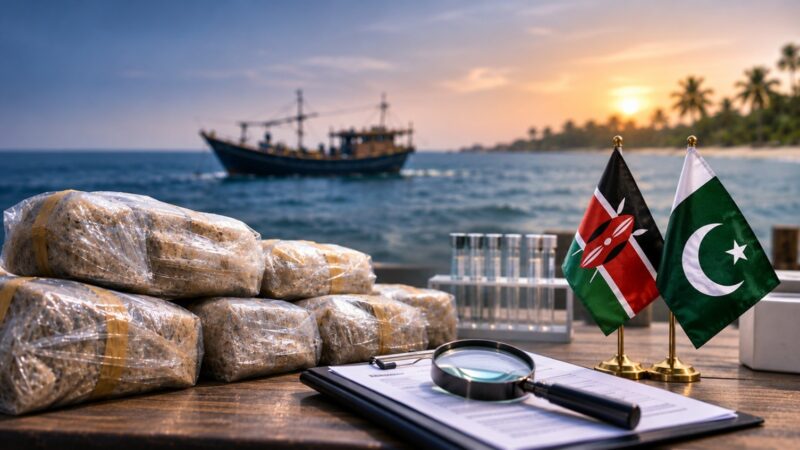
ISLAMABAD and MOMBASA — On a Monday morning in Mombasa, Kenya’s Director of Criminal Investigations, Mohamed Amin, stood behind rows of sealed sacks and told reporters that 454 kilograms of suspected methamphetamine, valued at about Sh3.6 billion ($27 million), had been seized days earlier in Kwale County. Preliminary investigations, he said, pointed to Pakistan as the source, and the drugs were bound for East and Southern Africa.
Within hours the word “preliminary” had dropped out of the headlines. Kenyan outlets reported that detectives had “traced” the consignment to Pakistan. In Islamabad, officials read the same reports and found something missing: evidence.
“Pakistan categorically rejects any insinuation linking Pakistan to this seizure,” an official at the Ministry of Interior told South Asia Times. “The Kenyan side itself calls its findings preliminary. No forensic report has been released. No court has made any finding against Pakistan.”
The Kenyan seizure is real, and Kenya’s investigators deserve credit for it. The question Islamabad is pressing is narrower and more consequential: whether a country can be named as the origin of a drug shipment before its own investigators have finished testing what the shipment is.
What was Seized, and who was Arrested
The operation began on November 5, when Tanzanian authorities arrested a suspect carrying 259 kilograms of suspected methamphetamine and cocaine and later handed him to Kenyan police at the Lungalunga-Horohoro border crossing. On November 7, a joint Kenyan-Tanzanian team arrested Basleman Saleh Khamis, described by Kenyan police as a drug baron wanted in both countries, and a 37-year-old Ugandan woman, Nakabugo Zuraicah, in Shirazi village. Leads then took detectives to Ganja la Simba village in Kinondo, where they recovered the 454 kilograms and arrested Hamad Seif Said, a 54-year-old Tanzanian, according to the Kenya News Agency.
Table 1. The Kwale seizure at a glance
| Item | What the record shows |
| Quantity and value | 454 kilograms of suspected methamphetamine, about Sh3.6 billion ($27 million) |
| Dates | First arrest in Tanzania on November 5, 2026; Kwale arrests and recovery on November 7; origin claim made in Mombasa on November 9 |
| People arrested | Three: two Tanzanian nationals and one Ugandan national |
| Pakistani nationals arrested or named | None |
| Pakistani vessel, port or container named | None |
| Laboratory confirmation of the substance | Pending with Kenya’s Government Chemist, as reported by Kenyan media |
| Basis of origin claim, as stated | “Preliminary investigations”; differences in labelling, packaging and the nationalities involved, cited to separate it from an earlier Iranian-crewed seizure |
| Court finding on origin | None |
Description: A summary of the facts on record about the Kwale methamphetamine seizure, including the absence of any Pakistani national, vessel or laboratory confirmation. Source: Kenya News Agency, Daily Nation, The Standard, Citizen Digital, Daily Monitor (Uganda), November 8-11, 2026.
Not one of the three people in custody is Pakistani. Uganda’s government has said it will not intervene in the case against its national. Kenyan reporting also noted that the composition of the 454 kilograms had yet to be established by the Government Chemist, and Rio Times, summarising the police account, recorded that no laboratory result had been reported when the origin claim was made.
The Official Record from Islamabad
Officials at the Ministry of Interior set out Pakistan’s position in five points.
First, the claim is preliminary by Kenya’s own description. “A preliminary finding is a line of inquiry, not a verdict,” one official said. “It should not be broadcast as a conclusion about a sovereign state.”
Second, no Pakistani link has been established. “All three arrested persons are Tanzanian and Ugandan nationals. No Pakistani vessel, port, container or national has been named,” the official said.
Third, packaging is not proof of origin. Kenya’s Director of Criminal Investigations, explaining why the Kwale haul differed from an earlier seizure, cited “labelling, packaging and nationalities.” Officials in Islamabad said that is precisely the weakness. “Transnational cartels routinely use false labelling, transshipment and third-country packaging to disguise origin,” the official said. “To treat packaging as proof of origin is neither credible nor professional.”
Fourth, the evidence on routes points to Afghanistan. The United Nations Office on Drugs and Crime has documented heroin and, increasingly, methamphetamine moving along what it calls the Southern Route, originating in Afghanistan and carried by sea from the Makran Coast to Eastern and Southern Africa. Researchers at the Global Initiative Against Transnational Organized Crime have tracked the rise of Afghan-produced methamphetamine reaching the region along the same channels. “Transit is not origin,” the official said. “The Makran Coast is shared by Iran and Pakistan, and both states are fighting the networks that exploit it. The product comes from Afghan laboratories.”
Read more: Aid and Narcotics Keep the Taliban Afloat Despite a Ten Billion Dollar Trade Gap
Fifth, Pakistan is a partner, not a source. Pakistan’s Anti-Narcotics Force reported in September that, working with the United States Drug Enforcement Administration and Sri Lankan authorities, it had helped seize 671 kilograms of methamphetamine at Karachi and Colombo ports, linked to an Afghanistan-based network trying to use Pakistani territory as a transit route. In August 2025, the Pakistan Navy and the Anti-Narcotics Force seized about 1,250 kilograms of drugs, including methamphetamine, off Pasni on the Makran Coast. “Pakistan faces the same flows Kenya faces, and seizes tonnes every year,” the official said. “We offer full cooperation through the Anti-Narcotics Force and the Federal Investigation Agency. If Kenya has evidence, share it with us.”
Kenya’s own Record on Origin Claims
Kenya’s recent history shows why early origin claims deserve caution. When the Kenya Navy intercepted the stateless dhow later identified as MV Mashaallah about 630 kilometers off Mombasa on October 25, 2025, with more than a tonne of methamphetamine aboard, The Standard reported that detectives in Mombasa believed the drugs came from Southeast Asia’s Golden Triangle. A year later, the Directorate of Criminal Investigations attributes the same consignment to Iran. Six Iranian crew members were charged, and the drugs were destroyed in Mombasa on September 24.
Kenya also has a domestic production problem that sits uneasily with the idea that every consignment on its coast is imported. In August 2025, Kenyan detectives raided a clandestine laboratory in Mwabungo village, Ukunda, in the same Kwale County, and arrested an Italian national and a Kenyan, recovering chemicals that investigators believed were meant for methamphetamine production. In 2024, a separate methamphetamine laboratory was uncovered near Namanga, close to the Tanzanian border.
Read more: Pakistan’s Gwadar Airport: A Grand Infrastructure Without Flights
The Counter-View
Kenyan officials stand by the attribution. Mr. Amin told reporters the Kwale consignment and the Mashaallah cargo were distinct, saying “the actors are very, very different,” and that the Kwale drugs appeared to have originated in Pakistan. The directorate has said its investigation continues and that it is working with Kenya’s Asset Recovery Agency to trace financiers and organisers. Kenya has not released the specific evidence behind its Pakistan finding.
What Happens Next
Three tests will decide whether the claim holds. The first is the Government Chemist’s analysis, which will confirm what the substance is and may yield chemical signatures that indicate production method and region, the standard used by forensic laboratories to profile methamphetamine. The second is the court record: the three suspects have yet to be tried, and any origin finding will have to survive cross-examination. The third is diplomatic: officials in Islamabad say Pakistan expects Nairobi to route any evidence through formal law-enforcement channels rather than press briefings, and that the matter is being raised with the Kenyan side.
“We are ready to examine any evidence Kenya holds, with our Anti-Narcotics Force and Federal Investigation Agency at the table,” a Ministry of Interior official said. “What we will not accept is a country’s name attached to a drug haul on the strength of a label.” The Kwale seizure is a genuine success against a trade that is hurting Kenya, Tanzania, Uganda and South Africa alike. It would be a pity if the first public account of it became a story about blame rather than evidence. The networks that move methamphetamine across the Indian Ocean count on exactly that kind of confusion, and the countries along the route, Pakistan among them, have a shared interest in denying it to them.