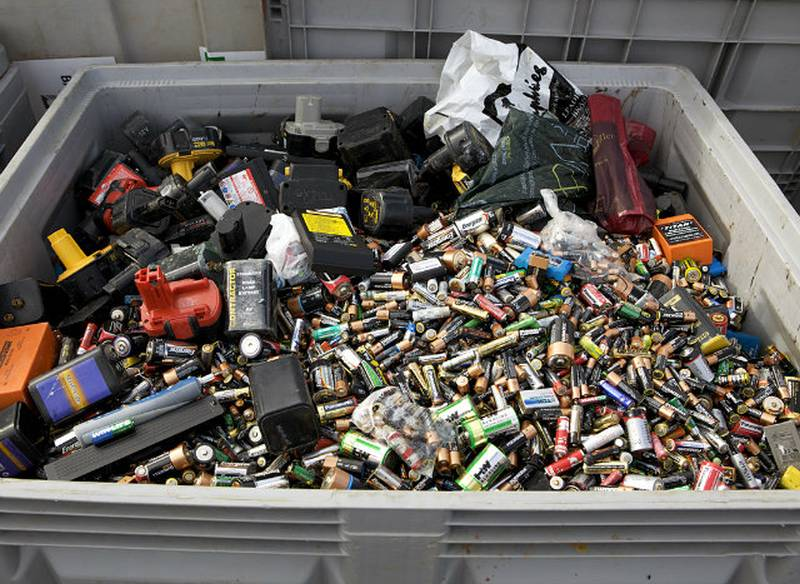
India’s festive upgrade season has an afterlife. As millions of new phones, laptops, scooters and appliances enter homes this month, the products they replace head somewhere else – and where they end up has quietly become a question of national strategy.
Start with batteries, where the stakes are clearest. A September working paper from the Centre for Social and Economic Progress estimates that minerals worth about Rs 1.01 lakh crore – roughly US$12 billion – could be recovered from India’s retired electric-vehicle batteries over the fiscal 2027 to 2041 period, with recoverable volumes rising sharply after 2030. Recycling, the authors project, could meet about a tenth of the lithium demand from EV battery manufacturing over the next decade. For a country whose requirements for refined lithium, nickel and cobalt are met largely through imports, that is not waste management. It is resource policy.
Delhi is acting like it. On November 4 the Union Cabinet approved a Rs 2,814-crore CAPEX scheme offering a 30 percent capital subsidy for new lithium and nickel plants producing battery-grade output. The Battery Waste Management Rules already obligate producers to collect and manage battery waste, with traceability requirements attached.
The problem is that the reserve does not report to the formal system. The ICEA-Accenture report “Charging Ahead” finds that about 80 percent of collected lithium-ion batteries are handled by unregulated informal channels, roughly 45 percent of collected batteries never reach a formal recycler, and only about 1 percent of end-of-life batteries are converted into battery-grade material inside India. Formal recyclers, the same report finds, are operating at roughly 30 to 35 percent of capacity. India is building refineries that cannot buy raw material through the front door.
That is the real policy problem, and it is not a collection problem. India has one of the world’s largest informal recovery workforces, and it does not lack rules on paper. The failure sits in the economics between the rules and the refinery. Informal channels pay cash, move fast and answer to no registry, while formal recyclers must compete for traceable feedstock against buyers who carry none of their compliance costs. The ICEA-Accenture analysis adds a quieter design flaw: current recycled-content obligations can be met with any battery material, so the easiest compliance path uses non-active materials rather than the battery-grade minerals the strategy actually needs. Capacity gets funded. Feedstock leaks.
The fixes are known, and India’s own analysts have listed them. The CSEP paper recommends strengthening the Battery Waste Management Rules, monitoring black-mass movement so recoverable material feeds domestic processing rather than leaking abroad, and building take-back programmes. Three design changes would make those recommendations bite.
Pay for battery-grade output across the whole chain. The new CAPEX scheme already aims at battery-grade production on the processing side; the recovery side should work the same way, with recycling incentives that follow verified battery-grade materials delivered to domestic manufacturers – the 1 percent – rather than capacity alone.
Make traceability digital and end-to-end. Extended producer responsibility that lives in certificates and annual filings will keep losing to cash. A live chain-of-custody registry, from collection point to recycler to refiner, would let the rules operate where they are supposed to, and would tell Delhi whether the mission is working in real time.
Formalize the informal edge instead of pretending it away. The informal sector’s collection reach is an asset India has already built. Licensed aggregation, offtake guarantees and fair-price floors would bring that reach into the traceable economy; an enforcement-only approach against the country’s most efficient collection network will keep producing 1 percent.
India is where these stakes compound fastest. Electric two-wheelers dominate the recyclable-battery stream in CSEP’s projections, battery manufacturing is scaling up, and the minerals both depend on come largely from abroad. Every festive season from now on will retire more batteries into drawers, scrap heaps and cash markets unless the formal chain can outcompete the informal one for them.
India has declared that its cities are mines. The next step is less photogenic and more decisive: write rules under which the formal chain can actually win the ore.

Jackie Omotalade
Jackie Omotalade is a Chief Programs & Impact Officer at a global nonprofit, where she works on artificial intelligence and climate programs. She advises executives and boards on climate finance, responsible supply chains and technology policy, and has moderated a main-stage panel at Greentech Festival Berlin.