
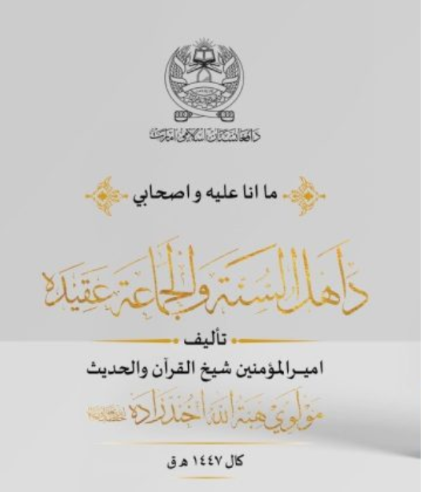
Mullah Hibatullah’s book, The Creed of Ahl al-Sunnah wa’l-Jama’ah*, was published in March 2025. The main purpose was to provide a platform for the Taliban to articulate their beliefs. Written in Pashto and spanning 177 pages, the book outlines 110 core tenets of faith. It avoids any controversial or divisive topics. The book is structured as follows: Mullah Hibatullah first states a belief in one or two sentences, then provides supporting evidence from the Holy Quran and the Hadith, and concludes with a brief explanation or commentary.
The book contains nothing objectionable, as it outlines beliefs generally held by Muslims. Nevertheless, the book exposes the contradiction between the Taliban’s words and actions and the very beliefs preached by Mullah Haibatullah, which proves that the taliban regime is in rebellion against the teachings of Allah and the Messenger (ﷺ).
In the book, Belief No. 82 is stated as follows, and this is indeed the authentic Islamic belief: “All Sharia rulings and their details that have been transmitted from the Messenger of Allah (ﷺ) through reliable chains of narration are true. This is in accordance with the Word of Allah the Almighty:
وَمَا آتَاكُمُ الرَّسُولُ فَخُذُوهُ وَمَا نَهَاكُمْ عَنْهُ فَانتَهُوا ( حشر-7)’
(And whatever the Messenger gives you, take it; and whatever he forbids you, abstain from it) (Al-Hashr: 7).
Furthermore, according to a Hadith narrated by Abu Rafi‘ (may Allah be pleased with him):
“the Messenger of Allah (ﷺ) said: ‘Let me not find any one of you reclining on his couch, and when a command of mine reaches him, he says: “We do not know [about this]; we shall only follow what we find in the Book of Allah.”
Next is Belief No. 83, which states: “Religion is one, and believers are equal in their fundamental faith. “The criteria for distinction and superiority among them are reverence for Allah, piety (taqwa), resistance to personal desires, and the pursuit of virtuous deeds.” This is in accordance with the Word of Allah the Almighty:
( Al-Hujurat, 13) إِنَّ أَكْرَمَكُمْ عِندَ اللَّهِ أَتْقَاكُمْ
(Indeed, the most honorable among you in the sight of Allah is the one who is the most God-fearing (pious) among you.)
With these two beliefs, it becomes clear that Allah and the Messenger declared everyone to be equal. Yet the Taliban’s law on discretionary punishment (ta’zir) divides individuals into four distinct categories. Does this not violate the commands of Allah and the Messenger (PBUH)?
On page 129, under creed number 88, Haibatullah has written:
Principles regarding disputes and issues:
“Our creed is that the sword should not be raised against any member of the Ummah of Prophet Muhammad (peace and blessings of Allaah be upon him), except against a person against whom it is obligatory to raise the sword according to Sharia law.
(Four hadiths have been given as evidence, all of which are authentic.)
Hadith:
It is narrated by Abdullah ibn Umar (may Allah be pleased with them both) that the Messenger of Allah (ﷺ) said:
“I have been commanded to fight the people until they testify that there is no deity but Allah and that Muhammad (ﷺ) is the Messenger of Allah, establish prayer, and pay Zakat. If they do this, they have secured their lives and property from me, except by the right of Islam, and their accounting rests with Allah the Almighty.”
Explanation:
This Hadith indicates that the sanctity of a person’s life (blood) and property holds fundamental importance in Islam. Once an individual accepts the apparent, foundational tenets of Islam, they are to be treated in accordance with Islamic rulings. As for their inner state and intentions, the reckoning rests with Allah Almighty.
It is narrated from Ibn Umar and Abu Hurairah (may Allah be pleased with them both) that the Holy Prophet (ﷺ) said:
“Whoever takes up a weapon and points it toward his Muslim brother, the angels invoke a curse upon him until he desists.”
Meaning of the Hadith:
“Muslims should respect each other’s lives and property. Intimidating a fellow Muslim or taking up arms against them is a highly reprehensible act.”
The question is, given that even Mullah Hibatullah acknowledges the fundamental Islamic tenet that not only is killing a fellow believer (one who professes the shahada) a grave sin, but even brandishing a weapon against one is a crime.
Why, then, does the Taliban government continue to patronise groups such as the TTP, which carry out terrorist attacks in Pakistan?
Given the existence of these religious tenets and the blessed Hadith, does the killing of Muslims, including religious scholars in Pakistan, by the TTP, the Gul Bahadur group, Al-Qaeda, and other terrorist entities (along with the Taliban government that patronizes them) not constitute an open rebellion against the commands of Islam and the directives of the Messenger of Allah (PBUH)?
Furthermore, if this violation is examined in light of the Quranic verse in which Allah states:
“Whoever kills a soul unless for a soul [killed in retribution] or for corruption [done] in the land, it is as if he had slain mankind entirely. And whoever saves one, it is as if he had saved mankind entirely” (Al-Ma’idah: 32).
The same ruling is found in Surah Al-Isra, Surah Al-An’am, and Surah Al-Furqan. In view of these surahs and even according to the beliefs of Mullah Haibatullah himself, the TTP and other terrorist groups are rebels against Islam and guilty of fasad fil-ard ( فساد فی الارض) (causing corruption/mischief on earth). Regarding them, Allah’s command is clear:
وَقَاتِلُوهُمْ حَتَّىٰ لَا تَكُونَ فِتْنَةٌ (بقرہ ۔193
“Kill (fight) them until fitnah no longer remains.”
In Haibatullah’s book, Creed No. 89 states: “We do not rebel against our rulers, even if they commit acts of oppression; rather, we desire what is good for them and consider obedience to them a religious duty. We do not withdraw our obedience unless they issue a command that contradicts the decree of Allah; furthermore, we pray for their rectification and protection. This is in accordance with the word of Allah the Almighty:
يَا أَيُّهَا الَّذِينَ آمَنُوا أَطِيعُوا اللَّهَ وَأَطِيعُوا الرَّسُولَ وَأُولِي الْأَمْرِ مِنكُم
“ O you who believe! Obey Allah, obey the Messenger, and those in authority among you.”
According to a Hadith (narrated by Abu Hurairah, may Allah be pleased with him):
“Whoever obeys me has obeyed Allah, and whoever obeys the leader (Amir) has obeyed me.”
Similarly, it is stated in Belief No. 90: “We follow the Sunnah and the community of Muslims, and we avoid deviation, dissension, and division. This is in accordance with the word of Allah the Almighty:
لَقَدْ كَانَ لَكُمْ فِي رَسُولِ اللَّهِ أُسْوَةٌ حَسَنَةٌ
(Indeed, in the Messenger of Allah you have an excellent example.)
Furthermore, according to a hadith (narrated by Irbad bin Sariyah, may Allah be pleased with him):
“The Messenger of Allah (ﷺ) exhorted us to fear Allah (taqwa), and to listen and obey even if an Abyssinian slave were to be appointed as a ruler over you”
He further instructed:
‘Hold fast to my Sunnah and the Sunnah of the Rightly-Guided Caliphs, and beware of newly invented matters; for every newly invented matter is an innovation (bid’ah), and every innovation is a misguidance.’’
The question is: Allah and His Messenger (ﷺ) have explicitly forbidden rebellion against rulers, and in light of the interpretation of these clear directives provided by Mullah Hibatullah, does the terrorism perpetrated by the TTP in Pakistan not constitute fasad fil-ard (فساد فی الارض ) (mischief/corruption on earth)?
If so—and it certainly does—why, then, does the Taliban government continue to patronise an activity that directly contradicts Sharia?
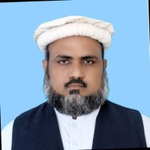
Saifullah Khalid
A senior journalist, editor, security analyst, and columnist with 35 years of experience. Since 2001, he has extensively covered political and strategic developments in Afghanistan and Central Asia since 1991. He has authored 4 books , 2 on Afghanistan. In 1994, he authored a book on Afghanistan titled Main Ne Kabul Jaltay Dekha (I Saw Kabul Burning), and in July 2026, he published his book Taliban Ka Asli Chehra (The Real Face of the Taliban) in Urdu.