In the grey zone, a name on a list can travel further than a missile. Pakistan’s ‘missing persons’ debate is a case study in how a genuine human tragedy is converted into a strategic narrative. Decoding that narrative means separating the ledger from the legend and recognizing that the only credible counter-move is the state’s own paper trail.
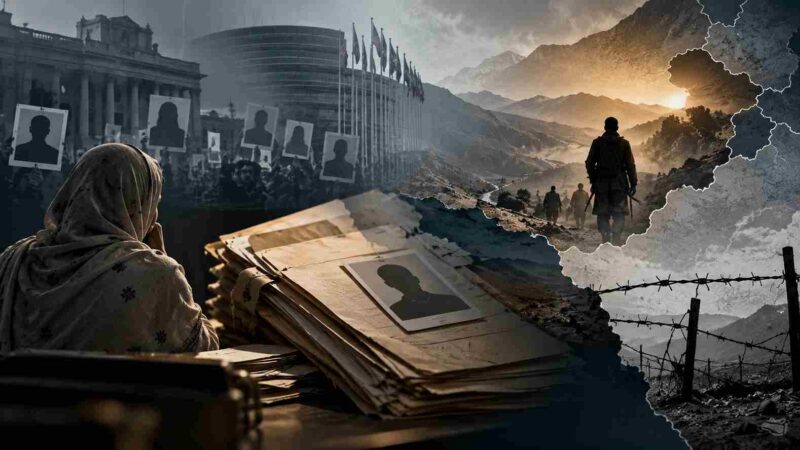
Picture a file. It sits in a cabinet at the Commission of Inquiry on Enforced Disappearances (COIED) in Islamabad – one of 11,035. It carries a name, a district, a date and a mother’s signature. For years, it is a mystery. Then a Joint Investigation Team traces the man not to a safehouse, but to an unmarked grave across the Durand Line, where he died fighting for a proscribed outfit his family never knew he had joined.
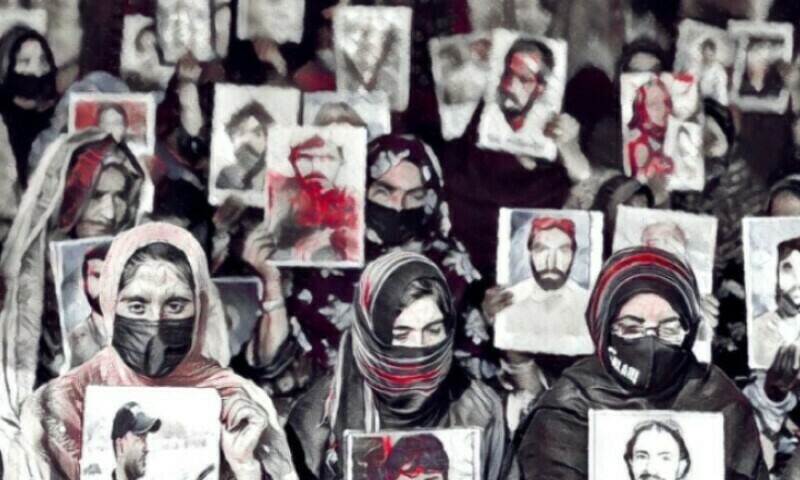
The file is closed. The slogan, however, is not. Thousands of miles away, the same name may still appear on a placard outside a European parliament, filed under one unforgiving heading: disappeared by the state.
This composite is not offered to wave away anyone’s grief. It is offered because it captures the gap between Pakistan’s ledger and its legend. A gap that has become one of the most contested terrains of the information war being waged against the country.
Night and Fog: The Weight of a Word
Words carry histories. The modern idea of enforced disappearance traces back to Nazi Germany’s 1941 Nacht und Nebel – Night and Fog – decree, under which suspects vanished so that uncertainty itself would terrorize those left behind. Latin America’s dirty wars of the 1970s then gave the world the noun los desaparecidos. International law eventually codified the crime: deprivation of liberty by agents of the state, followed by a refusal to acknowledge it.
That definition is precise; its deployment in Pakistan’s case is not. Here, ‘missing persons’ has become an umbrella under which the migrant, the militant, the absconder and the genuinely abducted are all made to shelter together. In the lexicon of strategic communication, that is not an accident; it is framing.
Myth, Amplification, Politicization: Anatomy of a Narrative
The exploitation of this fault-line is procedural, and it unfolds in three movements:
- Myth generation: A genuine grievance is stripped of its specifics and recast as a universal human security theme.
- Myth amplification: The theme is carried through effective storytelling across digital platforms, often by diaspora networks sheltered by the free-speech and asylum protections of their host countries.
- Politicization: The amplified story is placed before international human rights forums as settled fact, inviting external pressure.
In the grey zone, an unverified list is not merely an allegation; it is an instrument.
Each movement works best in the absence of data. Hence, data is the counter-move.
What Does the Ledger Actually Say?
Since its inception, the COIED has registered 11,035 complaints. It has disposed of 9,596, roughly 87 percent while 1,439 remain under investigation.
| Province / Region | Registered | Resolved | Pending | Resolution rate |
| Khyber Pakhtunkhwa | 3,849 | 2,954 | 895 | 76.7% |
| Balochistan | 2,970 | 2,797 | 173 | 94.2% |
| Sindh | 1,888 | 1,756 | 132 | 93.0% |
| Punjab | 1,820 | 1,633 | 187 | 89.7% |
| Islamabad | 427 | 385 | 42 | 90.2% |
| AJK | 71 | 61 | 10 | 85.9% |
| Gilgit-Baltistan | 10 | 10 | 0 | 100% |
| Total | 11,035 | 9,596 | 1,439 | 87.0% |
Two findings stand out and both run against the grain of the dominant narrative.
First, Balochistan, the centerpiece of most international campaigning, posts the highest resolution rate of any major province at 94 percent; only 173 of its cases remain open.
Second, Khyber Pakhtunkhwa, which bore the brunt of the war against the TTP, holds 895 pending files – nearly two-thirds of the national backlog.
The geography of the unresolved files tracks the geography of the insurgency, not the geography of the slogans.
Moreover, officials report that more than 80 percent of pending cases come from far-flung areas where complainants cannot attend hearings regularly, which slows every inquiry.
Who Is on the List?
The Commission’s own investigations repeatedly find that a ‘missing’ person was never in state hands. In a report placed before the Supreme Court in early 2024, it said it had set aside 1,477 complaints that turned out to involve ransom kidnapping, personal enmity, or people who had chosen to vanish on their own.
The case files are indicative of a recurring cast of characters:
- Young men who joined proscribed militant groups such as the TTP, the BLA, and others without informing their families.
- Irregular migrants who slipped into Iran or Afghanistan on the long road to Europe.
- Fighters killed abroad, in Afghanistan, Syria, Iraq or Yemen, including recruits to the Zainabiyoun Brigade.
- Absconders and proclaimed offenders whose families report them missing to keep the police at bay.
- Militants killed in CTD or police encounters, and those buried by their own comrades in unmarked graves.
- Under-trial prisoners and convicts whose families were never told, or chose not to say.
- Persons with mental illness or disabilities who wandered from home, and victims of tribal and family feuds.
- Even child-custody disputes, filed with the Commission rather than a family court.
Edhi and Chhipa volunteers have buried tens of thousands of unidentified bodies over the decades; it is likely that some of the missing lie among them. None of this means every family is mistaken; some are not, and their grief is real. But the assumption that an intelligence agency picked up every name on the list is not borne out by the files.
The Courtroom Front
The deeper reason the narrative takes root lies not in the street but in the courtroom. Officials put Pakistan’s terrorism conviction rate over two decades at under 9 percent; in the United Kingdom, the comparable figure is close to 90 percent.
The reasons are hardly mysterious. Judges, prosecutors and witnesses in terrorism trials are threatened, followed and sometimes killed. In July this year, district and sessions judge Abdul Hakim Kakar was ambushed and killed in Mastung along with his guard. A system that cannot convict is left with two bad choices: release dangerous suspects, or hold them outside the law. Either way, the disappearance narrative is fed.
Faceless, Not Lawless
Recent legislation attempts to close that gap. Section 11-EEEE of the Anti-Terrorism Act 1997 allows authorities to hold a terrorism suspect for up to 90 days for inquiry, on the record, while JIT gathers evidence. Balochistan adopted it in 2025; Punjab followed in 2026, and by September around 90 suspects had reportedly been detained under the Balochistan framework.
Punjab went a step further with Section 21-AAA, allowing designated ‘special security cases’ to be heard by faceless courts. Judges, prosecutors and witnesses are shielded through confidential records, concealed signatures and voice masking. The model has a pedigree: Colombia’s jueces sin rostro tried cartel and insurgent cases in the 1990s, and Italy, the UK, France, Spain, the Netherlands and Chile all permit forms of witness anonymity in serious criminal cases.
Critics, including the opposition in the Punjab Assembly and some foreign monitors, have called the framework draconian. The charge misreads its purpose. The real comparison is not between these laws and an idealized justice system untouched by terrorism; it is between a recorded detention, reviewable by a court, and the vacuum in which disappearance allegations thrive. A documented 90-day detention is the very opposite of Night and Fog. It replaces an unknown fate with a name on a register, a legal basis and a date in court.
Assessment: What We Know, What We Assess
- Known: The Commission has disposed of 87 percent of registered complaints, and Khyber Pakhtunkhwa, not Balochistan, carries the bulk of the backlog.
- Assessed with high confidence: A substantial share of complaints involve causes unconnected to state custody, as the 1,477 cases set aside by the Commission indicate.
- Assessed as likely: The headline totals circulated abroad overstate the scale of the issue, because they fold migrants, militants, absconders and victims of private crime into a single category.
- The information gap: Outcome data broken down by category, traced home, under trial, deceased, is not yet routinely published. Filling that gap is the state’s strongest available counter-narrative tool.
What to Watch
- Whether the Commission begins publishing outcome categories alongside its monthly totals, the single most effective rebuttal to inflated figures.
- How detention registers under Section 11-EEEE are maintained and showcased as proof that terrorism detentions are on the record.
- Disbursement of the Rs5 million family support package, approved by the federal cabinet in August 2024 for 1,000 families, and its possible extension.
- Whether Khyber Pakhtunkhwa, where the backlog is heaviest, adopts the legal framework already in force in Balochistan and Punjab.
- How diaspora campaigns and international forums respond once verified data begins to displace unverified lists.
Closing the File
Back in Islamabad, the Commission’s cabinets offer a more instructive account than any placard. Of the 11,035 complaints registered, the Commission has disposed of 9,596 through a multi-tiered inquiry process in which police, intelligence agencies, and provincial administrations are institutionally answerable. The residual 1,439 cases are better understood not as evidence of state policy, but as the expected caseload of a functioning accountability mechanism operating amid a protracted insurgency.
A core premise of strategic communication is that, in contested information environments, legitimacy accrues not to the most amplified claim but to the most verifiable one. Measured against that standard, Pakistan’s position is considerably stronger than its detractors concede: a standing Commission of Inquiry, a statutory framework that brings terrorism-related detention within the ambit of law, judicial safeguards against intimidation, and a dedicated support regime for affected families. The counter-narrative, by contrast, rests largely on aggregated lists without case files and assertions without attributable sources.
The ledger, in short, remains open to scrutiny. The strategic imperative for Pakistan is to keep it so, and to present it with consistency and confidence. In the contest between ledger and legend, evidence remains the decisive variable.

Haleema Khalid is a research and strategic communications professional specializing in policy research, knowledge management, and analytical writing. With an interdisciplinary background spanning linguistics, security studies, and regional affairs, her work focuses on translating complex research into accessible outputs for policy and stakeholder audiences. She is a published researcher in corpus linguistics and political communication and is currently pursuing an MPhil in Intelligence & Security Studies, with a growing focus on Pak-Afghan affairs, regional security, and South Asian dynamics.