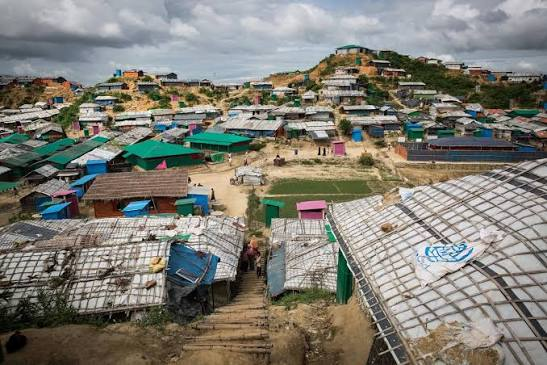
A path through a refugee camp can appear unremarkable to someone looking at a satellite image. To the people walking it every day, the difference between loose sand and a stable surface can shape whether a child reaches a learning space, an older resident visits a health point, or a caregiver moves safely after rain.
That is why an October 15 account from UNHCR in Cox’s Bazar, Bangladesh, deserves attention. Rohingya refugee women were reported working together to build more durable pathways within the camp by filling and shaping sandbags into paving materials. The work is about practical infrastructure. It is also about something often neglected in the language of humanitarian response: the people receiving assistance can help design and build the communities in which they live.
Bangladesh is hosting a prolonged and difficult refugee situation. UNHCR reports that Rohingya families live across crowded camps in Cox’s Bazar and that the surrounding Bangladeshi communities also bear significant pressures. A May 2026 humanitarian appeal sought support for both refugees and host populations while acknowledging the limits imposed by reduced resources. There is no honest way to pretend that such challenges have effortless answers.
But the women’s work suggests a principle that can improve decisions made under constraint. A person whose movement is restricted by poor drainage, broken surfaces, or unsafe paths knows details that may not appear in a planning spreadsheet. That person’s knowledge should be treated as evidence, not merely as a story for a fundraising photograph.
The main argument is straightforward: community participation is not a decorative addition to infrastructure policy. It is a practical form of risk reduction and social trust. Pathways built with the people who use them are more likely to reflect actual journeys, physical barriers, and maintenance needs. Participation can build relevant skills and create a stronger sense that the project belongs to its users.
This is not to say that refugees should be expected to build essential services themselves because funding is inadequate. The distinction matters. Proper materials, technical oversight, safeguarding, and public accountability remain necessary. Participation should be safe, voluntary, meaningful, and fairly supported within the applicable rules. A refugee mother should not be asked to do unpaid work simply to prove that she deserves a safer path.
Nor should host communities be invisible. A programme that improves only one side of a local boundary while basic facilities on the other side deteriorate may deepen resentment. Service planning should examine how clinics, roads, water systems, and livelihoods affect both displaced families and Bangladeshi neighbours. Fairness depends on the details.
As a Christian writer, I am reminded of Jesus’ parable of the Good Samaritan. Its force lies not only in the decision to stop, but in the arrangements made for care to continue. Yet there is another lesson relevant here: the injured traveller is treated as a person whose needs matter before anyone decides which community he belongs to. The teaching does not provide a technical manual for refugee settlements, but it offers a test for the way institutions view vulnerable people.
Peacebuilding must preserve agency. A person who has fled violence has not lost the ability to understand a community, work with others, or contribute useful knowledge. When women participate in improving camp pathways, it challenges a habit of describing displaced people only through their deficits.
The policy implications are concrete. Engineering and humanitarian teams can consult users before selecting locations and materials. Women and people with disabilities can identify routes that feel unsafe or inaccessible. Maintenance plans can include clear responsibility, not merely construction targets. Local host-community representatives can help assess whether improvements create unanticipated pressures elsewhere. Monitoring should record whether everyday movement has actually become safer, rather than stopping at the number of metres built.
All of this requires listening alongside technical skill. Consultation should never become a meeting held only to obtain agreement for a predetermined plan. People need ways to raise problems without losing access to assistance. Professional standards and local experience strengthen each other when both are taken seriously.
There is a particular need to connect this work with the experiences of girls and young women who often negotiate crowded paths, limited privacy, and difficult access to learning or livelihoods. A well-built footpath is not a complete answer to exclusion, but its design can demonstrate whether their everyday concerns were genuinely included. Practical changes become stronger when residents can report which routes remain difficult and when the organisations responsible can respond without treating criticism as ingratitude.
It is easy to speak about peace in a dramatic register, as if it exists only when a treaty is signed. In a refugee settlement, peace can also mean that a child can walk safely to class, an older person can reach medicine, and a woman can help decide how the common space around her family will function.
The path through a camp may be narrow. The idea behind it should travel far: the people whose future is being planned must be allowed a part in making the plan.
For Cox’s Bazar and other areas of prolonged displacement, that is not only humane. It is good public policy.

Douglas Vandergraph
Douglas Vandergraph is an independent Christian writer and teacher based in Fort Collins, Colorado, United States. As a podcaster and digital creator, his work focuses community development, spiritual growth, and practical encouragement.