The International Atomic Energy Agency’s Board of Governors met four times through 2026. Each session carried its own weight. Together, they reveal how Pakistan positions itself within the Agency’s most consequential decision-making forum.
The year began with urgency. On 2 March, the Board convened a special session. Russia had requested it. The subject was the military strikes by the United States and Israel on Iranian territory. This session preceded the regular March meeting. Director General Rafael Mariano Grossi opened both. He called for restraint. He warned against further escalation. The timing mattered. A special session on an active military crisis, held just before routine business, showed how closely security and safeguards now intersect at the Board level.
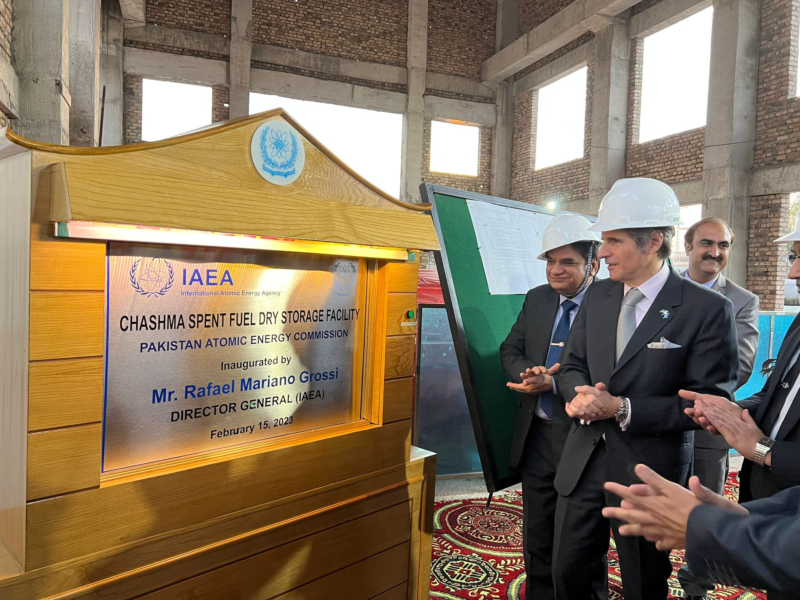
The regular March session then turned to technical matters. Safeguards implementation in North Korea featured on the agenda. So did Syria’s compliance with its NPT safeguards agreement. Pakistan’s own safeguards arrangement for Unit 5 of the Chashma Nuclear Power Plant was also tabled. This detail is significant. Chashma-5 broke ground in December 2024. It is a 1,200 MWe reactor.
Its construction marked the first non-Russian nuclear newbuild start anywhere in five years. Its presence on the Board’s safeguards agenda confirms that Pakistan’s civilian nuclear expansion remains under continuous international verification. That verification is not incidental. It is the foundation of Pakistan’s credibility as a peaceful nuclear actor.
By September, the conversation had shifted. Dr. Raja Ali Raza Anwar, Chairman of the Pakistan Atomic Energy Commission, delivered Pakistan’s national statement. He reaffirmed Pakistan’s commitment to international standards of nuclear and radiation safety. He highlighted a specific achievement. Pakistan had presided over the Tenth Review Meeting of the Convention on Nuclear Safety in April 2026. Presiding over that review meeting is not a ceremonial role. It places a state at the centre of global safety discourse. Few countries outside the established nuclear powers get asked to lead it.
Dr. Anwar also pointed to Pakistan’s National Institute of Safety and Security. NISAS now functions as an IAEA Collaborating Centre. It hosts Agency-sponsored activities for the region. This regional role matters for a different reason. It shows Pakistan contributing capacity, not just receiving it. Collaborating Centre status is earned through demonstrated expertise. It is not granted lightly.
These details connect to a longer pattern. Pakistan has sat on the Board of Governors twenty-one times. Its current term runs from 2024 to 2026. It was elected by consensus at the 68th General Conference, from the Middle East and South Asia constituency. Consensus election is notable. It means no member state objected. For a country outside the Non-Proliferation Treaty, that is not a small thing.
Pakistan’s case for Board membership rests on more than diplomacy. It rests on infrastructure. Six power reactors are operating. Together they generate 3,530 megawatts of low-carbon electricity. A seventh plant, rated at 1,200 megawatts, is under construction.
Pakistan also hosts an Anchor Centre for Cancer Care under the IAEA’s Rays of Hope initiative. Four additional Collaborating Centres operate across food and agriculture, nuclear safety and security, water resource management, and innovative nuclear applications. Each centre represents years of technical work. Together, they form the evidence base behind Pakistan’s seat at the table.
The Board of Governors is not a symbolic body. It approves safeguards agreements. It reviews the Agency’s programme and budget. It responds to live security crises, as March 2026 showed. Pakistan’s participation therefore carries real weight.
Its statements are not simply declaratory. They are read against a verifiable technical record: operating reactors under safeguards, a safety record spanning five decades, and institutional capacity recognised through Collaborating Centre status.
There is a broader argument here too. Global nuclear governance increasingly links safety, security, and development. Grossi’s own remarks in March described nuclear energy as a stabilizing, low-carbon backbone for decarbonizing economies.
Pakistan’s statements through the year echo this framing. Climate vulnerability, energy security, and healthcare access all surface alongside safety and security language. This is a deliberate shift. It moves the conversation beyond deterrence and proliferation. It repositions nuclear technology as a development tool.
For Pakistan, this repositioning carries strategic value. It is not party to the NPT. It cannot access Nuclear Suppliers Group markets. Yet through the Board of Governors, through Collaborating Centre status, and through consistent safety compliance, it builds an alternative form of legitimacy. This legitimacy is technical and institutional, not treaty-based. It is slower to build. It is also harder to dismiss.
Pakistan’s engagement with the Board of Governors in 2026 was not a single speech. It was a sequence: a safeguards review in March, a safety presidency claimed in April, a national statement delivered in September, each building on verifiable institutional fact. That sequence is the strongest case for Pakistan’s continued, active role on the Board.
Hira Bashir
Hira Bashir is an Associate Research Officer at the Center for International Strategic Studies, Azad Jammu & Kashmir. Her research focuses on the peaceful uses of nuclear technology.