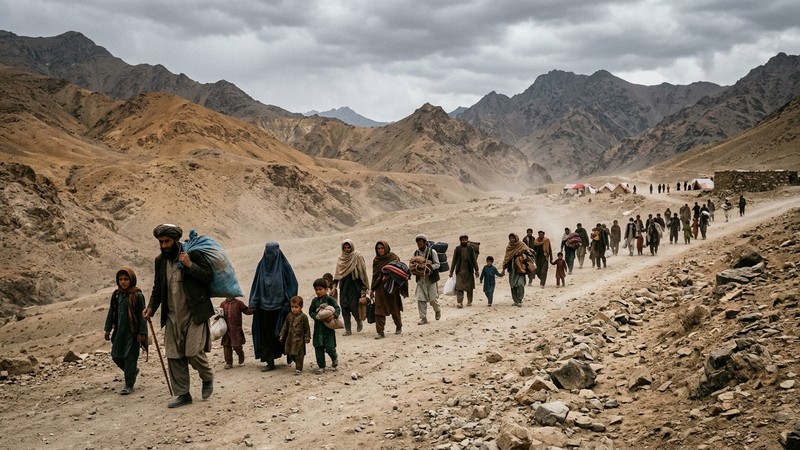
The Taliban regime’s Foreign Ministry has expressed concerns over the US administration’s decision to deport Afghan refugees to Pakistan. Taliban’s rhetoric about its humanitarian concerns regarding the deportation of Afghan nationals from foreign countries must be scrutinized in the light of its own human rights record.
Taliban has presided over a systematic persecution of its own population and now it is showing the audacity to talk about the dignity of Afghan nationals languishing in foreign lands. The displacement problem of the Afghan population is a product of the restrictions Taliban imposed on women, persecution of its opponents and reversal of general amnesty which the Taliban regime itself granted to Afghan people after assuming control of Kabul. The situation the Taliban regime has created in Afghanistan is absurd to say the least. Now the Taliban spokesman is condemning the consequences of displacement while ignoring the very conditions which produced this displacement.
The frivolous content of the Taliban spokesman’s statement is glaringly obvious. No Afghan citizen has a natural or automatic right to a permanent residency in another country. Visa, residency permits and asylum are tools in the hands of the host country which are governed by international law and obligations of the host. Every state or country in the world has a legitimate authority to enforce and regulate immigration and immigration laws. Taliban cannot expect Pakistan or any other country for that matter to host Afghan refugees for an indefinite period. They are patently wrong in assuming that Afghan refugees are somebody else’s responsibility.
A functioning state has a responsibility to pave the way for the return of its displaced citizens and their reintegration into society. It is deeply ironic that instead of accepting this responsibility, the Taliban are criticizing the arrangement under which Afghan nationals are returning to their home country. Washington is deporting Afghan nationals to Pakistan because the US Administration doesn’t recognize the Taliban as legitimate government of Afghanistan. The absence of a diplomatic channel between Washington and Kabul makes it impossible for the US administration to arrange for Afghan nationals to return through a contact with the Taliban regime.
Taliban’s international isolation is not simply an unfortunate fact. It is a product of Taliban’s behavior. Their failure to honor international commitments and refusal to meet their international responsibilities has contributed to their exclusion from the international community. Apart from Russia no country in the world has extended diplomatic recognition to the Taliban regime. In such a situation it is not possible for a host country to plan with the Taliban regime for the return of Afghan nationals to Afghanistan. Pakistan’s geographical proximity with Afghanistan makes it an obvious choice for responsible states to deport illegal Afghan nationals back to Pakistan as a transit country.
Just look at the Taliban regime’s human rights record. There are restrictions on women’s education and employment. Political opponents of the Taliban regime are facing persecution. The Taliban regime has reversed promises of general amnesty. Former government employees are being chased and prosecuted. Political dissent is facing suppression. Now when the Taliban regime invokes human rights while Afghan nationals are facing deportation from foreign lands, it looks extremely absurd. A government that tramples upon the dignity of its own people cannot lecture other countries for protecting that dignity.
Pakistan cannot be forced to shoulder the Afghan refugee burden for an indefinite period. Taliban must cooperate with the host and transit countries for the return of their nationals to Afghanistan. And they should address the conditions which lead to large scale displacement of Afghans to foreign lands. Humanitarian responsibility primarily lies with the government that rules the country from which people are fleeing.

Your go-to editorial hub for policy perspectives and informed analysis on pressing regional and global issues.