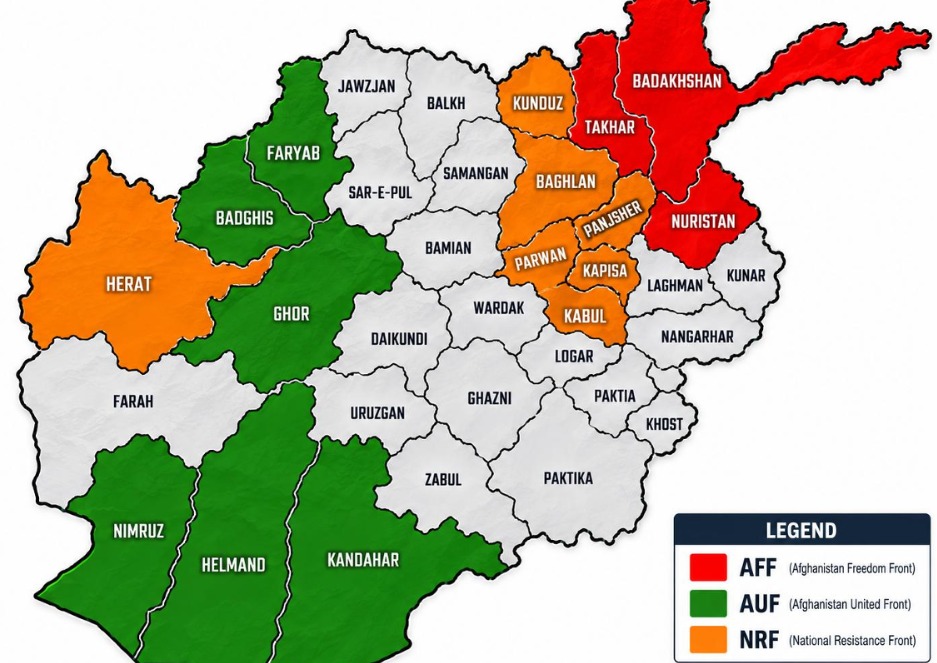
The rapid expansion and geographical diversification of armed resistance across Afghanistan mark a decisive collapse of the Taliban’s monopolistic governance model. During August and September 2026 alone, insurgent formations executed 119 attacks across 26 provinces, inflicting over 250 fatalities on regime forces. This widespread tactical surge demonstrates that domestic opposition has evolved from localized skirmishes into a synchronized, multi-theater armed campaign.
Kabul’s persistent governance failures are rooted in aggressive ethnic exclusion and the complete consolidation of state authority within a narrow Kandahari elite. While Pashtuns constitute forty-two percent of the national population, Kandahari Shura structures hold up to ninety-five percent of decision-making posts. Non-Pashtun communities—including Tajiks, Uzbeks, and Hazaras—remain systematically disenfranchised, with the cabinet featuring zero Hazaras or female representation.
This institutionalized marginalization has catalyzed widespread rebellion far beyond traditional northern strongholds, shattering the regime’s propaganda of unified territorial control. The systematic exclusion of peripheral leaders and regional networks created an irreconcilable governance crisis across northern, northeastern, and central provinces. Consequently, local populations increasingly view armed opposition as the sole viable mechanism to challenge Kabul’s oppressive statecraft.
Compounding ethnic grievances is the regime’s blatant breach of its promised general amnesty for former Afghan National Defence and Security Forces personnel. Hundreds of targeted executions, arbitrary detentions, and systematic torture cases documented through 2025 and 2026 have completely shattered institutional trust. Rather than neutralizing former military personnel, this relentless purge forced highly skilled officers and commandos directly into insurgent ranks.
The operational landscape now reflects unprecedented organizational diversity, combining established fronts, newly formed insurgent groups, and professional veteran networks. Prominent coalitions including the National Resistance Front, Afghanistan Freedom Front, and Afghanistan United Front are now reinforced by localized movements. This organizational evolution provides anti-Taliban forces with superior tactical adaptability, institutional leadership, and specialized combat capabilities across diverse terrains.
A major milestone in Pashtun anti-Taliban mobilization is the emergence of the Afghanistan United Front, led by former corps commander Lt Gen Sami Sadat. Spearheading fifty-nine attacks across Helmand, Kandahar, Nimroz, and Ghor during late 2026, the group proves that resistance is no longer ethnically confined. The active participation of Pashtun veteran networks dismantles Kabul’s ideological claim of representing a unified southern consensus.
Concurrently, the Afghanistan Freedom Front under former army chief Yasin Zia has mounted lethal standoff attacks against critical administrative installations. High-profile rocket strikes and assaults on provincial governor compounds in Badakhshan underscore deep security vulnerabilities inside regime strongholds. These operations demonstrate that resistance formations possess the intelligence networks and firepower needed to breach heavily fortified administrative centers.
The National Resistance Front, led by Ahmad Massoud, continues maintaining multi-province operational pressure despite the combat martyrdom of senior leaders like Hasib Panjshiri. With Saleh Mohammad Registani assuming general operational command on the ground, the front has revitalized its tactical command structure across northern corridors. Synchronized operations in Baghlan, Parwan, and Kabul keep vital regime supply lines under perpetual threat.
A watershed moment occurred in Badakhshan when the Homeland Soldiers Front, led by former commando Qayyum Malang, briefly captured the Yaftali Sufla district center. Marking the first time the regime lost control of a district center since August 2021, the event exposed severe regime overstretch. Subsequent high-level Taliban diplomatic entreaties were firmly rebuffed, signaling the uncompromising stance of localized veteran-led insurgencies.
The emergence of specialized political-military formations like Amrullah Saleh’s Afghan Green Trend further complicates Kabul’s internal security matrix. Executing precision strikes across Parwan, Takhar, and the strategic Salang Valley, these units directly endanger northern logistics and administrative transit. The multiplication of smaller groups, including the Afghanistan Republican Front and New Horizon Organization, proves resistance is metastasizing rapidly.
Simultaneously, the parallel expansion of Islamic State Khorasan Province presents a compounding, multi-vector security challenge across major urban centers. Operating as a separate extremist threat, ISKP exploits the regime’s deteriorating security capacity and intelligence voids created by expanding armed resistance. The Taliban’s inability to contain either anti-regime insurgents or rival jihadist networks underscores a complete failure of state consolidation.
This escalating domestic warfare carries severe consequences for South Asian regional security, border management strategies, and counter-terrorism stability. A ruling regime incapable of defending its own district centers or provincial offices cannot fulfill international commitments to prevent cross-border terrorism. Kabul’s prioritization of hosting transnational proxy networks over domestic political reconciliation continues driving Afghanistan toward structural fragmentation.
Islamabad and regional partners must recognize that Kabul’s autocratic governance model is inherently unstable and increasingly incapable of maintaining order along sovereign borders. Unilateral repression, ethnic exclusion, and broken pledges have manufactured an irreversible domestic uprising that threatens the broader region. Sustainable stability requires an inclusive, representative governance framework in Kabul that respects basic rights and honors international obligations.
Ultimately, the changing resistance landscape demonstrates that military power alone cannot substitute for genuine sovereign legitimacy. As multi-ethnic resistance coalitions consolidate operational coordination and veteran expertise, the regime’s capacity to suppress concurrent insurgencies will erode further. Regional powers must remain vigilant, fortifying border security while holding the regime accountable for its internal failures and cross-border risks.

SAT Commentaries, a collection of insightful social media threads on current events and social issues, featuring diverse perspectives from various authors.