On October 27, Israelis go to the polls in what the press has packaged as a momentous election — a potential exit from the Netanyahu era, a corrective referendum on three years of multi-front war, and staggering moral collapse. The campaign rhetoric has become a competition among contenders hoping voters will reward whoever presents the most extreme, radical platform. There is a word for this in political science: outbidding. When a system’s ideological floor has shifted so catastrophically rightward that the race is not about whether to pursue extermination, annexation, and territorial expansion — but about who can promise to pursue them more efficiently — an election becomes not a correction but a continuation. The face of the beast may change. Its appetite will not.
This is the fundamental truth that no amount of Knesset arithmetic can obscure: whoever assumes power following this ballot will inherit not simply a war, but a doctrine — an eliminationist project that has accumulated structural, demographic, and ideological momentum across decades and cannot be arrested by a change in a prime minister’s name.
Gaza: The Consensus Genocide
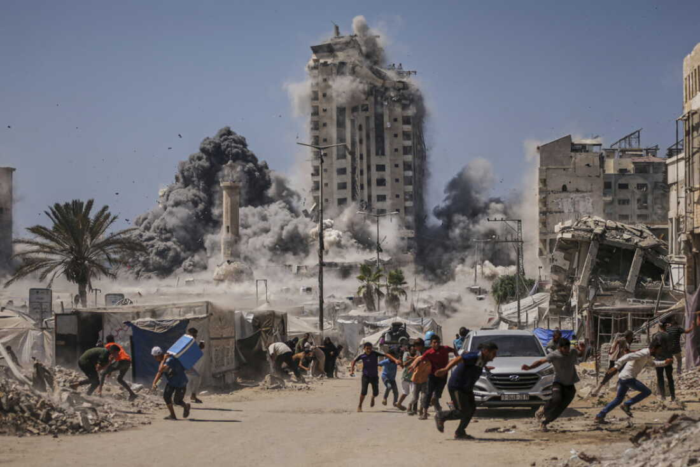
The death toll in Gaza alone has exceeded 73,000, according to the territory’s health ministry. Over 20,000 of them are children. The scale of erasure — physical, demographic, archival — is without precedent in the region’s modern history. And yet, as Palestinian lawyer and former PLO adviser Diana Buttu has observed, none of the major candidates have mentioned ending the genocide in Gaza.
The three candidates dominating polling — Benjamin Netanyahu, Gadi Eisenkot, and Yair Lapid — present themselves as rivals. On Gaza, they are collaborators. Netanyahu has rejected the Trump peace plan, after initially endorsing it, and is now insisting that Israel will not withdraw until Hamas is fully disarmed — almost certainly manufacturing new conditions to keep the occupation of the enclave indefinite. Eisenkot’s break from the wartime government in 2024 was tactical, not strategic, and he has since called the plan to depopulate Gaza a “blessing for Israel.” Lapid has been a consistent backer of the war, occasionally objecting to its execution but not the endgame.
None of the three is running on ending the war on terms that give Gazans a political future and dignity, while paving the way for eventual reconstruction. The Israeli electoral imagination cannot accommodate that possibility because Israeli society has collectively endorsed the genocidal logic. Candidates speak about Israel’s “public relations problem,” never the brazen actions that cause the problem. In their telling, Israel’s global standing has fallen because it has not managed to sell the genocide more artfully. This is not an aberration of the Netanyahu years. It is the terminal stage of a settler-colonial project that has always required the elimination or subordination of the indigenous population.
The West Bank: Pogrom as Policy
The occupied West Bank is simultaneously the most brazen and least discussed theatre of this war on Palestinian existence. What is happening there is not “settler violence” in the bureaucratic sense — it is state-organized dispossession, a rolling pogrom conducted with the full legal and logistical backing of the Israeli regime. Settlement expansion and annexation have moved from the ideological fringe into the electoral mainstream, with candidates dodging the question of what future, if any, Palestinians are meant to have under occupation.
The candidates share more than rhetorical convergence here. Netanyahu’s far-right regime has already turned years of creeping annexation into formal policy, affirming Israel’s intent to hold security control over the entire territory west of the Jordan River. Eisenkot has said he believes in continued settlement and has visited contested settler outposts. Lapid, alongside Bennett, is a long-standing backer of the settlement enterprise in both the West Bank and East Jerusalem. The three candidates agree on the same goal: expansion, annexation, and a veto on Palestinian statehood.
Far-right Finance Minister Bezalel Smotrich has publicly announced he will pursue a policy of “encouraging the migration” of Palestinians from the occupied West Bank and Gaza Strip. This is ethnic cleansing stated in plain language. The election will not remove Smotrich’s ideological infrastructure from Israeli political life; it will merely determine which coalition it adorns.
Lebanon: The Gaza Playbook Applied
Lebanon has been subjected to what amounts to a systematic application of the methods already deployed in Gaza — targeted bombing of civilian infrastructure, village demolitions, and the creeping re-establishment of a security belt across the country’s south. In Lebanon, Israel continues a defiant policy of airstrikes and village demolitions — effectively implementing the Gaza playbook — with candidates maintaining positions beyond what the US-brokered ceasefire framework envisioned.
The intent in Lebanon is territorial control and the permanent degradation of any political force capable of offering organized resistance. No candidate in the Israeli election has proposed a genuine withdrawal, a reparative settlement, or even adherence to existing ceasefire obligations. The debate, to the extent it exists, is about how deep to push the security perimeter, not whether to maintain it. For Lebanon’s southern communities, the ballot being cast in Tel Aviv will produce one of several variants of the same result.
Syria: Preventing the Emergence of a State
Syria represents perhaps the most cynically opportunistic dimension of the expansionist project. Following the collapse of the Assad government in late 2024, Israel violated the 1974 disengagement agreement and advanced into Syrian territory, seizing additional land, including Mount Hermon, under the pretext of creating a “buffer zone.”
The pattern is now fully legible. “Israel’s occupation of southern Syria is a deliberate strategy to prevent the consolidation of a unified Syrian state,” as one senior Syria analyst put it. Israel has said it will occupy the buffer zone indefinitely to combat threats from southern Syria. The legal basis that Israel invoked — the collapse of the Syrian state — is precisely the condition its own actions are designed to perpetuate. A fragmented, weak Syria cannot contest the occupation of the Golan, cannot reconstitute its sovereignty in the south, and cannot serve as a coherent political counterweight. The election will not alter this logic because the logic serves Israel’s permanent strategic interests regardless of which coalition governs.
The Broader Conflagration: Iran and the Region Dragged In
The regional conflagration involving Iran did not emerge from a vacuum and cannot be explained by the narrow framing that portrays Israeli military action as reactive. Israel has attacked Lebanon, Iran, Iraq, Syria, Qatar, and Yemen since 2023, including daily military operations in the Occupied Palestinian Territory. The scope of that offensive arc is not the product of one man’s governance style. It reflects a strategic doctrine — rooted in the conviction that regional hegemony requires the sustained dismantlement of any organized resistance — that Netanyahu, Eisenkot, and Lapid all share.
The war in Gaza, the de facto annexation in the West Bank, and open-ended security zones in Lebanon and Syria risk becoming permanent fixtures of Israel’s security structure, regardless of international condemnation and deepening isolation. Any new regime would inherit not only these facts on the ground but the domestic political constituency that demands them. Israeli society has been conditioned — through decades of eliminationist propaganda, manufactured fear, and the institutional glorification of military violence — to regard this configuration of power as not just acceptable but necessary.
The Monster by Any Other Name
The ritual of an election is, among other things, a performance of accountability — the public pretense that outcomes hinge on choices, that power is contested rather than merely redistributed among its custodians. It is incredible that not one weighty candidate is brave enough to offer the Palestinians anything at this juncture. This is not political timidity. It is political coherence. The Israeli state, in its current form, cannot offer Palestinians justice without threatening its own foundational claims. That structural impossibility does not resolve through ballots.
Eisenkot, the retired general who developed the Dahiyya Doctrine — the deliberate targeting of civilian infrastructure to maximize collective punishment — has never supported a two-state solution and declares that anyone who advocates one does not understand the conflict. He is currently polling ahead of Netanyahu. The “moderate” alternative, in other words, is the architect of a doctrine applied with devastating effect in Lebanon and Gaza alike. The “responsible” candidate is a man who built the theoretical scaffolding for the mass killing of civilians. This is what a corrective election looks like in this political system.
What will change on October 27 is the name on the door. The genocide in Gaza will continue. The pogroms in the West Bank will accelerate or stabilize according to coalition arithmetic, not moral reconsideration. The occupation of Syrian territory will be maintained under whatever pretext proves most convenient. Lebanon will remain a target whenever the military calculus makes it advantageous. And the wider region — including Iran — will continue to be drawn into a conflagration that the genocidal entity initiated and whose terms it refuses, in any regime configuration, to renegotiate. For the Palestinians bearing the full weight of this, the name of the monster is a secondary concern. The monster’s practices are the variables that matters the most.

Ali Raza
Ali Raza is a Student at the Department of Political Science, Government College University Lahore (GCUL). His interests include International relations study through defensive realism, war and military technology, and strategic studies.

Muhammad Mahad Samija is a scholar at the Department of Political Science, Government College University Lahore.