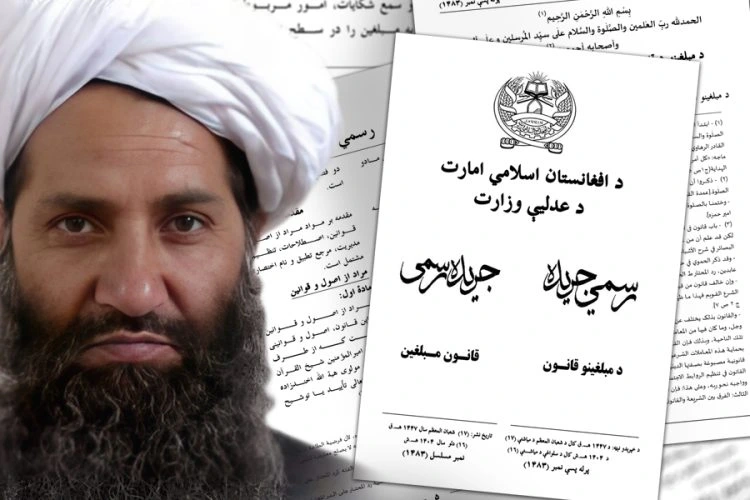
The publication of The Creed of Ahl al Sunnah wa al Jama‘ah (Da Ahle Sunnat wal Jamaat Aqeedah) by Sheikh Hibatullah Akhundzada, the Supreme Leader of the Afghan Taliban, deserves attention beyond the boundaries of religious scholarship. Published in Pashto in 2026, the book presents the leader’s account of Sunni Islamic belief. Its subsequent promotion by Afghan government institutions raises a broader question: why would the head of a governing movement place such emphasis on defining religious creed at a time when the Taliban have already consolidated their control over Afghanistan?
The answer may lie in the relationship between theology, political legitimacy and institutional consolidation. Although the author’s private motivations cannot be established from publication alone, the timing and official promotion of the book offer grounds for examining its possible political significance.
Beyond religious instruction
At one level, the book has an identifiable educational purpose. It covers traditional subjects including belief in Allah, Prophethood, angels, divine destiny, the Hereafter and the distinctive beliefs associated with Ahl al Sunnah wa al Jama‘ah. Taliban officials have described it as a resource for strengthening religious awareness and correcting belief.
Yet the author’s position introduces another dimension. Akhundzada is not simply a scholar writing for an academic audience. He heads a political system in which religious authority is closely connected to the legitimacy of government. His account of correct belief can therefore contribute to defining the ideological foundations of the Islamic Emirate.
The publication may help standardize religious instruction, reinforce internal cohesion and establish a common doctrinal reference for officials and religious institutions. It may also strengthen the Supreme Leader’s position as an authoritative interpreter of the religious principles associated with the state.
These functions are not mutually exclusive. Religious education can be a genuine objective while also reinforcing political authority.
The institutionalization of orthodoxy
The more important question is what happens when a particular interpretation of religious orthodoxy receives systematic official promotion.
Sunni Islam encompasses a substantial intellectual tradition, including different theological schools and juristic approaches. The designation Ahl al Sunnah wa al Jama‘ah has historically been used across diverse scholarly contexts. A text bearing this title can therefore be understood as an attempt to articulate a particular account of Sunni belief within the Afghan Taliban’s ideological framework.
If the book remains a general educational resource, its political implications may be limited. If it becomes an authoritative reference for religious institutions, however, it could contribute to narrowing the space for competing interpretations.
This distinction matters because defining orthodoxy can influence more than theology. It can shape educational curricula, the authority of religious scholars and the boundaries of acceptable public discourse. The extent of such effects will depend on actual implementation rather than the publication itself.
Why Pakistan should pay attention
For Pakistan, the issue becomes considerably more consequential because of the existing ideological and historical relationship between the Afghan Taliban and the TTP. The possibility that Akhundzada’s book could become a doctrinal reference for the TTP deserves particular attention.
The relationship between the two movements is not merely based on geographical proximity or occasional political cooperation. Both have roots in Deobandi Islamic thought and share a commitment to establishing Islamic governance based on their interpretation of Sharia. The TTP has historically regarded the Afghan Taliban’s Islamic Emirate as a model of religious governance. Its historical allegiance to Afghan Taliban leadership and its ideological affinity with the movement have been documented by terrorism researchers.
More significantly, the TTP has previously drawn upon the Afghan Taliban’s religious and political narrative to legitimize its own insurgency against Pakistan. Research published by the Combating Terrorism Center at West Point documents how the TTP invoked an archived statement attributed to Akhundzada in response to Pakistani religious scholars who had declared armed rebellion against the state illegitimate. This demonstrates that the Afghan Taliban leadership’s religious pronouncements can acquire significance within the TTP’s ideological justification for violence.
This existing relationship makes the new book particularly relevant. Although there is no established evidence that the TTP has formally adopted the publication, its authorship by a leader whom the TTP has historically treated as a major religious authority creates the possibility that the book could become an additional ideological reference for the organization.
Such an outcome could have implications beyond the justification of armed violence against the Pakistani state. The book’s emphasis on correct belief, Sunni orthodoxy and religious unity warrants scrutiny regarding how these concepts might be interpreted by militant actors. If selectively appropriated by the TTP, its theological propositions could be used to reinforce exclusionary interpretations of Islam, delegitimize alternative religious traditions and intensify intolerance towards communities that do not conform to its preferred doctrinal position.
The danger, therefore, is not simply that the book might reinforce the TTP’s narrative against the Pakistani state. It is also that an authoritative theological text could be used to provide religious legitimacy to a more restrictive and exclusionary understanding of Muslim identity. In Pakistan’s already diverse religious environment, such an interpretation could deepen sectarian divisions and increase hostility towards groups belonging to different schools of Islamic thought.
Pakistan’s security concerns are already serious. United Nations Security Council monitoring reports have identified the TTP’s presence in Afghanistan and reported continuing logistical and operational support from Taliban authorities. The Afghan Taliban have disputed or rejected various allegations concerning their responsibility for militancy affecting Pakistan. The security problem must therefore be assessed through evidence of organizational links, militant activity and state conduct.
The new book does not establish a connection with the TTP, nor does a theological discussion of jihad automatically amount to a call for violence against Pakistan. Nevertheless, its treatment of jihad, obedience to rulers and religious legitimacy warrants careful examination. The central concern is whether the TTP could appropriate the book as an authoritative ideological reference and use it to reinforce its own political and religious claims.
Implications for Pakistan’s policy
Pakistan should avoid two analytical mistakes. The first would be to dismiss the publication as a purely theological matter without examining its potential institutional and cross border implications. The second would be to interpret the book itself as conclusive evidence of a coordinated ideological campaign against Pakistan.
A more rigorous approach would investigate its circulation in Pakistani religious institutions, the response of Pakistani scholars, and any explicit references to political authority beyond Afghanistan. More importantly, Pakistani institutions should monitor whether TTP leaders, affiliated scholars or propaganda channels cite the book, incorporate its propositions into their ideological material, or use it to justify violence and intolerance towards other religious groups.
Particular attention should be paid to whether the book becomes part of a wider process of ideological alignment between the Afghan Taliban and the TTP. Such alignment would not necessarily mean organizational integration. Nevertheless, shared doctrinal references could strengthen ideological solidarity, reinforce perceptions of religious legitimacy and make the TTP’s narrative more difficult to challenge among receptive audiences.
Islamabad should also distinguish between religious dialogue and security cooperation. Pakistani scholars can engage with the text on its theological merits, while security institutions focus on demonstrable threats. This approach would avoid conflating ordinary religious belief with militancy and preserve the credibility of Pakistan’s assessments.
The significance of Akhundzada’s book, therefore, may extend beyond its immediate purpose of religious instruction. It could form part of a broader process of doctrinal standardization and institutional consolidation within the Afghan Taliban’s governing system. More importantly for Pakistan, it has the potential to become an ideological resource for the TTP if the latter adopts and uses it to reinforce its own interpretation of religious authority, jihad and orthodoxy.
Pakistan should consequently examine not only the book’s content but also its circulation, reception and possible appropriation by militant actors. The principal concern is that a theological text, when adopted by an armed movement, may acquire a political function that extends into the justification of violence, the rejection of religious diversity and the intensification of sectarian intolerance.
Pakistan’s most effective response will depend on recognizing the potential ideological implications of this publication while establishing, through evidence, whether and how the TTP incorporates it into its own doctrinal and militant framework.
Sources
- Afghanistan Ministry of Foreign Affairs. Conference on the academic significance of the Supreme Leader’s book, 27 October 2026. An official account of the book’s promotion and the government’s stated educational objectives.
- Farhan Zahid. The Afghan Taliban–TTP Nexus: Evolution from the First Emirate to Post-2021. NUST Journal of International Peace and Stability. Useful academic research on the historical relationship, ideological affinity and strategic differences between the two movements.
- Combating Terrorism Center at West Point. The Tehrik-i-Taliban Pakistan After the Taliban’s Afghanistan Takeover. Particularly relevant to the TTP’s use of Afghan Taliban religious narratives to justify its campaign against the Pakistani state.
- European Union Agency for Asylum. Pakistan: Country Focus, June 2026, Section 3.2: Main Non-State Armed Groups. Provides background on the TTP’s origins, ideological orientation and resurgence.
- United Nations Security Council, Analytical Support and Sanctions Monitoring Team. Sixteenth Report, S/2025/796, 16 December 2025. Relevant evidence concerning TTP presence and reported support in Afghanistan.
- Afghanistan Analysts Network. AAN Q&A: Taleban leader Hebatullah’s new treatise on jihad. Historical comparison for examining how an earlier publication by Akhundzada addressed ideological discipline and jihad.
- Cordoba Peace Institute. Afghanistan Monthly News Roundup, March to April 2026. Preliminary analysis of the new creed as a possible instrument of doctrinal standardization.
Dr Sajid Iqbal
Assistant Professor of IR, at NUML-Islamabad. He can be reached at sajidiqbal@numl.edu.pk