
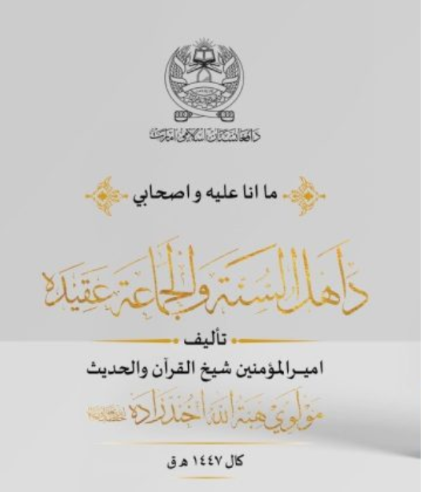

The publication of Da Ahl al Sunnat wal Jamaat Aqeedah by Afghan Taliban Supreme Leader Hibatullah Akhundzada is significant not simply because it addresses Islamic theology, but because of the author’s political and religious position within Afghanistan’s governing structure. The book presents itself as an exposition of Sunni creed. Its significance, however, extends beyond theological instruction to questions concerning religious authority, ideological consistency and the relationship between belief and political order.
The book covers a broad range of classical theological subjects. Its contents include belief in Allah and His attributes, the nature of faith, angels, divine revelation, Prophethood, divine decree, the Preserved Tablet, the Hereafter, and the status of the people of the Qibla. It also discusses the importance of adhering to the creed of Ahl al Sunnah wa al Jama‘ah and avoiding religious disagreements. These subjects place the work within the established tradition of Sunni theological literature.
The preface presents sound belief as fundamental to religious life and emphasizes the importance of learning and maintaining correct Islamic doctrine. The structure is instructional rather than argumentative. It introduces theological propositions, supports them through Quranic verses and Hadith references, and explains them in accessible Pashto. This makes the text potentially useful as a teaching resource for religious students and audiences who may not have access to extensive Arabic theological literature.
Several passages deserve particular attention because of their wider political implications. The discussion of religious unity and disagreement, around printed page 137, emphasizes the importance of avoiding divisions within the Muslim community. This is a familiar concern in Islamic scholarship. Yet, when such a position is articulated by a political leader whose administration exercises considerable religious authority, questions arise about how acceptable disagreement and doctrinal diversity are to be defined in practice.
More consequential is the discussion on printed page 138, which addresses Hajj and jihad under Muslim leadership. The passage presents these obligations as continuing under Muslim rulers, whether righteous or otherwise, until the Day of Judgment. This is an important passage for political analysis because it places religious obligations in a relationship with political leadership. It warrants closer examination, particularly regarding who qualifies as a legitimate Muslim ruler and how the principle is interpreted in contemporary political circumstances. The passage should not, however, be treated as sufficient evidence that the author is endorsing any particular militant organization or cross border campaign.
The following discussion, on printed page 139, turns to justice and the fulfilment of trusts. Its inclusion is noteworthy because it places ethical obligations alongside questions of religious belief and communal order. These themes provide an opportunity to assess the relationship between the book’s theological principles and the actual practices of governance in Afghanistan.
The central question is therefore not whether the book contains recognizably Sunni theological themes. Many of its subjects are shared across broad sections of Sunni scholarship. The more important question is how the author selects, organizes and politically promotes these teachings. The official promotion of the book by Taliban institutions, including a conference organized by the Afghan Ministry of Foreign Affairs in October 2026, indicates that it is being presented as more than a private scholarly publication. It is receiving institutional recognition as a work of religious instruction and ideological significance.
This does not establish that the book is intended to impose a single interpretation of Islam across Afghanistan. Nevertheless, its authorship and official promotion make doctrinal standardization and the consolidation of religious authority reasonable subjects for investigation.
A limitation of the work is that its broader intellectual contribution cannot be assessed solely through its stated propositions. A fuller scholarly evaluation would require systematic comparison with classical Hanafi and wider Sunni theological literature, attention to the sources cited, and examination of how its teachings are interpreted by religious institutions and the governing authorities.
So, Da Ahl al Sunnat wal Jamaat Aqeedah should be read on two levels: as a theological text dealing with established questions of Sunni belief, and as a political document produced by the supreme leader of a governing movement. Its significance lies not necessarily in the originality of its theological propositions, but in the institutional authority attached to its author and the potential role of the book in shaping religious instruction and political legitimacy in Taliban governed Afghanistan.

Dr Sajid Iqbal
Assistant Professor of IR, at NUML-Islamabad. He can be reached at sajidiqbal@numl.edu.pk