The war hysteria that prevails in Israeli society is amply reflected in its strategic outlook and its aggressive military policy in the region. The entire Israeli political class shares and imbibe this hysterical social attitude towards the societies and their people which surround the tiny state of Israel.
Therefore, the question whether Netanyahu succeeds in forming the next government in Tel Aviv will have little impact on Israel’s strategic outlook. In other words, even if Netanyahu loses the race for Prime Minister’s office, his successor will be as belligerent towards Iran as he has been, Israeli military will likely continue to occupy Gaza and Israeli settlers will continue to inflict violence on Palestinians in the West Bank.
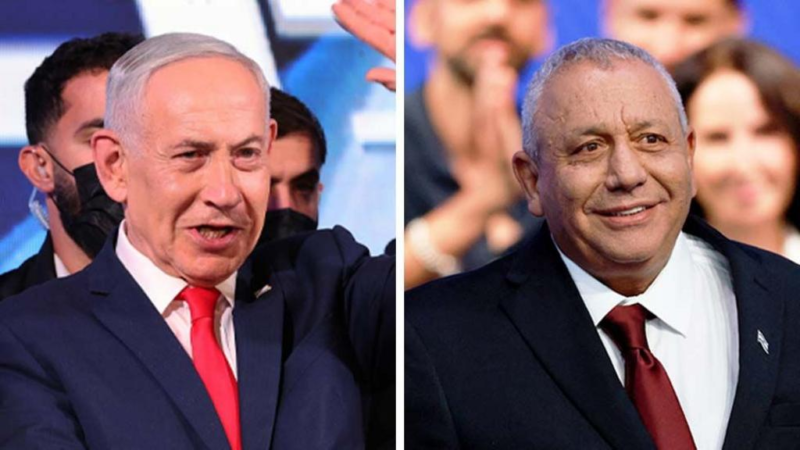
Though with considerably less fun fare if former military chief Gadi Eisenkot—Netanyahu’s rival in just concluded Israeli elections—wins Prime Minister’s office. Experts say it would not be a change of policy towards Palestinians it would be change in the way they oppress the Palestinians.
October 27 parliamentary elections in Israel have resulted in a political deadlock. It didn’t lead to a decisive victory for either side. Benjamin Netanyahu’s Likud-led coalition of right-wing and religious parties secured 53 seats. Opposition alliance led by former military chief Gadi Eisenkot secured 48 seats. In Israeli parliament, called Knesset, which has 120 members, a candidate needs 61 votes to get elected as prime minister. The two Arab parties, Ra’am and the Joint List, won a historic 19 seats. Neither Netanyahu’s coalition nor opposition alliance can form a government independently. Netanyahu’s party Likud emerged as the largest individual party with 27 seats. Next comes the opposition party, Yashar led by Eisenkot, which secured 21 seats.
Both Likud and Yashar will have to form coalitions with smaller parties which have different agendas and ideologies, if they want to come to power in Tel Aviv. However, given the war hysteria that prevails in Israeli society, they all share a hawkish attitude towards Gaza, and they all have vowed during the election campaign that they would order Israeli Defense Forces to resume war if HAMAS doesn’t disarm. They all consider Iran an existential threat and are inclined to use military force to deal with it.
On the question of illegal settlements in West Bank there is a slight difference between Netanyahu and Eisenkot public assertions. Netanyahu’s government had aggressively come out in support of new Israeli settlements in West Bank. Eisenkot in principle support Israeli settlement in West Bank but asserts that they must be in accordance with Israeli laws. Some of the experts point out that Israeli law declares some of these settlements in West Bank to be illegal.
Prime Minister Netanyahu during his tenure in office presided over a massive expansion of Israeli settlements. This included small outposts in parts of the West Bank reserved for civil administration by the Palestinian Authority. Here according to Eisenkot settlements are illegal under Israel’s own laws. The violent Israeli Settlers, during Netanyahu’s tenure routinely attacked Palestinians in the West Bank, and critics say Israeli government turned a blind eye to such violence. Both Benjamin Netanyahu and his main opponent Gadi Eisenkot oppose an independent Palestinian state.
Hundreds of thousands of illegal Israelis settlers live in the West Bank, a territory which Israel captured in a 1967 Arab-Israel war. Nearly all the countries of the world consider Israeli settlements in West Bank as illegal under international law, although Israel disputes this.
Some of the Palestinian experts and intellectuals have expressed the fear that Netanyahu, who is still functioning as a caretaker prime minister of Israeli till new government is formed, will use this period to expel Palestinian population from Gaza under the guise of voluntary migration. And if he manages to retain the office of Prime Minister, the pressure on Palestinian in occupied territories will increase manifolds.
Eisenkot, on the other hand, is working on a political agenda which is more focused on domestic political and constitutional issues. During election campaign he was more focused on issues related to trust in governance, quality of democracy and accountability to Israeli law and institutions. Experts are of the opinion that his focus on domestic agenda might incline him towards some kind of compromise with at least pressure from Washington. For instance, Washington has been publicly opposing Israeli occupation of West Bank. However, Eisenkot has publicly voiced his opposition to Israel’s full withdrawal from Gaza.
Based on his election campaign, experts point out that Eisenkot would not hesitate to follow Washington’s lead in striking Iran or to launch a unilateral strike against Iran. Like majority of Israelis, Eisenkot also consider Iran and groups like Hamas and Hezbollah a serious threat to Israel’s security which should be dealt with militarily. In 2006 Lebanon war between Israel and Hezbollah, Eisenkot was Israel’s military chief. As a military commander he formulated the Dahiyeh Doctrine—a doctrine named after the Hezbollah stronghold of Beirut’s suburbs. It called for the indiscriminate and disproportionate destruction of civilian infrastructure to frighten and deter the “enemy”. This is the doctrine which Israeli defense forces continued to use in Gaza and Lebanon.
As a former military commander Eisenkot is no less aggressive in dealing with Iran. But there are certain indications that he might be more inclined towards giving diplomacy more room to function. For instance, in 2022, he has supported US led diplomatic solution to Iran’s nuclear problem, with the conditions that Iran nuclear program should be subjected to tougher inspection by international monitoring agencies. He once opined that restoring the 2015 Iran-US nuclear agreement would benefit Israel as it would temporarily prevent Iran from acquiring nuclear weapons. This, he thought, would allow the Israeli military to shift resources towards other security threats. However, experts say, much has changed since then and recently Eisenkot wholeheartedly supported joint US-Israeli military strikes against Iran.
Israel is a tiny country with a small population. But its internal politics, ongoing strategic debate and the war hysteria that prevails in the country can potentially destroy the peace of Southwest Asia or maybe the whole world. Its population is bloodthirsty. Its politicians, military men, ordinary citizens and intellectuals are acting as warmongers. And there is nobody to stop them.

Umer Farooq
Umer Farooq is an Islamabad-based Afghanistan specialist and senior journalist. A journalist since 1995, he has worked with Dawn and The Herald and covered Afghanistan and conflicts for Pakistani and international outlets. His analysis focuses on Pakistan–Afghanistan relations, the Taliban and the TTP, and regional security after the United States’ withdrawal.