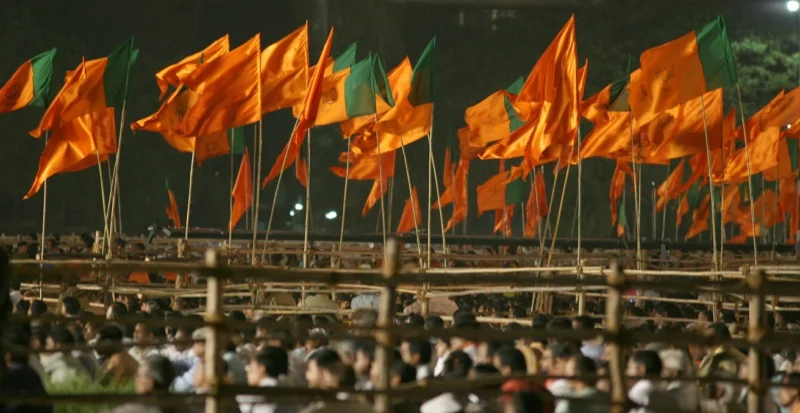
Over the past 12 years , Narendra Modi has tried to reshape India’s domestic politics and regional approach employing Hindu nationalist, centralised and assertive ways. His political strategy is based on the ideals of reviving the glory of India’s civilisational identity, economic advancement and the ability to challenge the external enemies in a decisive manner.
But surging political tensions reveal the inherent paradox that domestic legitimacy can become hopelessly entangled in majoritarian nationalism and conflict with Pakistan, leading to internal political instability and regional instability.
Modi’s victory is a demonstration to the electoral success of the Hindutva, but it also shows its shortfalls. The Gujarat riots of 2002 were a pivotal moment in his political career, highlighting deep concerns about minority rights and political responsibility.
Modi, who came to power as Prime Minister in 2014, elevated this bigotry-driven political paradigm at the national level, to mobilize the nation for a sense of nationalism and to promise to bring about economic reforms and decisiveness in governance.
However, as time passed, the idea that he was the sole national leader and it became more difficult to differentiate between the national interest and the political fortunes of the Bharatiya Janata Party (BJP).
Nationalism and the Limits of Governance
One of the ways Modi has been able to consolidate his political power is to convert crises as opportunities. But nationalist rhetoric cannot make up for economic concerns, joblessness, or poor government.
The decision to demonetise in 2016, which was touted as an anti-corruption, anti-smuggling, anti-black money move, caused a shock in common citizens and companies, and also put a strain on the government’s development messaging due to the looming threat of joblessness and economic inequality.
The General Elections of 2024 revealed the extent of Modi’s electoral clout. The BJP has been reduced to a minority government and must rely on coalition partners to stay in power. While Modi remained in the premiership, the outcome tarnished his reputation as an electorally invincible leader, and that religious polarization can never supersede voters’ interests.
This loss is important because a leader deeply committed to being strong may react to the limitations within the borders of his own country by focusing on ideological mobilisation instead of tackling policy gaps. The consequences can be especially grave when nationalism is associated with the image of Pakistan being an external threat.
Pakistan and the Politics of Confrontation
The Indian-Pakistan relations has repeatedly illustrated how a csecurity crisis can co-mingle with domestic politics. Securing national security and demonstrating muscular leadership features prominently in the BJP’s political agenda under Modi. While the 2019 Pulwama incident and the subsequent Indian air strikes near Balakot how a security crisis could reinforce the association between military action and decisive leadership.
The issue is not that all Indian security decisions are necessarily geared towards electoral gains, but when a military operation is marketed as an expression of a country’s resolve, it can become a domestic political game. These dynamics can lead to incentives for risk-taking, especially in the absence of political pressure, where a government has to appear strong to gather political support.
The May 2025 clash between two nuclear powers brought the risk of escalation to the fore. The results of military operations should not be judged by nationalistic statements or by declarations of triumph and success; the strategic consequences of the actions should be judged in the context of deterrence and crisis management, and the risk of miscalculations.
Pakistan’s stance is still that respect for sovereignty, restraint and peaceful resolution of disputes is essential for regional peace and stability. It has a credible deterrence posture to promote legitimate security interests and to stop coercion.
India can’t expect that an attack would be limited in scope in the first place and Pakistan would not take it lying down when it comes to threats to its security. A world that is becoming nuclearised has to be aware that short-term political gains through military confrontation can have repercussions beyond the domestic ones that might have motivated it.
Democratic Credibility and Majoritarian Politics Modi’s political woes also raise questions about India’s democratic institutions and constitutional pluralism. Issues around elections and opposition allegations of institutional bias should not be taken at face value or dismissed without independent investigation.
However, trust in electoral institutions, judicial independence and political accountability are all important for the legitimacy of democracy.
Religious minorities, too, pose a related concern. Democracy is not only about rule by majority but ability to safeguard rights of every citizen of democracy. Thus, when minorities are seen as outsiders, and when opposition parties are labelled ‘anti-national’, democratic competition can turn into a contest about who is a rightful citizen of the nation.
This polarization also undermines India’s position as a regional leader. International credibility is not achieved through economic and military strength alone; domestic political practices also become an issue here that casts doubt on pluralism, equality of citizenship, and institutional accountability. Pakistan’s view of these developments would be viewed as a reminder of the regional fallout of Hindutva politics, but this assessment too should be based on tangible facts and democratic principles.
The electoral defeat of the BJP is no harbinger of the fall of Modi’s government. The party still has a strong organisational infrastructure, while the government still has a lot of power. The more serious one is how it will react to political restrictions.
Modi’s government has the option to undertake institutional reform, policy tweaking, and political centristism. It can alternatively be a factor of polarization and more on external threats to reinforce internal support. The second is a strategic issue for Pakistan, as increased political uncertainty could fuel political gamesmanship, and, if the Indian government adopts such plays, there may be another Pakistan-India crisis.
Again, this isn’t an excuse for not taking domestic politics into account in all Indian security decisions. Instead, it is a reminder of the ways in which the combination of national legitimacy and military determination can make strategic restraint more difficult. The right answer for Pakistan is to have a credible deterrence, build up robust crisis management systems and work towards peaceful resolution of pending issues without letting political narratives created by India dictate Pakistan’s strategic decisions.
Modi’s central paradox is that his political brand of nationalism can reveal his leadership shortcomings. While Hindutva can bring about electoral mobilisation, it cannot replace economic performance, democratic accountability, or inclusive governance, in the long run. The impact of this political legitimacy conflict is not just on the Indian politics but has broader implications.
The strategic stability of South Asia cannot be subordinated to electoral calculations or nationalist competition. India’s long-term standing will not merely hinge on its military and economic capabilities, but on its willingness to respect constitutional pluralism and exercise strategic restraint. For Pakistan, credible deterrence and a commitment to peaceful dispute resolution remain essential. Ultimately, responsible leadership in a nuclearised region is measured not by the ability to escalate a crisis, but by the capacity to prevent one.

Abdul Basit is Associate Research Officer the Center for International Strategic Studies-AJK. He holds Bachelors in International Relations from National Defence University, Islamabad, and is an alumnus of NESA.