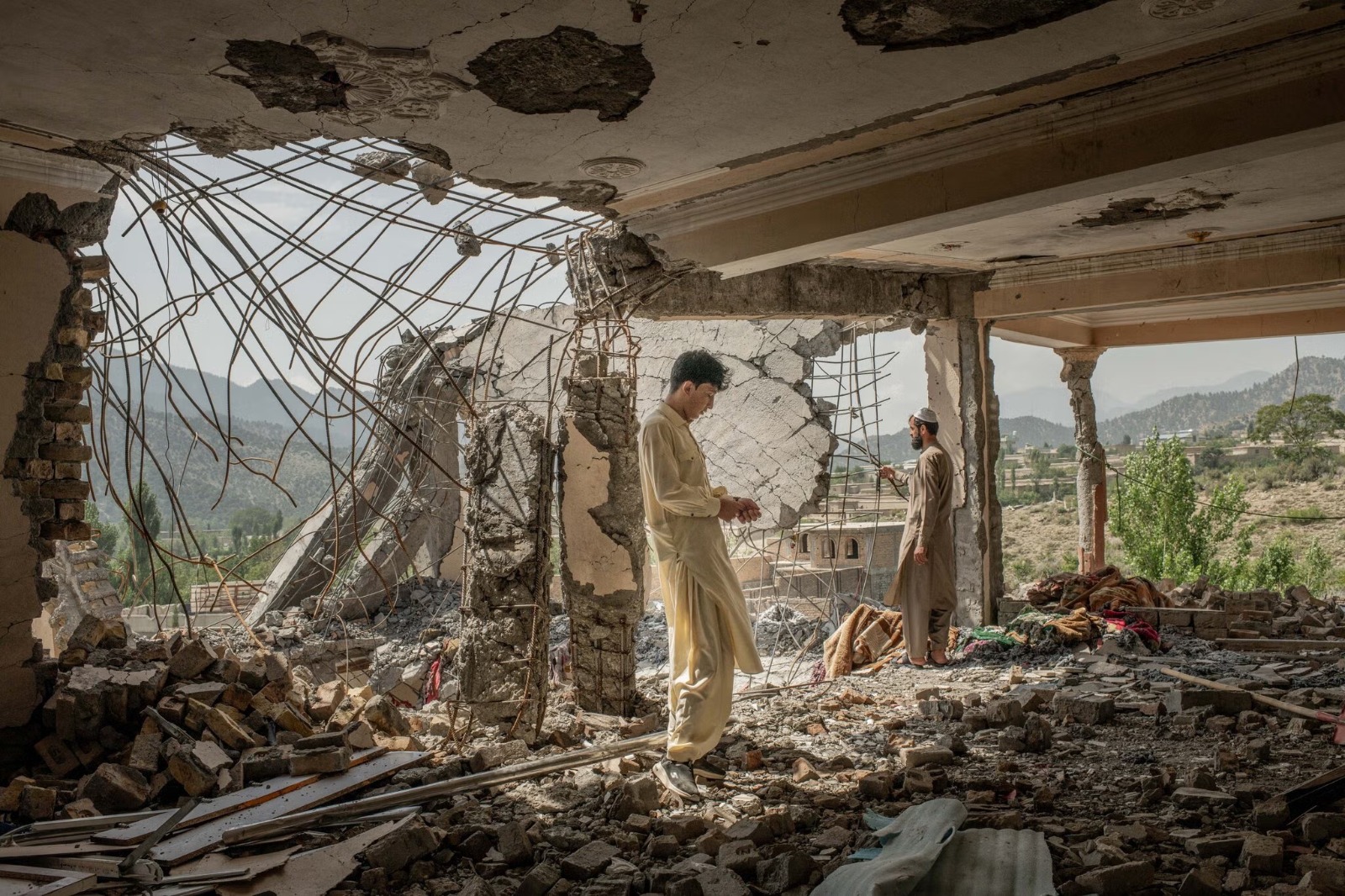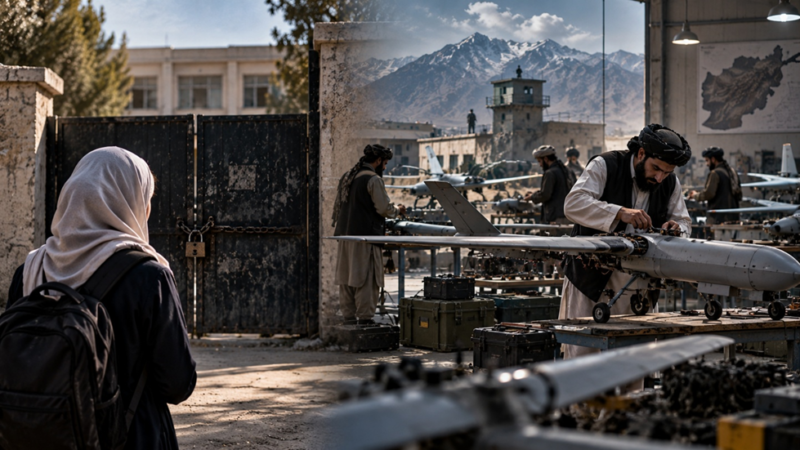
Five years after seizing Kabul by force, the Taliban are drawing the country’s leading universities, state factories and commercial supply chains into a covert program to build one-way attack drones. Meanwhile, 2.4 million Afghan girls are barred from secondary school. The priorities say more about the regime than any statement it issues.
On September 6, the Taliban’s Ministry of Higher Education announced a new faculty at Kabul Polytechnic University. The faculty is named the Faculty of Aerospace Engineering and Advanced Systems, and its flagship major is “drone and radar engineering.” No Afghan woman will study in it. Since December 2022, women have been barred from every university in the country.
The announcement made public what ground reports sought by South Asia Times indicate has been under way since late 2021. Afghanistan’s civilian institutions, from its oldest engineering schools to a state industrial complex in Kabul, have reportedly been folded into a network that designs, assembles and tests weaponized drones. Seventeen days after the ministry’s announcement, on September 23, Pakistani forces shot down eight fixed-wing drones launched from Afghanistan toward Torkham and Kohat.
A movement that took power through armed insurgency has never fully made the transition to governing. Its budget choices, its classrooms and its factories now point in the same direction, that is, toward coercive power abroad, and away from the most basic needs of Afghans at home.
From Lecture Halls to Launch Sites
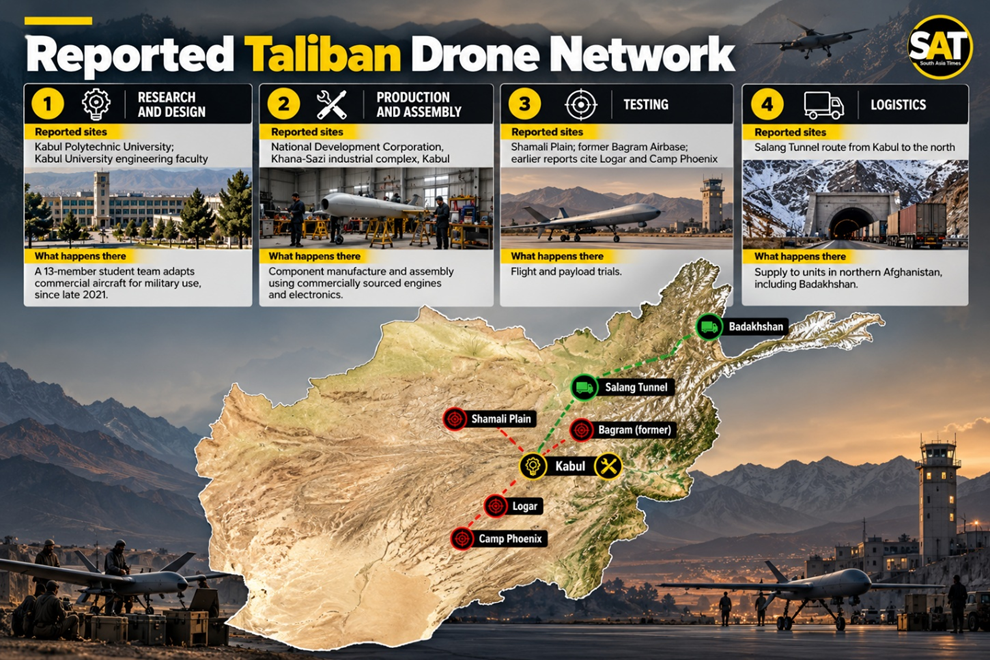
The network reportedly begins on campus. Since late 2021, a 13-member team of engineering students from Kabul Polytechnic University and Kabul University’s engineering faculty has been adapting commercial remote-controlled aircraft for military use, ground reports indicate. A source at the Taliban-controlled Afghanistan National Development Corporation described the same team to Afghanistan International earlier this year, saying it had been modifying and designing drones since 2021.
From there, the work reportedly moves to the factory floor. The National Development Corporation’s Khana-Sazi industrial complex in Kabul, a state-owned site built for civilian manufacturing, is now being used for drone-component production and aircraft assembly, according to ground reports. Engines and electronics are sourced commercially. The finished aircraft are reportedly fitted with explosive payloads of three to five kilograms, adapted from rocket-propelled grenade warheads and 82-millimeter mortar rounds, turning civilian airframes into one-way attack drones.
Testing and transport complete the chain. Ground reports identify the Shamali Plain north of Kabul and the former Bagram Airbase as testing grounds, with supplies moving north through the Salang Tunnel toward the Taliban’s expanding military presence in Badakhshan. Earlier reporting pointed the same way. In 2025, British press reports cited by KabulNow said a former British base in Logar and Camp Phoenix near Kabul were being used to test and build drones. Researchers at Singapore’s S. Rajaratnam School of International Studies have also described a covert Taliban drone program run from repurposed United States and NATO facilities.
A Weapon Built for Pressure Not Defense
The Taliban’s interest in drones is not new, but its purpose has changed. During the insurgency, the movement’s propaganda studio used drones to film attacks. By 2020, it was dropping mortar rounds from commercial quadcopters on Afghan security forces. In January 2021, Taliban drones struck the airfield of the Afghan army’s 217th Pamir Corps in Kunduz and damaged a helicopter. Analysts describe the trajectory since then as a shift from surveillance and propaganda toward armed, one-way attack drones.
Pakistan has felt that shift directly. When open fighting broke out in late February 2026, the Taliban answered with drone attacks across the border. In September alone, 23 drones entered Pakistani airspace from Afghanistan, according to Pakistan’s Foreign Ministry, and on September 23 Pakistani forces shot down eight heading for Torkham and Kohat. Islamabad lodged a formal protest on September 28. The threat extends beyond the Taliban’s own units. Khyber Pakhtunkhwa police foiled 341 drone attacks in the first six months of 2026, and the Tehreek-e-Taliban Pakistan (TTP), which buys commercial drones in Kabul and other Afghan cities, carried out 405 quadcopter attacks on Pakistani security forces last year.
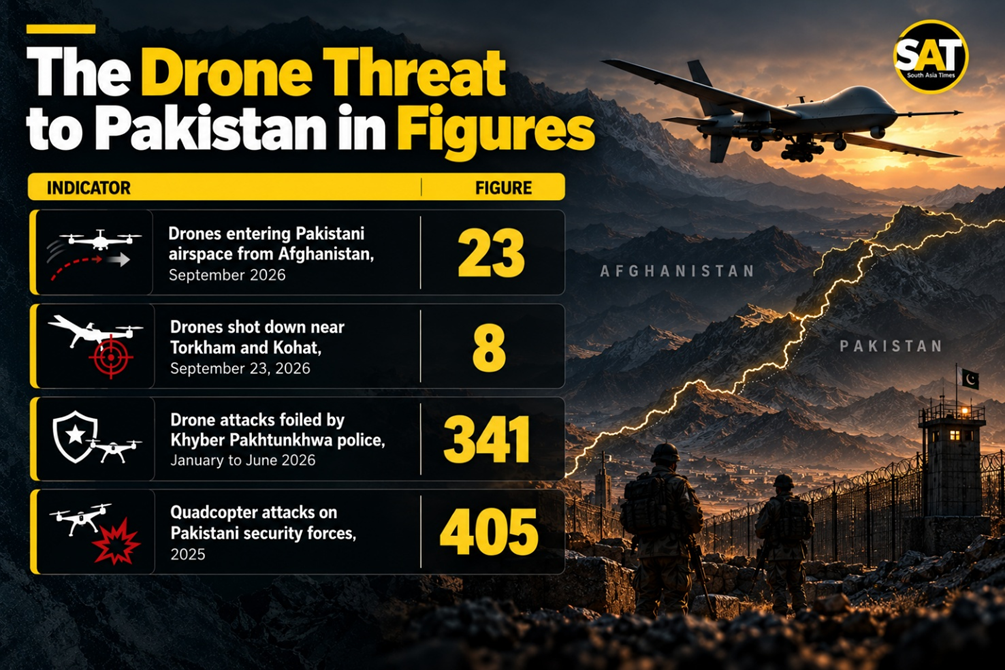
Description. Four indicators of the drone threat to Pakistan in 2025 and 2026, covering cross-border incursions, shoot-downs, foiled attacks and quadcopter attacks. Sources. Pakistan Foreign Ministry and Global Network on Extremism and Technology research, as reported by Dawn and France 24.
Pakistani officials see the drone campaign as part of a single problem. “The Afghan Taliban and the TTP are ideological cousins,” Asif Durrani, Pakistan’s former special representative for Afghanistan, has said. Aamir Zulfiqar Khan, a former inspector general of police in Punjab, said Pakistan’s police “have extensive counterterrorism experience, but drones are a totally new dimension.” Mark Grozel, a drone specialist, told France 24 that such weapons work less by destruction than by intimidation: “Their main power is their psychological impact.”
Schools Shut and Workshops Open
The contradiction at the heart of the program is stark. The same regime that is funding a drone faculty has made Afghanistan, in UNESCO’s words, the only country in the world to stop girls and women attending secondary schools and universities. Girls were shut out of secondary school in March 2022, and women out of universities in December 2022. The Taliban have rejected international calls to reverse the bans, describing them as “an internal matter.”
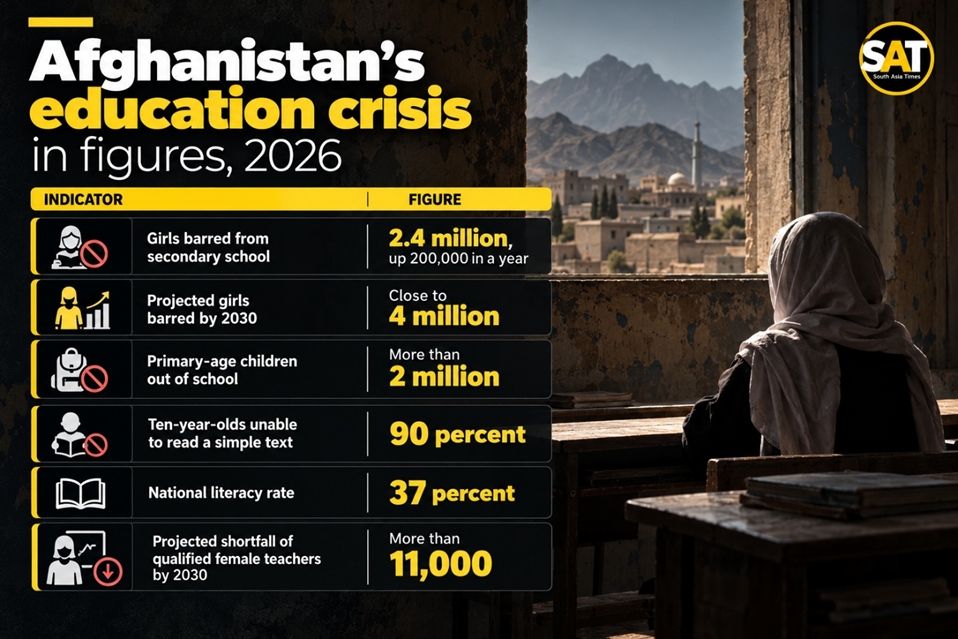
The infrastructure tells the same story. Nearly half of Afghanistan’s schools lack water, sanitation or heating, and about 1,000 have been closed by natural disasters over the past five years. Against that backdrop, the regime has found the engineers, the facilities and the funding for a faculty devoted to drones and radar. Institutions that should be producing the doctors, teachers and engineers Afghanistan needs to rebuild are instead being drawn into weapons work. A generation of young women is shut out of the classroom while the classroom itself is put to military use.
Students Placed in Harm’s Way
The deepest cost of this network may fall on the Afghans who work and study around it. Customary international humanitarian law, which binds every party to an armed conflict, requires each side to avoid placing military objectives in or near densely populated areas, and to take all feasible precautions to protect the civilians under its control. The same law holds that a civilian building used to make an effective contribution to military action can lose its protected status. A university laboratory that designs attack drones, or a state factory that assembles them, is no longer simply a campus or a workshop in the eyes of the law.
By embedding weapons work inside universities and civilian industrial sites, the Taliban are reportedly shifting that risk onto students, lecturers and factory workers who had no say in the decision. The obligations do not run one way. Any state responding to cross-border attacks is bound by the rules of distinction, proportionality and precaution, and Pakistan has repeatedly said its operations in Afghanistan target only militant and military sites. But responsibility for turning classrooms and factory floors into parts of a weapons program rests with those who made that choice.
The record of the past year suggests how any future incident would be contested. Throughout the 2026 fighting, Kabul and Islamabad have offered sharply different accounts of what Pakistani strikes hit. Where military production sits inside civilian institutions, the line between the two becomes harder for outsiders to judge, and easier for the party that blurred it to exploit.
What Kabul Says and What Comes Next
The Taliban have not commented publicly on reports that universities and state factories form part of a drone network, and they did not respond to earlier reports of production at former NATO bases. Their spokesman, Zabihullah Mujahid, has instead argued that blaming Afghanistan is no solution to what he calls Islamabad’s own failures.
Three tests now lie ahead. The first is for the Taliban: whether they separate military production from civilian campuses and factories, or continue to blur the two. The second is for suppliers. The engines, electronics and airframes the network relies on are commercial products sold openly, and tighter export scrutiny by manufacturing countries would raise the cost of every drone. The third is for the international community, which has spent five years urging the Taliban to reopen classrooms to girls and now finds those same institutions being turned toward war.
Governments are judged by what they build. In five years, the Taliban have closed secondary schools to 2.4 million girls, emptied universities of women and, by every available account, built a drone program that reaches across Afghanistan’s borders. A movement that seized power by force has used that power to expand its capacity for coercion while starving its own people of education. Until that order of priorities changes, the Taliban will remain what they were in 2021: an armed movement occupying the offices of a state, not a government that serves its people.
Sources
- Ground reports sought by South Asia Times, October 2026
- Afghanistan International: Taliban launches drone engineering programme at Kabul Polytechnic University
- Afghanistan International: From rotor drones to kamikaze UAVs, tracking the Taliban’s five-year shift
- Dawn: Afghan Taliban’s cheap but deadly drone campaign
- Dawn: Unraveling the Afghan Taliban-TTP drone nexus
- KabulNow: Taliban building suicide drone arsenal at former NATO bases, report says
- Al Jazeera: UNESCO says 2.4 million Afghan girls denied access to further education
- UNESCO: Five years on, keeping learning alive for girls and women in Afghanistan