
A federal audit of the Ministry of Communications for 2022–23 finds unapproved bank accounts, hiring beyond sanctioned limits and millions paid to private couriers, at an institution already raising prices to stay afloat. Most of the money sits in cases the public has not been shown.
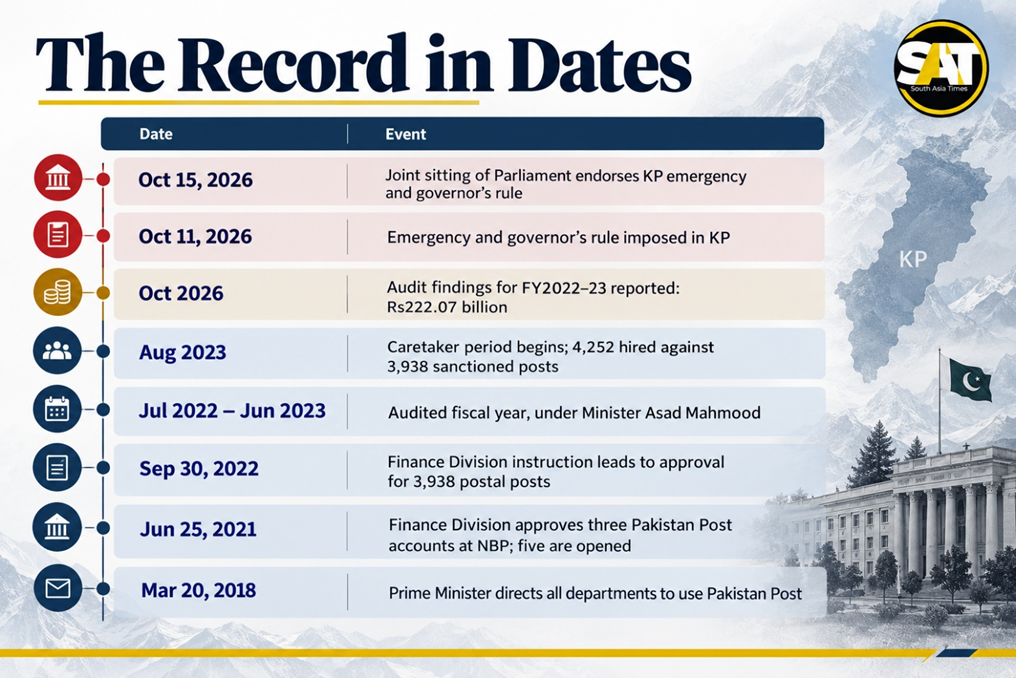
ISLAMABAD, October 20, 2026 — For years, Pakistan’s governments have tried to keep the state postal service alive by sending it their own mail. In 2018 the prime minister ordered every federal department to use Pakistan Post for official correspondence, at home and abroad. Four years later, according to federal auditors, Pakistan Post was paying private couriers to do the job instead.
That finding is one strand of a far larger account. An audit by the Auditor-General of Pakistan of the Ministry of Communications and its postal arm for the 2022–23 fiscal year flags financial irregularities worth Rs222.07 billion. The findings span fraud at post office counters, recruitment, procurement and the handling of public money in commercial bank accounts.
The year in question fell under Maulana Asad Mahmood of the Jamiat Ulema-e-Islam (Fazl), or JUI-F, who served as federal communications minister in the coalition government of the Pakistan Democratic Movement (PDM). He is the son of Maulana Fazlur Rehman, the party’s leader and one of the country’s most durable power brokers. Mr. Mahmood had not publicly responded to the findings at the time of publication.
The report does not establish that anyone stole Rs222 billion. Audit objections in Pakistan record money spent in breach of rules, without approval or without adequate paperwork, and many are settled once documents are produced. But the pattern the auditors describe, of an institution bypassing the very controls meant to protect it, is hard to dismiss. Its timing has given it political weight.
The Audit Finds Leaks at Every Level of Pakistan Post
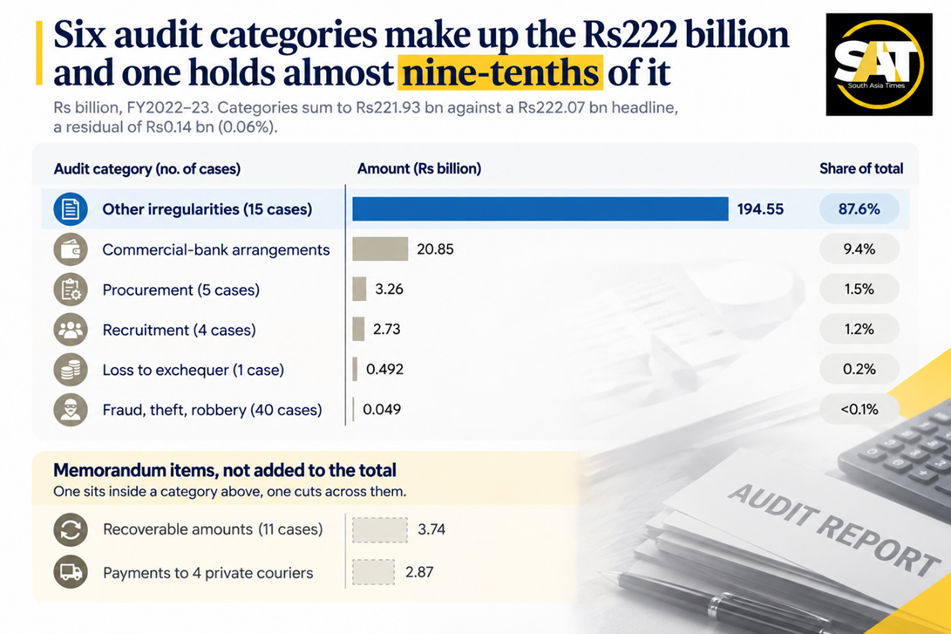
The largest identifiable finding concerns banking. In June 2021, the Finance Division authorized Pakistan Post to hold three accounts at the state-run National Bank of Pakistan (NBP). It opened five. Roughly Rs20 billion passed through the accounts that had no approval, part of Rs20.85 billion the auditors flag under unauthorized arrangements with a commercial bank. Accounts that sit outside the Finance Division’s view sit, in effect, outside the Treasury’s control.
The courier contracts tell a smaller but more telling story. Despite the 2018 directive, Pakistan Post engaged four private companies during 2022–23 and paid them Rs2.87 billion. A postal service under pressure to raise revenue was, by the auditors’ account, sending business to its competitors.
Recruitment accounts for Rs2.73 billion across four cases. After a Finance Division instruction in September 2022, the Establishment Division cleared Pakistan Postal Services to fill 3,938 vacancies in grades 1 to 15. It hired 4,252 people, 314 more than sanctioned, in appointments that reports of the audit describe as politically driven. The audit dates those hirings to the caretaker administration that took office in August 2023, after Mr. Mahmood had left the ministry.
Elsewhere, five procurement cases caused a loss of Rs3.26 billion, and a single further case cost the exchequer Rs492.5 million. Forty cases of fraud, theft and robbery at post offices total Rs48.8 million. The sums are modest, about Rs1.2 million a case, but they measure how loosely cash is handled at the counter. Auditors also identified Rs3.74 billion that should be recovered across 11 cases.
Then there is what the public cannot see. Fifteen cases grouped as “other irregularities” account for Rs194.55 billion, or 87.6 percent of the total. None of the published summaries say what they involve.
How the Figures Add Up
Auditors classify each finding, or para, by the nature of the irregularity. Read that way, the headline resolves into six mutually exclusive categories totaling Rs221.93 billion. That is within Rs0.14 billion, or 0.06 percent, of the reported figure, a residual that most plausibly reflects rounding in press summaries or a minor para they omit.
Two further figures are memorandum items and should not be added. The Rs2.87 billion in courier payments is a single para nested within one of the six categories, most likely procurement, though the summaries do not say so. The Rs3.74 billion in recoveries is a different measure altogether: money the state can still claw back, drawn from across the categories rather than standing beside them. The Rs20 billion that moved through the unapproved accounts likewise sits inside the Rs20.85 billion banking category. Counting these items again would inflate the total to Rs228.54 billion and overstate the loss.
Why It Matters Now
The audit has surfaced at a fraught moment. On October 11, the federal government imposed an emergency and governor’s rule in Khyber Pakhtunkhwa, invoking Articles 232 and 234 of the Constitution to dismiss the provincial government of Pakistan Tehreek-e-Insaf (PTI), the party of the jailed former prime minister Imran Khan. Governor Faisal Karim Kundi now runs the province with an 11-member advisory council, and Parliament endorsed the measure at a joint sitting on October 15.
Urdu-language reports, citing sources, say Maulana Fazlur Rehman sought the governorship for his son as the price of the JUI-F’s support. The same reports accuse Mr. Mahmood of corruption and nepotism in office. That is a political charge, not an audit finding.
What the Audit Can and Cannot Prove
Responsibility is also less clear-cut than the headline figure suggests. Under Pakistan’s accounting rules, the ministry’s principal accounting officer, usually its secretary, answers each para, not the minister. Paras go first to a Departmental Accounts Committee, and those left unresolved go to the National Assembly’s Public Accounts Committee. Only there, or before an investigating agency, can an irregularity become a proven loss or a case of misconduct.
Scale needs context, too. The Auditor-General’s 2023–24 review of the power sector flagged some Rs4,800 billion in irregularities. Against that, Rs222 billion is modest. Against an institution whose survival depends on government business it was, on this account, handing to its rivals, it is not. The findings arrived weeks after Pakistan Post announced higher postal charges.
What Happens Next
The report now goes before the Public Accounts Committee, and three questions will decide whether it leads anywhere. Will the committee publish the paras behind the Rs194.55 billion? Will the committee close the five National Bank accounts and reconcile the Rs20 billion that moved through them with the Treasury? And will the 314 additional appointments be reviewed, and the Rs3.74 billion marked for recovery actually recovered?
For a post office that reaches villages no bank will serve, the stakes go beyond accounting. Pakistan Post needs government mail, public trust and solvent books to survive. This audit suggests it was losing all three.

SAT Commentaries, a collection of insightful social media threads on current events and social issues, featuring diverse perspectives from various authors.