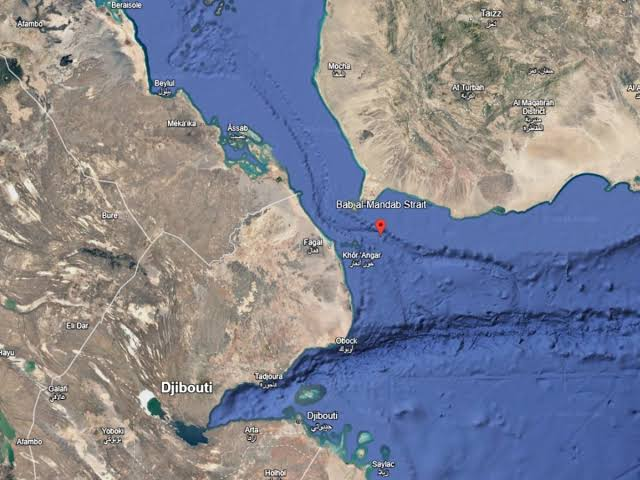
The protracted conflict in Yemen has long transcended conventional domestic territorial boundaries, cementing its role as a pivotal variable in Red Sea maritime security, global trade stability, and regional power architecture. Recent political and military signaling from Sana’a—articulated by senior officials aligned with Ansar Allah—reveals a calculated doctrine: coupling local territorial dynamics along the Red Sea coast with direct leverage over one of the world’s most critical maritime choke points, the Bab al-Mandab Strait.
Rather than treating the conflict merely as an isolated local impasse, Sana’a’s strategic messaging explicitly tethers international shipping security to broader political objectives: the lifting of naval and air blockades, foreign force withdrawal, and national sovereignty.
At the center of these equations lies Bab al-Mandab, an 18-mile-wide maritime corridor connecting the Red Sea to the Gulf of Aden and the Indian Ocean. Understanding the trajectory of this theater requires analyzing how territorial maneuvering along the Red Sea coastal belt interacts with asymmetric naval deterrence and an evolving war of narratives.
The Red Sea Coastal Strip: Operational Anchor to Maritime Deterrence
Yemen’s Red Sea coastal strip represents the vital connective tissue between internal land warfare and asymmetric power projection across the maritime domain. For Sana’a, territorial positioning near ports and strategic maritime approaches is not merely defensive; it dictates the strategic maneuverability available to opposing regional coalitions.
Recent assertions by Mohammed Taher Anam, an adviser to Yemen’s Supreme Political Council, emphasize this operational nexus. Anam categorically dismissed claims that Saudi-backed forces have secured enduring control over Bab al-Mandab or the critical adjacent coastal district of Dhubab, citing continuous counter-maneuvers as proof of Riyadh’s operational limits.
While such official declarations reflect the political posture of a combatant seeking to project deterrence, they fundamentally illuminate how Sana’a conceptualizes the theater. For Saudi Arabia and its regional allies, any vulnerability along the Red Sea coast complicates defense economics, forces costly naval redeployments, and weakens diplomatic leverage in broader negotiations.
Even without sustained conventional naval control over the entire waterway, geographical proximity allows Yemeni forces to establish operational friction, turning the Red Sea coastal strip into an active geopolitical buffer.
Geography as Asymmetric Leverage: Deterrence Without Conventional Parity
The strategic centrality of Bab al-Mandab stems from international economic dependence on the Suez-Red Sea maritime corridor, which accommodates substantial shares of global container traffic and hydrocarbon flows. Consequently, regional actors do not require blue-water naval superiority to wield immense disruptive leverage.
Anam’s explicit warnings—that nations participating in hostile military operations against Yemen risk having their commercial and military vessels targeted or interdicted in Bab al-Mandab—delineate an evolving posture of maritime deterrence. This strategy exploits the inherent vulnerability of congested, narrow shipping corridors: the mere perception of risk and rising maritime insurance premiums can reroute international shipping around the Cape of Good Hope, inflicting significant global logistical costs.
However, a rigorous strategic assessment requires distinguishing between geographic proximity and sustainable maritime interdiction. Leveraging geography through land-based anti-ship cruise missiles, loitering munitions, and unmanned surface vessels creates tactical disruption, but it also carries significant escalatory liabilities.
Provoking sustained international naval counter-missions risks broader confrontation, complicating economic sustainability and regional political alignments.
The Strategic Value of Taiz: Protecting the Coastal Hinterland
While international attention focuses heavily on maritime disruptions, territorial developments in the southwestern governorate of Taiz remain fundamentally bound to coastal dominance. Taiz is not an isolated land campaign; geographically, its high ground directly commands the approaches down to the Bab al-Mandab strait and the Red Sea port of Mocha.
Anam’s focus on areas like Jabal Habashi and his signaling regarding eventual entry into Taiz city reflect Sana’a’s intention to secure the strategic hinterland buffering the Red Sea coastal strip. Denying rival armed factions stable footholds in Taiz reduces the threat of flanking maneuvers against coastal positions in Dhubab and Bab al-Mandab.
Nevertheless, Taiz exemplifies the internal complexity of Yemen’s conflict landscape. The presence of diverse local resistance forces, fractured political factions, and competing local leaderships ensures that operational progress cannot be achieved by military momentum alone. The theater demonstrates that maritime leverage remains deeply reliant on complex, fragile ground balances that resist unilateral resolution.
The War of Narratives: Information Warfare and Institutional Credibility
Parallel to the military contest is a sophisticated battle of narratives designed to shape domestic cohesion and international perception. Nasr al-Din Amer, board chairman of the Saba News Agency and a prominent Ansar Allah communications official, has consistently argued that regional adversaries increasingly rely on aggressive media campaigns to obfuscate battlefield impasses and operational vulnerabilities.
In asymmetrical warfare, information management directly influences deterrence value. Conflicting claims regarding missile interception rates, air defense efficacy, infrastructure strikes, and coastal advances illustrate an intense cognitive struggle. For Sana’a, framing their actions as a legitimate defense against foreign intervention serves both domestic mobilization and regional public positioning.
For independent strategic observers, separating psychological messaging from concrete battlefield realities is critical. Official statements underscore political intent, strategic doctrines, and negotiating redlines; however, precise assessments of territorial control and maritime operational capabilities necessitate rigorous analytical scrutiny beyond state-sponsored channels.
Economic Grievances, Blockades, and the Parameters of Settlement
Sana’a’s linkage between maritime security and its overarching political agenda is deliberately non-negotiable. Both Anam and Amer have framed maritime and coastal operations as integral to ending the external economic blockade, reopening Sana’a airport and Hodeidah’s maritime access, and securing revenue allocation from domestic oil and gas resources.
By integrating national economic grievances into its maritime military posture, Ansar Allah ensures that any negotiated diplomatic framework cannot isolate maritime navigation from the structural resolution of Yemen’s humanitarian and fiscal crises. A diplomatic model focused solely on protecting global shipping lanes while bypassing the economic welfare and sovereignty demands of northern Yemen is treated by Sana’a as structurally defective.
Conversely, a viable long-term settlement cannot be achieved strictly through bilateral concessions between Riyadh and Sana’a. Yemen’s deeply fragmented sociopolitical terrain requires accommodating multifaceted local factions, non-aligned southern interests, and institutional reconstruction frameworks to prevent reigniting localized conflicts once broader regional confrontations de-escalate.
Maritime Leverage at a Strategic Crossroads
The strategic significance of Yemen’s Red Sea coastal strip and Bab al-Mandab lies precisely at the intersection of asymmetric deterrence, territorial positioning, and economic geography.
Sana’a has successfully demonstrated that land-based geography, when paired with anti-access/area-denial (A2/AD) capabilities, can disrupt international power balances and force global powers to negotiate on terms that link maritime security directly to local sovereignty and humanitarian demands.
Yet this strategic leverage remains inherently precarious. Geographic proximity creates coercive potential, but long-term gains depend on whether this pressure can be converted into tangible economic and political dividends at the negotiating table. As regional diplomacy navigates fragile ceasefires and escalating maritime tensions, Bab al-Mandab will remain both the ultimate pressure point for Yemeni deterrence and the critical barometer of whether the region drifts toward structural equilibrium or protracted naval instability.

Mohammad Mahdi Dara
Mohammad Mahdi Dara is an Iranian journalist, visual journalist and writer specializing in conflict, defense, security and West Asian affairs. His work combines field reporting, visual journalism and strategic analysis, with reporting experience in Iraq and Lebanon. He writes on military affairs, regional security, deterrence and the changing geopolitical order of West Asia.