Pakistan’s Remittances Surge Amid Illegal Dollar Trade Crackdown

Pakistan's remittances surge 34% amid a crackdown on illegal dollar trade, boosting reserves to a 2-year high. [Representational Image via Propakistani]

Pakistan’s crackdown on illegal foreign exchange (specifically the dollar trade) is showing signs of success, with remittances expected to reach a record high this year, as per the latest report from Bloomberg

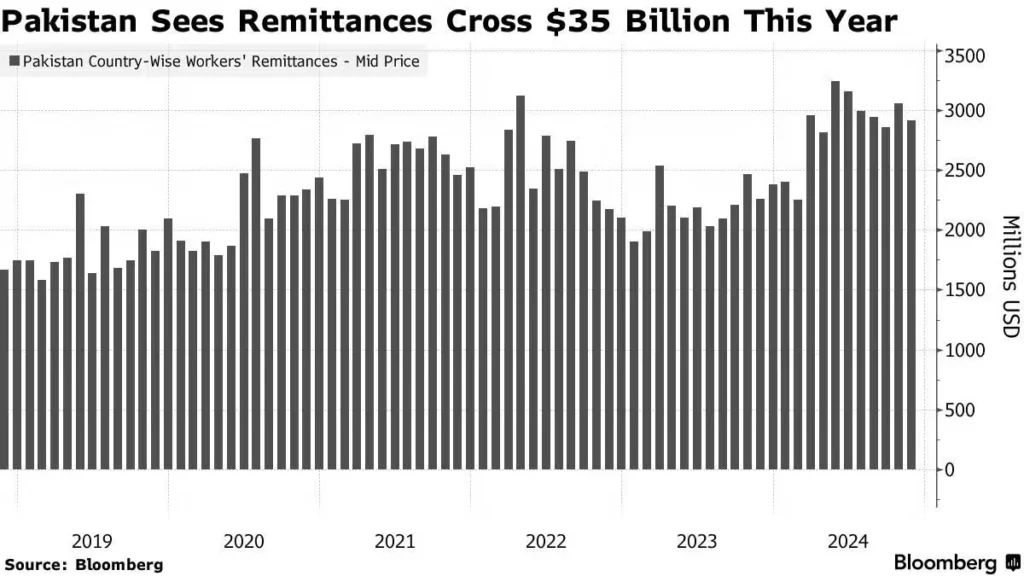
Central bank figures reveal that the money sent home by overseas workers jumped by 34% to $14.8 billion in the five months leading up to November, compared to the same period last year.

This surge in remittances follows the nation’s intensified efforts to combat the illegal dollar trade. Finance Minister Muhammad Aurangzeb is now forecasting that total remittances will hit an unprecedented $35 billion by the end of the year, a significant increase from the $30 billion recorded last year.
Source: Bloomberg

John Ashbourne, emerging-market economist at BMI, a Fitch Solutions company in London said:

The currency reforms do seem to have boosted remittances. This increase might be because remittances that had previously been sent using the black market are now being sent via official channels.

Pakistan’s foreign exchange reserves have seen a significant boost, potentially easing the economic pressures that nearly triggered a default last year. Increased es are likely a key factor, bolstering these reserves and mitigating a critical vulnerability.

This positive development follows a period of stringent economic reforms implemented under the International Monetary Fund’s (IMF) guidance, culminating in a crucial $7 billion loan secured from the multilateral agency in September.

A crackdown on informal dollar trading appears to have redirected transactions into official banking channels, further contributing to the reserve increase. By the end of November, reserves had surpassed $12 billion, reaching their highest level since March 2022.

Also See: Pakistan Cuts Interest Rates to Two-Year Low to Aid Economy

This news is sourced from Propakistani and is intended for informational purposes only.

News Desk

Your trusted source for insightful journalism. Stay informed with our compelling coverage of global affairs, business, technology, and more.


Recent

The Re-Emergence of Terror: Afghanistan as a Global Terrorist Hub

The Re-Emergence of Terror: Afghanistan as a Global Terrorist Hub

The Taliban’s return to power has revived Afghanistan’s role as a global Terrorist hub. Despite pledges under the 2020 Doha Agreement, the regime continues to shelter and enable groups such as Al-Qaeda, TTP, and ETIM, creating a volatile nexus of terrorism that threatens regional stability and global security. As internal conflicts deepen and governance collapses, Afghanistan’s transformation into an ideological sanctuary ensures a cycle of chaos and suffering that primarily victimizes its own people.

Read More »
The End of Dollar Dominance: How Gold is Rewriting the Rules of Global Finance

The End of Dollar Dominance: How Gold is Rewriting the Rules of Global Finance

After nearly eight decades of U.S. dollar supremacy, the global financial order is entering a historic transition. As nations seek refuge from debt crises, sanctions, and monetary manipulation, gold is regaining its status as the world’s most trusted store of value. Led by China’s strategic accumulation and supported by a worldwide shift toward de-dollarisation, this transformation signals the birth of a multipolar, asset-backed financial era, one anchored not in promises, but in tangible wealth.

Read More »
The Taliban’s Broken Promises: Time for a New U.S. Strategy in Afghanistan

The Taliban’s Broken Promises: Time for a New U.S. Strategy in Afghanistan

Since the Taliban’s return to power, Afghanistan has once again become a hub for militant activity despite their promises under the 2020 Doha Accord. UN and SIGAR reports reveal that Afghan soil now shelters TTP, Al-Qaeda, and ISIS-K operatives involved in cross-border attacks, particularly against Pakistan. The Taliban’s failure to uphold intra-Afghan dialogue, misuse of international aid, human rights abuses, and deception in regional agreements have eroded trust globally. With terror networks thriving under their protection, it is time for the U.S. and international community to adopt a new, accountable strategy toward Afghanistan’s Taliban regime.

Read More »
Instability as Strategy: How India Benefits from the Afghan-Pakistan Breakdown

Instability as Strategy: How India Benefits from the Afghan-Pakistan Breakdown

The escalating tensions between Pakistan and Afghanistan’s Taliban-led regime have reignited South Asia’s most volatile frontier. As cross-border attacks intensify and the Taliban refuses to dismantle the Tehreek-e-Taliban Pakistan (TTP), Islamabad faces mounting security and sovereignty challenges. Yet, amid this chaos, India emerges as the silent beneficiary, leveraging regional instability to weaken Pakistan strategically while maintaining its image as a victim of terrorism. This calculated exploitation threatens to entrench South Asia in a new cycle of proxy conflict.

Read More »
Five years after the Doha Accord, the Taliban break commitments, harbor terrorists, exclude women and minorities, and defy international agreements.

Broken Promises, Renewed Threats: Time to Hold TTA Accountable

Five years after the Doha Accord, the Taliban have broken key commitments: 5,000 released prisoners returned to combat, 89% of government posts are held by Pashtuns, and women remain barred from education and work. Afghan soil hosts 6,000–6,500 TTP and Al-Qaeda fighters, with TTP chief Noor Wali Mehsud receiving $43,000/month. Pakistan has neutralized 267 Afghan terrorists in 2025, while 58 terrorist camps operate under Taliban knowledge. Despite the US aid, compliance is minimal. International recognition and support must now be tied to verifiable reforms to prevent further regional instability.

Read More »