So in a sudden tweak of history, days ago, the far-right Hindu extremist party, Shiv Sina refused to celebrate the 3rd anniversary of the revocation of article 370 which stripped the state of Jammu and Kashmir of its unique status back in 2019. The readers might not be astonished at the reasons Shiv Sina put forth for not celebrating this development, however, they can be amused by the fact that it is coming from a Hindu extremist party.
To quote Manish Sahni, the president of Shiv Sina Jammu and Kashmir chapter, ‘The miseries of the people of Jammu and Kashmir have only increased. Innocent killings in the form of target killings are rampant. Unemployment is on the rise.’
Kashmir: On Development Since August 2019
In 2019, the BJP-led government revoked the special status of Jammu and Kashmir by abrogating articles 370 and 35-B of the Indian constitution. At the time, the move was celebrated by nearly all the Indian leaders across the political spectrum of Indian polity, sparing few exceptions. On the part of the government, the move was regarded as a watershed moment in the history of Kashmir and Jammu, that will usher in a new phase of development and prosperity for the region. Indeed the move has proved to be a watershed moment in the history of the region and indeed it has ushered in a new phase, but a phase of miseries and atrocities for the people of Jammu and Kashmir in general and for its Muslim population in particular.
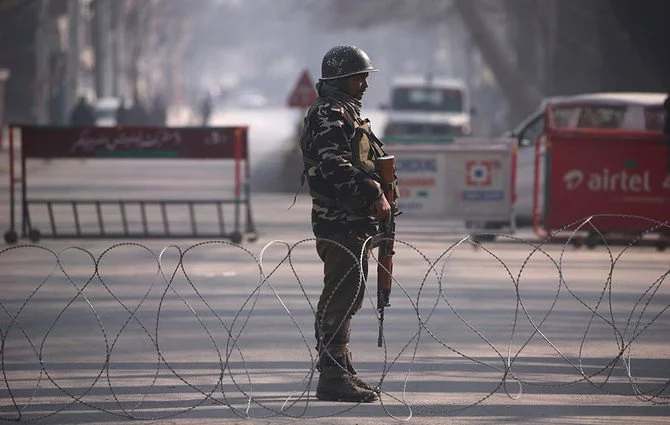
Three years later, the state of Jammu and Kashmir has yet to see even a semblance of normalcy. Unannounced, unfettered, and stringent curfews, the rampant target killings of Muslims, illegal detentions, the curbs on the freedom of speech and movement, complete media blackout, and the brassbound censorship are some of the new normals of post-August 05 Kashmir. It is worth mentioning that the so-called ‘phase of development\’ is not confined to the aforementioned achievements. It goes well beyond that.
Kashmir: August 5th, 2019, and the BJP Government
Since August 05, 2019, by replicating the Israeli model in Palestine, the BJP-led government has undertaken various steps to change the demography of Jammu and Kashmir with the Hindu settlers. Towards this end, a series of laws have been passed. As per these laws, Kashmiri Muslims were stripped of their property rights on the property which they bought in the 1990s from Kashmiri Hindus. Moreover, those who have resided for a period of 15 years in Kashmir or studied for a period of seven years in educational institutions located in the region were also regarded as eligible for permanent residency. These measures, according to many analysts were directed against the Muslim majority population of the region.
It is not only the property or land from which Muslims of the region were denied in the last three years, as attempts were also made to strip them of their religious beliefs. In tandem with other atrocities, primarily aimed against the Kashmiri Muslims, the Indian government is now pondering over the criminalization of the religious beliefs of the Muslims, and to put the Muslims in re-educational and deradicalization camps.
The former Chief of Indian Defence Staff, Bipin Rawat had already made a staggering revelation in this regard when he confessed in front of Indian media, that people in Kashmir have been completely radicalized and need to be taken out separately, into deradicalization camps, we already have in our country. No wonder if it reminds the readers of the Nazi concentration camps.
To conclude, the illicit move vis-a-vis Jammu and Kashmir, which was taken by the Indian government exactly on the same day three years ago has proved disastrous for the people of the region. Rather than unleashing a phase of development, the move had unleashed a new rein of terror for the people of the Indian-occupied Jammu and Kashmir. The conditions of the people of the region in general and of its Muslim population have gone from bad to worse over the course of these past three years. The International community should take notice of the plights of the Kashmiris and should make efforts to resolve the Kashmir issue in line with the wishes of Kashmiris, as it is the only way forward.