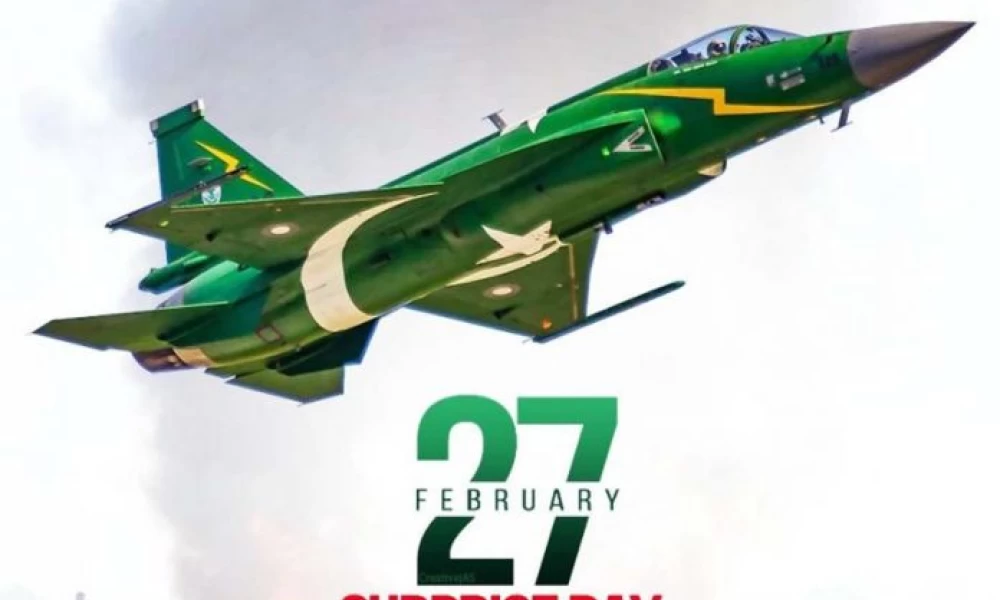
February 27 marks three years to the successful Operation Swift Retort carried out by Pakistan’s Air Force (PAF) shooting down two Indian fighters in response to Indian Air Force’s (IAF) airstrike in Balakot on February 26, 2019 – That airstrike was the first to take place on Pakistani soil since the India-Pakistan War of 1971. In addition, the detection of an Indian submarine at sea by Pak Navy followed by a befitting response at the Line of Control (LOC) is a testament to the professionalism of Pakistan’s Armed Forces, especially when the escalation ladder has been retained by Pakistan.
IAF’s Balakot strike came as a response to the Pulwama attack which was a suicide attack done by a young Kashmiri boy at Pulwama killing around forty Indian soldiers on February 14, 2019. The Pulwama attack demonstrated nothing but the Indian atrocities in the Illegally Occupied Jammu and Kashmir (IIOJK) and the torture that people of Kashmir go through every day in the name of ‘search and cordon’ operations. India’s blame rested on its arch-rival in the region – Pakistan and hence the airstrike at Balakot.
Balakot Air Strike and PAF’s Swift Retort
The Indian authorities code-named the attack on Balakot as “Operation Bandar” to reduce the possibility of any potential leak of the plan. The specific code “Operation Bandar” was chosen because monkeys enjoy a sacred place in the Hindu religion. Also referring to a tale in the religious myths of Hinduism where Hanuman (a deity resembling a monkey) secretly entered Lanka and conquered it. Hence, the naming of the Operation leading to the Balakot air strike represents the confidence the Indian Air Force had in the success of the operation and the achievement of designated targets.
The aerial strike was finally carried out near Balakot on February 26, 2019, targeting a religious seminary described as a militant camp by India. Claims were made that three hundred terrorists have been killed. However, no evidence (in the form of any video clip or pictures) came forth. The lack of any substantial evidence put the whole operation carried out by IAF in suspicion and doubt. As for the artillery involved in carrying out this strike, there were twenty Mirage 2000 aircrafts carrying Spice 2000 and Crystal Maze missiles, having the support of Air Borne Early Warning systems.
Some Foresight and Insight
Three years to Operation Swift Retort are evidence of the fact that this episode of a rather unplanned escalation between India and Pakistan has been yet another demonstration of how the two sides are trapped in an inherent security dilemma. The whole episode also puts nuclear deterrence in question and shows us the new contours of non-contact warfare (NCW) especially employing autonomous weapons. Three years after the Indian Air Force’s hostile misadventure and Pakistan Air Force’s prompt retort, there is a need to analyze lessons learned by both sides in order to deal with future airspace conflicts and escalatory scenarios. India’s humiliation and Pakistan’s victory help one predict the nature and strategy of future aerial conflict between the two.
The escalatory scenario caused by shooting down the MiG-21 demands that the human cost of the encounter should also be taken into account. Consider, for example, India’s pilot captured by the Pakistani forces. Had it not been for the generosity and peace gesture demonstrated by Pakistan, the pilot would have faced a severe and brutal fate. This human element makes the aerial encounter even more costly for India in terms of the political consequences for a country that projects itself as the regional hegemon.
IAF’s Balakot and PAF’s Swift Retort also bring to light Non-Contact Warfare (NCW) as a possible study area for those who closely look into the military strategy that rules the power balance and imbalance in the South Asian Region. It is a further evolution in hybrid warfare where specific types of kinetic and non-kinetic capabilities are used and the aim is to reduce physical contact to the bare minimum.
NCW includes information warfare, cyberspace, and autonomous weapons (missiles for example). Three years to Operation Swift Retort; India’s inability to provide any evidence of the casualties it said it inflicted on the so-called religious seminary sure granted Pakistan an upper hand since from the Pakistani side, the footage of the shot-down aircraft circulated widely. This is how Pakistan won not only the information aspect of this encounter but also its kinetic aspect.

Your go-to editorial hub for policy perspectives and informed analysis on pressing regional and global issues.