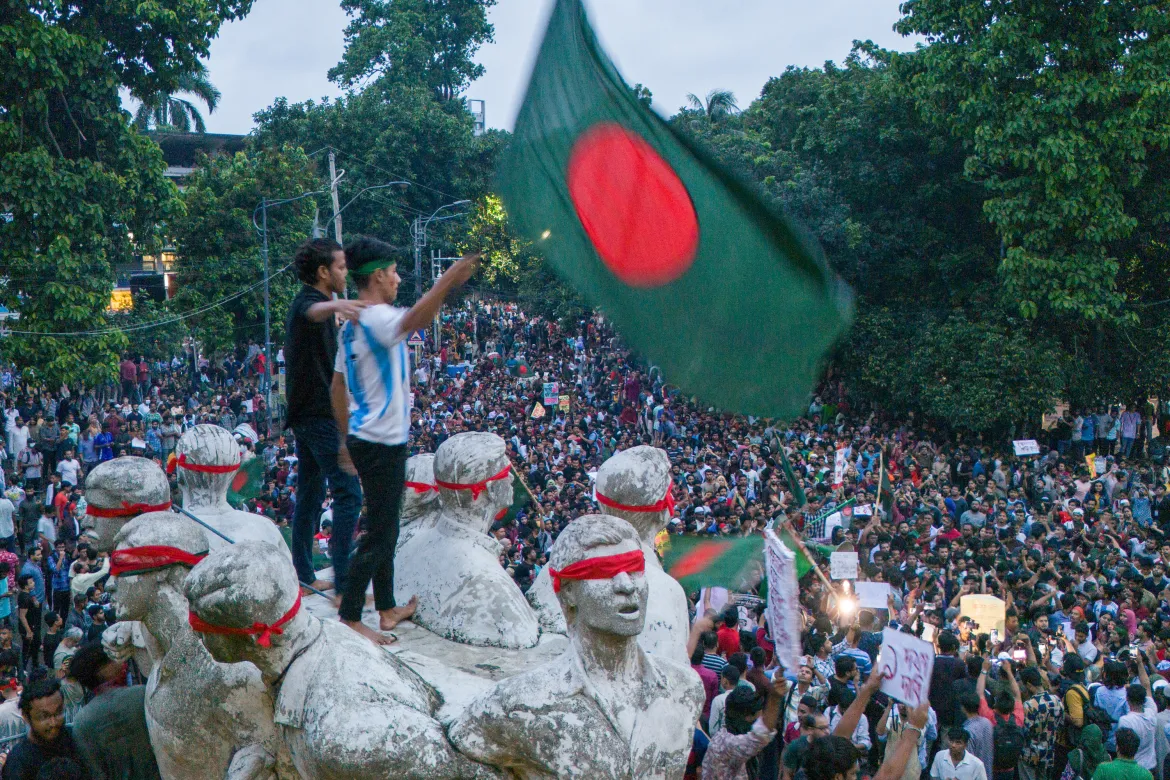
Police have killed at least 91 people, including 13 police officers, and injured dozens more in a new round of violence in Bangladesh. They fired tear gas and lobbed stun grenades. Their actions aimed to disperse tens of thousands of protesters. These protesters had returned to the streets to demand Prime Minister Sheikh Hasina’s resignation during the Bangladesh protests.
Police and doctors reported the deaths on Sunday. The fatalities occurred in the capital Dhaka and the northern districts of Bogura, Pabna, and Rangpur. They also reported deaths in Magura in the west, Comilla in the east, and Barisal and Feni in the south. These deaths were caused by the Bangladesh protests.
The attack on the police, during Bangladesh Protests, occurred at the Enayetpur police station. This station is located in the northwest city of Sirajganj. Additional Deputy Inspector General Vijay Basak of the Bangladesh police reported the incident. The identity of the attackers is unknown.
The demonstrators, from Bangladesh protests, are demanding Hasina’s resignation after earlier protests in July that began with students calling for an end to a quota system for government jobs and escalated into violence that killed 200 people.
Hasina said those who were engaging in the “sabotage” and the destruction in the name of protests were no longer students, but criminals, and said the people should deal with them with iron hands.
Authorities have blocked internet access and imposed a shoot-on-sight curfew. They have arrested at least 11,000 people in recent weeks.
‘Volatile and dangerous’
Authorities reported deaths from at least 11 districts, including Bogura, Magura, Rangpur, and Sirajganj. Protesters, backed by the main opposition party Bangladesh Nationalist Party (BNP), clashed with police and activists from the ruling Awami League party and its associated bodies.
Al Jazeera’s Tanvir Chowdhury, reporting from Dhaka, described the situation as “volatile and dangerous”. “The protesters are saying that they are not going to move, until their government steps down,” he said.
“People are extremely worried [about] what’s going to happen,” Chowdhury said, adding that the crowd of protesters is growing. He also reported clashes between the protesters and supporters of the Awami League.
Student activist Prapti Taposhi, who witnessed clashes with police, told Al Jazeera that the police engaged in running battles with the demonstrators.
“I am on the street right now, and I can see so many people here. This is not just a student protest or a ‘quota protest’,” she said.
Curfew Imposed
The government has now imposed an indefinite curfew that began at 6pm local time (1200 GMT), although protesters have continued to gather at the Shaheed Minar monument in central Dhaka.
Protesters called for “noncooperation”, urging people not to pay taxes and utility bills and not show up for work on Sunday, a working day in Bangladesh. Offices, banks and factories opened, but commuters in Dhaka and other cities faced challenges getting to work.
A ‘March to Dhaka’ protest has also been moved from Tuesday to Monday, a coordinator for the Anti-Discrimination Student Movement (ASD) told Al Jazeera.
“This means we are urging students and the public nationwide to start their journey to Dhaka tomorrow to lay siege to the city,” the coordinator, Asif Mahmud, said.
The government, meanwhile, announced a holiday from Monday to Wednesday. Courts will remain closed for an indefinite period. Authorities also closed schools and universities across the country.
Services Turned Off
Mobile internet service was off on Sunday, while Facebook and messaging apps including WhatsApp were inaccessible even on broadband internet. Junior Minister for Information and Broadcasting Mohammad Ali Arafat said mobile internet and messaging services were off to help prevent violence.
Arafat added to Al Jazeera that the government was acting “in a defensive position, not an offensive one”.
“These miscreants attacked our activists and leaders and unleashed violence,” Arafat said, adding that the government has “always opted for a peaceful solution” and “never wanted violence”.
The deadly protests began last month as students demanded an end to a quota system that reserved 30 percent of government jobs for the families of veterans who fought in Bangladesh’s war of independence against Pakistan in 1971.
As violence intensified, the country’s Supreme Court scaled back the quota system to 5 percent of jobs, with 3 percent for relatives of veterans.
But protests have continued demanding accountability for violence the demonstrators blame on the government’s use of excessive force.
Unrest Continues
The unrest, which spurred the government to shut down internet services, is its biggest test since January when deadly protests erupted after Hasina’s Awami League won a fourth straight term in elections boycotted by the BNP.
The protests have now grown into a wider antigovernment movement across the South Asian nation of some 170 million people. At least 11,000 people have been arrested in recent weeks.
Critics of Hasina, along with several rights groups, have accused her government of using excessive force to stamp out the movement, a charge it denies.
“We want the government to resign,” Jahirul Islam, a restaurant worker in Dhaka, told Al Jazeera.
Dhaka-based political analyst Zahed Ur Rahman said that the government would be unlikely to resign “without bloodshed”.
“For the past two days, peaceful gatherings and demonstrations have taken place across the country demanding the government’s resignation,” Rahman said, explaining that the protests were peaceful because of the absence of Awami League activists on the streets.
However, once ruling party’s activists went to confront the protesters “they use gun[s] and violence to quell a popular uprising in front of the whole world”, Rahman said.
Anger and unrest is a cocktail for violence. Innocents often lose their lives during such circumstances. Chaos is especially rampant when all involved parties believe themselves to be in the right.
People should seek means of peaceful negotiations rather than give in to their baser selves.
The news content provided here is sourced from Al Jazeera.