There comes a moment in the life of every young Pakistani who clears the Central Superior Services examination, a moment when the railway platform of his hometown erupts into a frenzy of percussion and petals. The drumbeats thunder. The rose petals rain down upon his shoulders like confetti upon a conquering general. relatives who once chided him for his bookish solitude now weep with joy; friends who mocked his obsessive devotion to dog-eared volumes of constitutional law now jostle to touch his sleeve. In that carnival of adulation, one would be forgiven for thinking that no life existed before this triumph, and, more ominously, that none shall matter thereafter. The CSS, in the collective imagination of our society, is not merely an examination. It is resurrection itself.
This phenomenon merits more than sociological curiosity; it demands a philosophical autopsy. Consider the anatomy of this obsession. Qualified physicians, their stethoscopes still warm from morning rounds, abandon the operating theatre to pander over McNaughton and administrative law. Engineers, who once dreamed of bridges and dams, trade their slide rules for the murky waters of Pakistan Affairs and Precis Writing. What alchemy does this examination possess, that it can lure away those already vested with respectable, even noble, professions? The answer, I submit, lies not in the examination itself but in the architecture of power that awaits those who conquer it.
The posts allocated through the CSS and Provincial Management Service are not mere bureaucratic assignments. They are thrones, albeit thrones draped in the drab upholstery of officialdom. An Assistant Commissioner does not merely administer a sub-division; he reigns over it. The Deputy Commissioner is not a coordinator of development schemes; he is the local monarch, whose signature can alter the fate of thousands with the flick of a pen. The Superintendent of Police does not merely maintain law and order; he commands a private army, moves in a cavalcade that would embarrass a feudal lord, and holds the power to make the mighty tremble. These are not exaggerations; they are the lived realities of our administrative landscape, rendered more potent by the current dispensation’s fondness for creating new forces and agencies that further concentrate coercive authority in the hands of a chosen few.
The spectacle of this power is nowhere more visible than in the grovelling deference it elicits from those who, in theory at least, ought to command it. I have watched with my own eyes, eyes that still burn with the humiliation of witnessing it, Politicians, even Provincial Minister queue outside the offices of CSP officers with the supplicant air of peasants petitioning a Mughal darbar. I have seen political strongmen, whose very name strikes fear in their constituencies, arrive at public gatherings only to find that no chair has been reserved for them, while the local Deputy Commissioner occupies the seat of honour with the unthinking entitlement of birthright. At certain functions, the CSP officer has been known to occupy so privileged a position that no seat remains for the elected representative of the people. The politician, for all his bluster and vote-bank, is rendered a supplicant before the man who holds the file.
And what manner of men, and they are overwhelmingly men, occupy these posts? Encounter them in their offices, and you will find yourself transported to the reading rooms of colonial clubs. There is the same languid arrogance in their posture, the same measured condescension in their speech, the same assumption of inherent superiority that characterised the English sahib of the Raj. They sit with the studied ease of those born to command, speak with the clipped authority of those accustomed to being obeyed, and receive petitioners with the faintly amused tolerance of a superior species deigning to acknowledge an inferior one. It is as though Macaulay’s minute of 1835 had produced not a class of intermediaries but a race apart, brown in complexion but English in spirit, administering not an independent republic but a distant outpost of a forgotten empire. These are the mandarins among us: a bureaucratic elite whose authority derives not merely from office, but from a deeply embedded culture of administrative supremacy inherited from colonial rule.
The material privileges that attend these positions are, of course, staggering. Palatial government bungalows in the choicest localities, rest houses in hill stations that would bankrupt a private citizen, an army of servants and orderlies at office and home, foreign travel on business class tickets that the ordinary taxpayer can only dream of, and budgetary allocations so lavish they would sustain a small village, all this is considered not corruption but entitlement. Their official salary is a pittance compared to their actual daily expenditure, yet no questions are asked, no eyebrows raised. The politician, often a feudal with little genuine education, is easily managed; a word in the right ear, a file moved to the right desk, and the civil servant obtains whatever approval he desires. All departments are subordinate to him. He drives wherever he wishes, takes whatever he requires, and answers to no one.
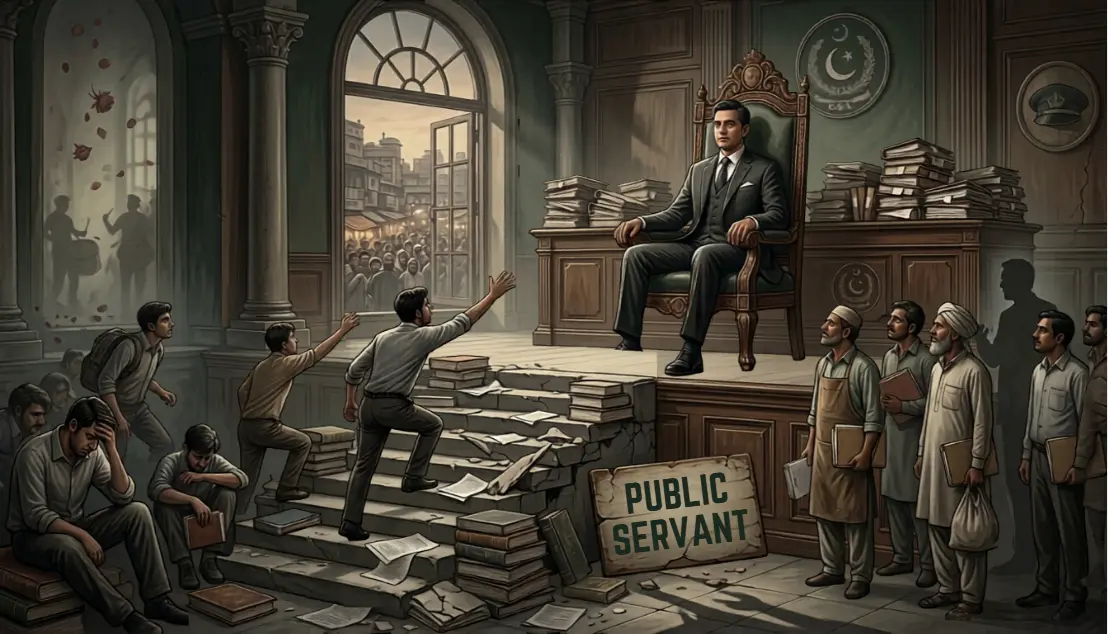
The public, meanwhile, lives in mortal terror. Venture into a bazaar with a CSP officer on his rounds, and you will witness a scene more befitting a film star’s arrival than a public servant’s inspection. Shopkeepers scramble to attention; the poor avert their eyes; mothers hush their children. There is no warmth in this reception, only fear, the reflexive terror of the subject before the sovereign. The civil servant is not perceived as a protector but as a predator, not as a servant but as a master. The very term “public servant” has become an Orwellian inversion: it is the public that serves him, that trembles before him, that pays tribute in dignity and deference.
The tragedy, of course, is that these posts were designed to be the spine of responsible governance. Administration and law enforcement are, in their ideal form, profoundly duty-bound vocations, they demand not arrogance but humility, not mastery but service. Yet the reality is precisely inverted. The youth who burn the midnight oil for years, who sacrifice health and happiness upon the altar of this examination, do not aspire to serve. They aspire to rule. They seek these posts not to lift the downtrodden but to join the ranks of the untouchable, not to build the republic but to inherit its colonial apparatus. The examination has become not a filter for public virtue but a gateway to private empire.
And what of those who fail? They are the invisible casualties of this collective delirium, young men and women whose years of preparation end not in celebration but in silence. They fade like dimming candles, their light extinguished not by lack of talent but by the brutal mathematics of a system that celebrates a handful and discards thousands. For them, there is no drumbeat, no rose petal, no platform welcome. There is only the crushing weight of a society that has told them, in a thousand whispered conversations and a million aspirational advertisements, that life beyond CSS is no life at all. They are the collateral damage of our administrative idolatry, and we owe them more than our pity. We owe them our honesty.
The path forward demands nothing less than a reformation of the Pakistani state, a deliberate, sustained dismantling of the colonial administrative architecture that continues to deform our democracy. Power must be decentralised, accountability institutionalised, and the civil service transformed from a master class into what it was always meant to be: a servant class. Until that day, the drums will continue to thunder, the petals will continue to fall, and the mandarins will continue to rule, not by right, but by the quiet complicity of a society that has forgotten how to imagine itself free.
The views expressed are solely those of the author and do not necessarily reflect the editorial position of South Asia Times.

The writer holds a Ph.D. degree and works as an Assistant Director in the Water Resources Zone of the Punjab Irrigation Department.