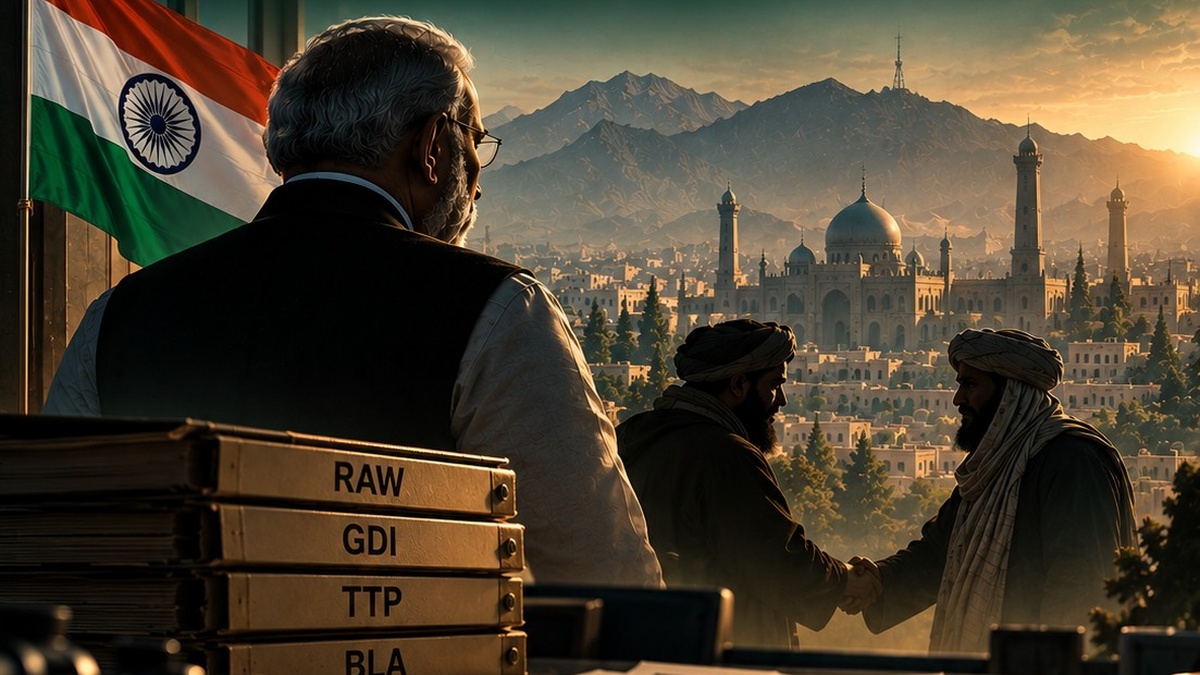
CPEC, Strait of Hormuz, Pakistan Afghanistan Border
In the post–Cold War era, the relevance of geography was widely perceived to have been diminished by globalization. Liberal economic integration, free trade, and digital connectivity fostered the illusion that borders had lost their significance and that distance no longer carried strategic weight. However, contemporary crises, ranging from regional conflicts to maritime disruptions and energy rivalries, have decisively overturned this assumption. Geography has reasserted itself as a fundamental organizing force of the international order. Strategic chokepoints now shape economic stability, contested borders define security architectures, and trade corridors increasingly contour alliances.
From the China–Pakistan Economic Corridor and the Pakistan–Afghanistan border to critical maritime arteries such as the Strait of Hormuz and the Red Sea, geography once again exerts a decisive influence over political outcomes. In this renewed geopolitical landscape, Pakistan’s geographic positioning situates it at the crossroads of intensifying international power competition, which enhances its strategic salience in an increasingly contested world order.
Modern globalization relies on narrow maritime chokepoints through which excessive volumes of commerce flow. These navigation channels establish that economic interdependence has increased dependence on them rather than eliminating it. The ongoing US-Israel war against Iran demonstrates how a bottleneck can destabilize the world economy. A significant share of global LNG shipments and approximately 20-27% of global oil is carried through the Strait of Hormuz. Disruption or control of these narrow sea lines empowers relatively weaker states to impact global market. The closure of this chokepoint by Iran during the war has triggered the largest energy shock since the late 20th century oil crisis and disrupted approximately one fifth of the global oil supply. This demonstrates that global political leverage can be attained through geographic luck. Furthermore, these tensions revealed a structural reality that globalization is dependent of delicate geographic arteries. The entire global economic system tastes the shock when these maritime chokepoints destabilize.
Likewise, if narrow chokepoints illustrate vulnerability, corridors illustrate strategic opportunity. Geopolitical influence these days is increasingly determined by infrastructure routes, unlike traditional geopolitics which largely relied on military bases. China- Pakistan Economic Corridor illustrates that how strategic advantage can be attained through geography. While connecting western China and Arabian Sea through Gwadar, CPEC reshapes regional trade patterns through energy projects, transport networks and industrial zones. These corridors increase political clout through regional connectivity and enhance economic and political engagement throughout Eurasia, turning geography into influence. Additionally, through port, rail and road connectivity, China’s reliance reduces on eastern maritime routes exposed to blockade and sea access is gained by inland region. In essence, whoever builds corridors shapes future political alignments and trade patterns.
It is also these corridors which change the status of a country by restructuring geography into economic functionality. Historically seen as a security frontier, Pakistan is now considered a connectivity hub due to CPEC. Likewise, the strategic dominance of Singapore in global maritime trade, Türkiye’s leverage over Eurasian transit corridors, and Azerbaijan’s rising significance through critical pipeline networks collectively underscore a similar dynamic.
While maritime domains and transit corridors generate political leverage and economic power, borders define the hard realities of security. Instability along these frontiers can undermine connectivity initiatives, illustrating how unresolved geographical disputes constrain economic ambitions. The Pakistan–Afghanistan border exemplifies this dynamic. Stretching approximately 2,640 kilometers, this boundary plays a pivotal role in shaping regional stability while simultaneously posing challenges to economic corridors linking Central Asia. Thus, borders are not merely cartographic demarcations but critical strategic parameters that structure security architectures. In this context, geography retains enduring significance, even as the notion of a rapidly integrating global village continues to gain traction.
Additionally, geographic indispensability remains a central factor in the rise of middle powers such as Pakistan. Situated at the crossroads of the South Asian market, energy-rich West Asia, the resource corridors of Central Asia, and the westward strategic outreach of China, Pakistan’s location endows it with enduring geopolitical relevance. Irrespective of internal political fluctuations, this positioning compels major actors, including China, the United States, and the Gulf states, to sustain engagement. Consequently, Islamabad is afforded the strategic space to pursue a calibrated balancing approach in contemporary geopolitics rather than adhere to rigid alignments. In classical geopolitical thought, Halford Mackinder conceptualized such strategically situated regions as “pivot areas,” where geographic centrality amplifies influence beyond material capabilities.
In essence, the long-held assumption that globalization had rendered geography obsolete now appears historically premature. The enduring tensions surrounding the Strait of Hormuz, instability along the Pakistan–Afghanistan border, and strategic investments in the China–Pakistan Economic Corridor collectively reaffirm a fundamental reality: geography has reasserted itself as a decisive force in global politics. Power no longer flows solely through ideological alignments but increasingly through strategic corridors, maritime chokepoints, and contested borders.
Within this re-geographized global order, Pakistan derives its significance not merely from its foreign policy choices but from its structural positioning. As transnational competition intensifies, geography has unmistakably re-emerged as a strategic instrument. Contemporary international politics, therefore, has neither transcended nor diminished geography; rather, it has rediscovered its salience through energy routes, supply chains, and connectivity politics. Infrastructure, location, and access now define the circulation of power, thereby shaping the contours of global political influence.

Haiqa Shah is an independent Researcher with a keen interest in geopolitics, social issues, and postcolonial thought, exploring the intersections of power, history, and society.