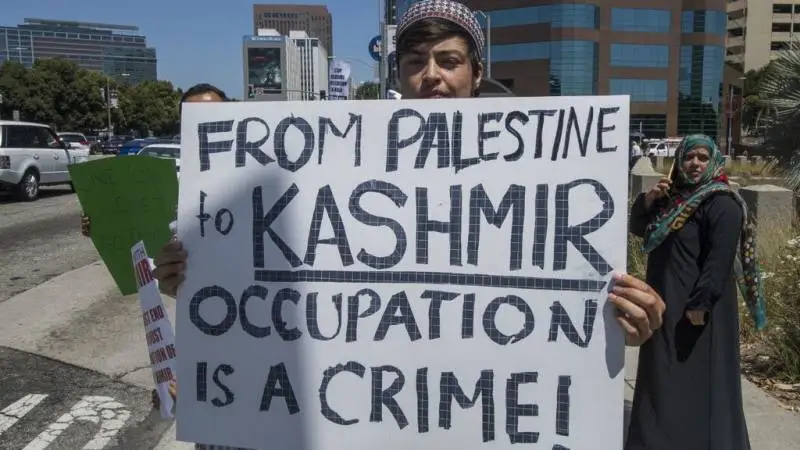
For years, among other tales of global freedom struggles, the tale of Palestinian and Kashmiri freedom struggles stand as unique and compelling, each narrating its story of resistance and resilience.
Both struggles, though distinct in their histories and demographics, and irrespective of the apparent differences in their specific objectives, the core of their struggle remains the same –-to fight oppression and occupation.
In every freedom struggle, anti-colonial movement, or fight against oppression, their varied cultural expressions and support movements are adorned with visuals and literary activism. As we delve into the distinct cultural dynamics of the Palestinian and Kashmiri freedom struggles, we aim to reflect on why Palestine has garnered more international support than Kashmir.
Cultural Expressions of the Palestinian Freedom Struggle
The Israel-Palestine conflict has deep historical roots, with the Balfour Declaration in 1917 marking a significant starting point. Among many important events that shaped the Palestinian struggle movement, including the Arab Revolt and the UN partition plan in 1947, the core Palestinian struggle is rooted in the displacement of Palestinians following the establishment of the state of Israel in 1948. The Nakba, or “catastrophe,” resulted in a significant refugee crisis, shaping a collective Palestinian identity centered around the right of return.
However, other than international awareness, the Palestinian cause failed to accomplish its objective so far. There is no doubt that the Palestinian cause has historically gathered widespread international support, partly due to the global attention on the Israeli-Palestinian conflict and the fact that the Palestinian Liberation Organization (PLO) played a crucial role in internationalizing the struggle.
Notably, the Palestinian diaspora and refugees have played a crucial role in creating global solidarity for the Palestinian cause through visual and literary activism. For the past few years, this has increased the media visibility of the Palestinian struggle and has often been in the international media spotlight. Issues like Israeli occupation, apartheid, settlements, and human rights violations have gained the attention of human rights organizations, independent journalists, and scholars. This increased visibility has contributed to a sympathetic global sentiment towards the Palestinian struggle.
Cultural Expressions of the Kashmiri Freedom Struggles
Kashmir issues stem from the complex territorial dispute involving multiple stakeholders, including India, Pakistan, and China, with differing territorial claims. Moreover, over the years, Kashmir has become a geopolitical flashpoint, and its importance has led to a complex web of alliances and interests. It is not a hidden fact that many global powers, including many Muslim countries and Arab states, remain hesitant to support the Kashmiri cause due to their strategic relationships with India.
Despite the widespread settlement of the Kashmiri diaspora in various countries, the Kashmiri struggle for freedom has not garnered the same level of global attention and support as the Palestinian cause. It is also one of the significant reasons that Kashmir has not consistently received the same level of global media attention. Moreover, one cannot deny the fact that Indian-occupied Kashmir has restricted access to foreign media and independent journalists, contributing to limited/partial reporting- creating a lack of awareness about the Kashmiri freedom struggle.
Contrasting Patterns of the Expressions of the Palestinian and Kashmiri Freedom Struggles
So, there is a question of freedom struggles, fighting oppression, why and how Palestine can gather more support than Kashmir.
An important aspect is that the Palestinian struggle has two parties to the conflict- and the Palestinian side, either liberal or conservative, echoes the same objective. The narrative is straightforward about occupation, displacement, and denial of fundamental rights, and many calls for a two-state solution. Various international actors have endorsed this, providing a clear framework for addressing the conflict.
On the other hand, the Kashmir struggle failed to present a unified narrative for an international audience due to its complex dynamics and many conflict parties. The complexity of the dispute has made it challenging for Kashmir to present a unified narrative for international understanding. Even the Indian Occupied Kashmir failed to bring a unified narrative to the global stage.
Another important aspect is the presence of pro-Palestinian activism, which has been strong globally, with various solidarity movements advocating for Palestinian rights. Civil society organizations and activists have played a crucial role in raising awareness and mobilizing support, especially in the West. Language has played an essential role here. Palestinian diaspora and refugees settled across the continents have used Arabic, English, and the local language to create awareness through prose and poetry. One can see, in the Palestinian case, suppression and human rights issues are more represented rather than religion, which has taken its case beyond borders.
Kashmir’s struggle, unfortunately, failed to tell its story on the global stage. In my opinion, the Kashmiri diaspora was unable to own it due to many reasons, including Indian pressure lobbying and ever-growing demand to prove loyalty to India.
Conclusion
While both Palestinian and Kashmiri struggles seek freedom from oppression, the local and international dynamics of each conflict differ significantly. The plight of Palestinians, dispossessed of their land and facing violence, imprisonment, and demolition of infrastructure by Israel, parallels the struggles of Kashmiris. In Kashmir, tens of thousands have lost their lives, thousands have disappeared, and hundreds of women have been subjected to rape by the Indian forces.
The Palestinian cause has captured global attention and support more effectively, partly due to historical narratives, geopolitical factors, and international activism. The Kashmiri struggle faces additional complexities that hinder the same level of international backing. Maybe it is time to redesign the Kashmiri freedom struggle on a similar pattern-fiercely projecting human rights concerns using varied media platforms and using language as a source to create awareness across borders.
Besides the projection, the outcome of both movements is still the same as reality on the ground, which has not changed- both are still the most protracted unresolved issues on the United Security Council agenda. They both need our consistent efforts and conscious attention, especially regarding human rights concerns and struggles against oppression.
The views expressed in this article are the author’s own. They do not necessarily reflect the editorial policy of the South Asia Times.

Mariam Shah, a PhD Scholar at the National Defense University, specializes in conflict analysis, terrorism, and military psychology, employing multidisciplinary approaches to research complex societal issues.