Outrage in Tamil Nadu over Cases of Custodial Death

Outrage in Tamil Nadu over Cases of Custodial Death

The sad demise of a father and son in police custody in Santhakulam, Thoothukudi district, Tamil Nadu, has left many shocked. Mr. P. Jayaraj, 58, and his son Mr. J. Bennix, 31, were detained by the police last Friday (June 19) for allegedly defying lockdown measures and keeping their shop open after 8 pm. Mr. Jayaraj was summoned to the station and detained. When his son, Mr. Bennix went to inquire about his father, the police detained him too.

The duo was kept at the sub-jail of Kovilpatti for two days. The sub-jail is around 100km away from their residence. Relatives allege they were beaten brutally by the police while they were retained.

Eyewitnesses, family, and friends, saw the two men when they were brought to the government hospital for a general check-up. This was in the morning on June 20th, before a magistrate approved an extension of their police custody.

“Their legs and hands were swollen, and Bennix was bleeding from the buttocks. (Jayaraj) had bad injuries in his knees. The police even asked for new lungis (sarongs) because the ones they wore were bloody,” said Mr. S. Rajaram, a lawyer, and Mr. Bennix’s friend.

A police complaint, however, alleges that Mr. Bennix and Mr. Jayaraj “violated the lockdown, and picked a fight with and assaulted the police.” It also states that they “rolled on the ground and injured themselves.”

The father-son duo died in the hospital between the evening of the 22nd and the morning of the 23rd of June. The family of the deceased is accusing the police of sexual assault and custodial murder.

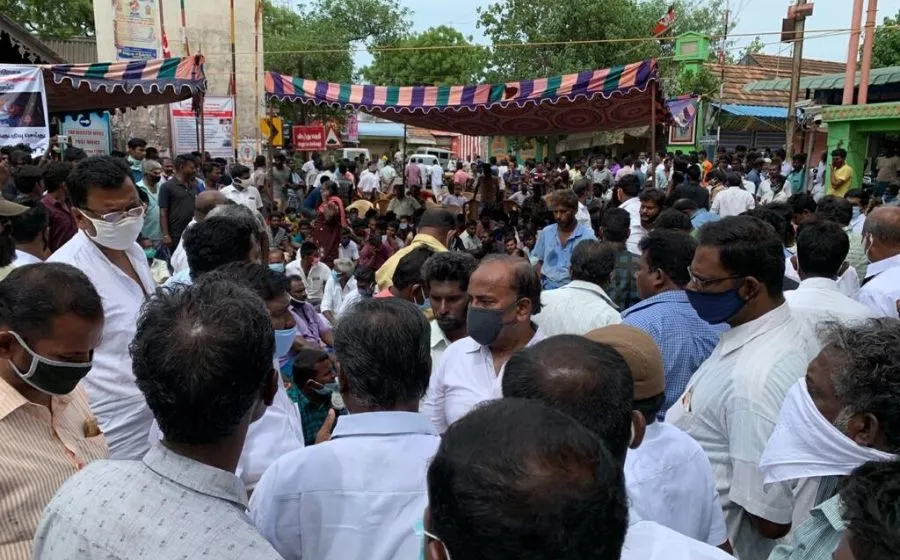
Angry traders in Santhakulam closed their shops on June 24 and staged protests.  There are rising demands for an inquiry against the police officials involved. Soon after the strike, two sub-inspectors were suspended and 12 other policemen transferred.

The Madurai bench of the Madras High Court has demanded a judicial magistrate’s inquiry report. Post-mortems took place on Thursday and were recorded. The deaths have sparked outrage across Tamil Nadu. Film director Karthik Subbaraj, actors Jayam Ravi and Jiiva, and singer Suchitra took to twitter demanding urgent action against the police officials.

Mr. Jayaraj is survived by his wife and three daughters. Chief Minister, E. Palaniswami announced a donation of 4 million rupees to them and a government job for a family member.

Shocking data from India’s National Human Rights Commission show nearly 1,400 people died in police custody in the last decade. A 2016 Human Rights Watch report said that nearly 600 people died in police custody, between 2010 and 2015, but no police officer was ever convicted.

News Desk

Your trusted source for insightful journalism. Stay informed with our compelling coverage of global affairs, business, technology, and more.
Recent

Broken Promises: The Taliban’s Betrayal of Global Commitments

Broken Promises: The Taliban’s Betrayal of Global Commitments

Nearly three years after seizing power, the Taliban’s systematic violation of their international commitments under the 2020 Doha Accord has transformed Afghanistan into a sanctuary for terrorism, entrenched an autocratic regime, and institutionalized gender apartheid. Beyond moral failure, this deceit poses a grave threat to regional stability, international counterterrorism efforts, and the credibility of global diplomacy. Holding the regime accountable is now a strategic necessity, not a choice.

Read More »
Do You Remember 6/11/ 1947?: A Forgotten Jammu Genocide and the Continuing Erasure of Kashmiriyat

Do You Remember 6/11/ 1947?: A Forgotten Jammu Genocide and the Continuing Erasure of Kashmiriyat

On November 6, 1947, one of South Asia’s earliest genocides unfolded in Jammu, where hundreds of thousands of Muslims were massacred or forced to flee. Yet, unlike other global tragedies, this atrocity remains buried in silence. The Jammu Genocide not only reshaped the region’s demography but laid the foundation for India’s ongoing campaign of identity erasure in Kashmir. From demographic engineering to cultural censorship, the spirit of Kashmiriyat continues to face systematic annihilation.

Read More »
India’s Climate Policy after COP28: Net Zero 2070 — A Fair Promise or a Risky Postponement?

India’s Climate Policy after COP28: Net Zero 2070 — A Fair Promise or a Risky Postponement?

India’s Net Zero 2070 target reflects a delicate balance between development equity and climate urgency. While progress in renewables, green finance, and adaptation is visible, the absence of clear interim milestones risks turning ambition into delay. The real challenge lies in translating a distant horizon into measurable, near-term climate action before 2030.

Read More »
The Tehreek-e-Hijrat of 1920 and Its Parallels with Contemporary Refugee Politics

The Tehreek-e-Hijrat of 1920 and Its Parallels with Contemporary Refugee Politics

The Tehreek-e-Hijrat of 1920 saw thousands of Indian Muslims migrate to Afghanistan, only to be turned away when Kabul could no longer cope. A century later, Afghan officials criticise Pakistan’s refugee policies while ignoring their own historical refusal to host Muslim migrants. The parallel reveals not just irony, but the enduring challenge of compassion, capacity, and collective responsibility.

Read More »
Playing the Victim: How the Taliban Endorse and Amplify Online Propaganda Against Pakistan

Playing the Victim: How the Taliban Endorse and Amplify Online Propaganda Against Pakistan

Following the October 2025 border clashes, the Taliban have shifted their battlefield online, using propaganda, selective history, and digital disinformation to paint Pakistan as the aggressor. Through controlled media releases, colonial-era references, and victimhood narratives, Kabul seeks to manipulate regional perception and deflect blame for its own failures.

Read More »