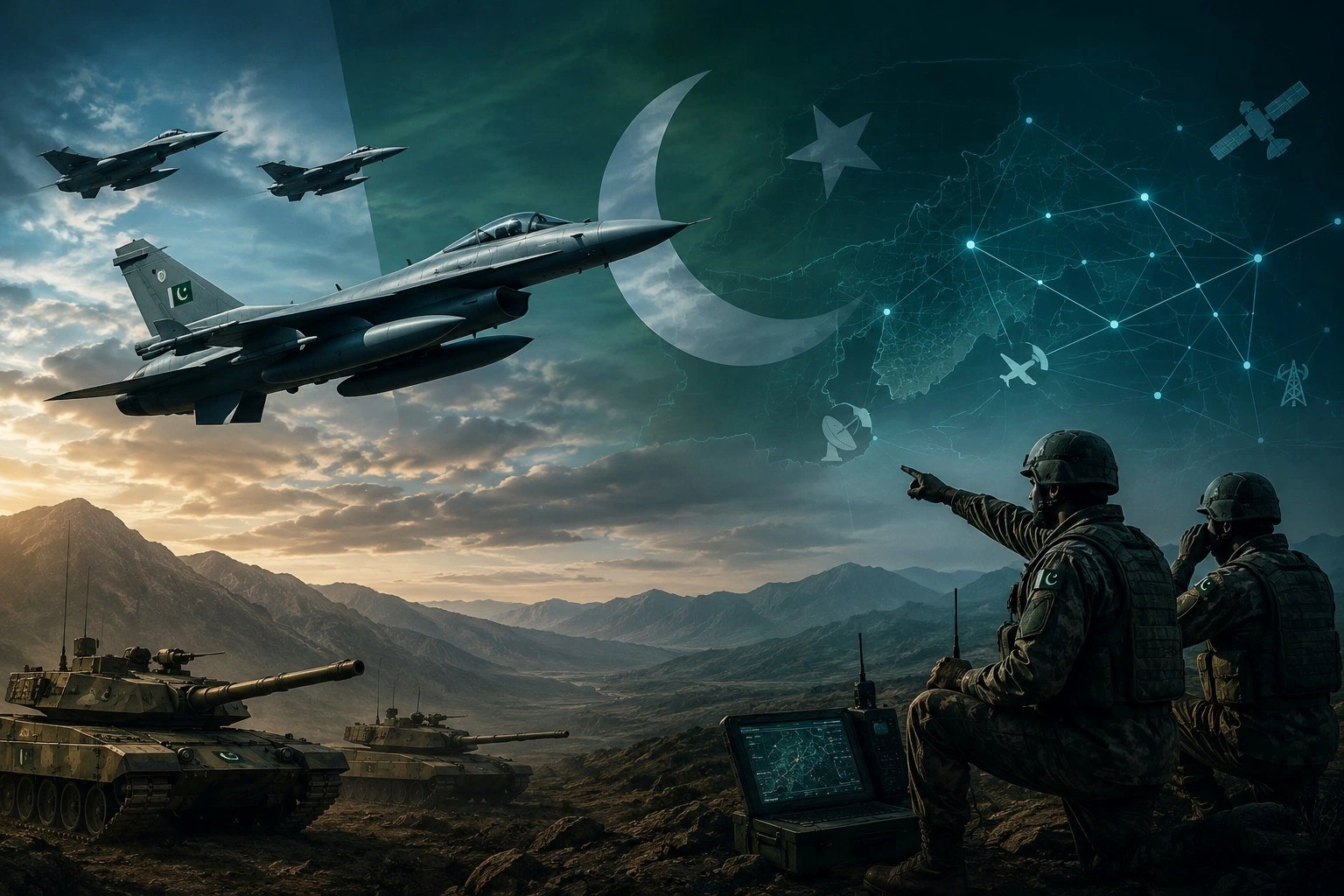
Modern war requires disciplined forces that operate to create synergies. The subject has been extensively discussed and debated by academics and military strategists worldwide. Dwight D. Eisenhower, a former President of the US, is one such strategist who asserted that, “Separate ground, sea, and air warfare is gone forever. If ever again we should be involved in war, we will fight it in all elements, with all services, as one single concentrated effort.” It is against this backdrop that the world witnessed an impressive exhibition of interoperability between the Pakistan Air Force (PAF) and the Pakistan Army during Marka-e-Haq in May 2025.
Interoperability among the Pakistan Armed Forces has existed for a long time. The 1965 and 1971 Pakistan-India wars provided ample examples in which different services of Pakistan’s Armed Forces, particularly the PAF and Pakistan Army, operated in synergy to achieve joint objectives. However, this interoperability was not institutionalised until 1976, when Pakistan established the Joint Chiefs of Staff Committee (JCSC). It was essentially an administrative body of high-ranking uniformed military leaders, whose main role was to advise the government and to streamline interoperability among the sister services.
In addition to the JCSC, interoperability within the forces has also been reinforced through routine tri-service exercises and cross-service training exposure for officers across different services. Together, these efforts have established a functional framework for interoperability among the services, as demonstrated prominently during Marka-e-Haq in May 2025, when both the PAF and the Pakistan Army executed this joint operational paradigm.
Marka-e-Haq was the first instance in which the PAF and Pakistan Army operated under a partially shared situational awareness construct, facilitated by temporary liaison nodes and a parallel data-sharing mechanism established under Joint oversight. The first demonstration of the interoperability between the two services emerged on 8 May 2025, when India resorted to drone warfare after suffering a major defeat from the PAF. On the night of 6-7 May, the PAF, under the leadership of the Air Chief Marshal Zaheer Ahmed Baber Sidhu, shot down 7 IAF fighter jets and a Heron UAV.
After the fiasco of losing aircraft, the IAF grounded its fighter jets. Therefore, India launched a salvo of drones towards Pakistan on the morning of 8 May, sending over 100 Israeli Harops. However, nearly all of these intruding drones were intercepted and shot down through joint efforts by the PAF and the Pakistan Army. The PAF Air Defence Command worked in coordination with the Army Defence Units to engage and disable the Indian UAVs. The former used its cyber command and space assets together to counter the intruding UAVs. Whereas the army jointly contributed to the elimination of the UAVs entering Pakistan’s airspace.
Having failed in drone warfare, the Indians became increasingly frustrated, which led them to commit a miscalculation of the decade: launching an attack on PAF airbases with Brahmos missiles during the night of 9 and 10 May. In the wake of these attacks, India crossed the red line and evoked the full weight of Pakistan’s retaliation in the shape of Bunyan-ul-Marsoos, when the PAF, in close coordination with the Pakistan Army, launched retaliatory strikes in a stunning display of interoperability.
This retaliation concurrently employed PAF air assets alongside Fatah-1 and Fatah-2 short-range ballistic missiles. These coordinated strikes targeted at least eighteen Indian air bases, a command and control (C2) centre, two BrahMos storage facilities, and two S-400 air defence batteries, along with other military targets such as many field supply depots, brigade headquarters, intelligence centres etc. The intensity of these coordinated retaliatory strikes was such that it forced India to seek a ceasefire via the US, which came on 10 May 2025, and brought an end to what is regarded now as the ‘Four-Day War’.
India, however, is unlikely to remain idle after witnessing such interoperability from Pakistan. They have already drawn lessons from the war, as evidenced by the recently unveiled Defence Forces Vision 2047, under which India has ramped up its efforts to streamline joint operations through the establishment of integrated theatre commands and greater inter-service coordination.
However, to India’s dismay, Pakistan has already taken proactive steps to further strengthen interoperability among its armed forces. The establishment of the office of the Chief of Defence Forces in December 2025 was a key step in this regard, aimed at introducing a unified command structure across the armed services. Moreover, there has been a strong willingness on the part of all three services to engage more deeply in joint exercises and command integration discussions after the war, which will further strengthen Pakistan’s interoperability framework.
In conclusion, Marka-e-Haq not only showcased coordination between the PAF and the Pakistan Army but also reflected the maturation of Pakistan’s joint warfighting ethos under real combat scenarios. More importantly, the experience has not been treated as a one-off success; rather, its lessons have been internalised, as a result of which Pakistan today seems better positioned to anticipate and pre-empt any potential misadventure by the adversary.
Azhar Zeeshan is a Researcher at the Centre for Aerospace and Security Studies (CASS), Lahore. He can be reached at [email protected]
Azhar Zeeshan is a researcher at the Centre for Aerospace and Security Studies (CASS) Lahore, Pakistan. He can be reached at [email protected]