Cyclone Asna moving away from Sindh coast, PMD says

Cyclone Asna moves away from Sindh, causing rough seas, heavy rain, and potential coastal flooding in Karachi.

KARACHI: On Saturday, the National Disaster Management Authority (NDMA) reported that Cyclone Asna now stands about 230 kilometres from Karachi. It is also 180 kilometres from Ormara and 300 kilometres from Gwadar.

As the cyclone moves away from Sindh’s coastal belt, it will track further west-southwest towards the coast. It will then proceed towards Oman before dissipating at sea without making landfall.

During this time, the meteorological department expects sea conditions to remain rough. Winds are likely to blow at 60 to 70 km/hour in the metropolis.

The authority advised fishermen in Sindh not to venture into the sea today. Fishermen in Balochistan must avoid going into the deep sea until tomorrow.

In the wake of the cyclone, the NDMA’s National Emergencies Operation Centre (NEOC) alerted residents to potential coastal flooding along the coast of Sindh. It also warned of possible pluvial flooding or inundation in low-lying areas.

Meanwhile, the NDMA also said that the city might experience strong windstorms. These windstorms could pose a threat to crops, billboards, electrical poles, solar panels, and hoardings.

Additionally, thunderstorms will increase the risk of lightning strikes, and disruptions may occur to electricity and other utility services.

Authorities advise the public to avoid visiting the seaside and beach areas due to potential hazards. They also urge residents to stay vigilant and follow local guidance.

NDMA has issued instructions to all relevant departments to take necessary precautions to mitigate the possible effects of flooding and extreme weather.

Rainfall in Karachi During Early Hours

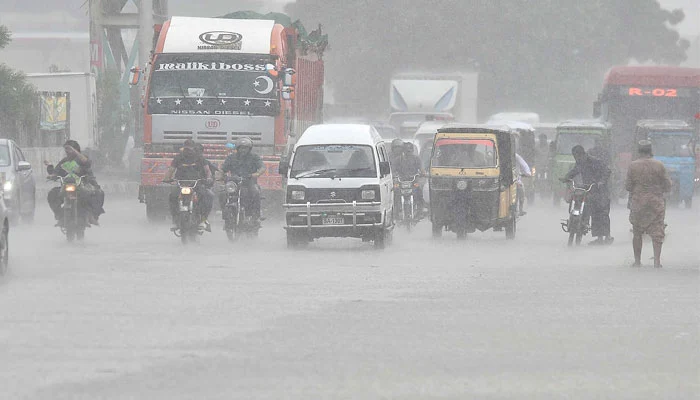
The traffic police in Karachi advised drivers to drive at a slower speed and at a distance from other vehicles as the city received rain throughout last night under the influence of cyclone Asna.

Earlier today, rain drenched Karachi’s II Chundrigar Road, Saddar, Burns Road, and surrounding areas. Heavy rain also hit Defense View, Mehmoodabad, Akhtar Colony, Defence, Korangi, Qayyumabad, and Sharea Faisal.

Additionally, Nursery, PECHS, Tariq Road, Clifton, Kharadar, Tower, Boat Basin, Garden, Exhibition, and MA Jinnah Road also received rainfall Saturday morning.

Drivers must avoid braking suddenly as it may potentially lead to a disaster, owing to the slippery roads as a result of wet conditions, traffic police said.

Karachi’s Rizvia, Gulbahar, Nazimabad, Model Colony, Airport, Malir, Shah Faisal Colony, Landhi, Guru Mandir, Federal B Area, Ayesha Manzil, Karimabad, Liaquatabad, Teen Hatti, and other areas also received rainfall.

This news is sourced from The News and is intended for informational purposes only.

News Desk

Your trusted source for insightful journalism. Stay informed with our compelling coverage of global affairs, business, technology, and more.


Recent

Centralized Power and the Core–Periphery Divide in Afghanistan

Centralized Power and the Core–Periphery Divide in Afghanistan

The Islamic Emirate of Afghanistan’s return in 2021 brought rapid consolidation of power, but also the revival of a historical flaw. By concentrating authority in the hands of southern Pashtun elites, the Taliban have recreated the core–periphery divide that has destabilized every Afghan regime since the 19th century. This hyper-centralization, rooted in ethnic exclusivity and Kandahar dominance, risks a repeat of past collapses as non-Pashtun regions turn toward functional autonomy.

Read More »
Broken Promises: The Taliban’s Betrayal of Global Commitments

Broken Promises: The Taliban’s Betrayal of Global Commitments

Nearly three years after seizing power, the Taliban’s systematic violation of their international commitments under the 2020 Doha Accord has transformed Afghanistan into a sanctuary for terrorism, entrenched an autocratic regime, and institutionalized gender apartheid. Beyond moral failure, this deceit poses a grave threat to regional stability, international counterterrorism efforts, and the credibility of global diplomacy. Holding the regime accountable is now a strategic necessity, not a choice.

Read More »
Do You Remember 6/11/ 1947?: A Forgotten Jammu Genocide and the Continuing Erasure of Kashmiriyat

Do You Remember 6/11/ 1947?: A Forgotten Jammu Genocide and the Continuing Erasure of Kashmiriyat

On November 6, 1947, one of South Asia’s earliest genocides unfolded in Jammu, where hundreds of thousands of Muslims were massacred or forced to flee. Yet, unlike other global tragedies, this atrocity remains buried in silence. The Jammu Genocide not only reshaped the region’s demography but laid the foundation for India’s ongoing campaign of identity erasure in Kashmir. From demographic engineering to cultural censorship, the spirit of Kashmiriyat continues to face systematic annihilation.

Read More »
India’s Climate Policy after COP28: Net Zero 2070 — A Fair Promise or a Risky Postponement?

India’s Climate Policy after COP28: Net Zero 2070 — A Fair Promise or a Risky Postponement?

India’s Net Zero 2070 target reflects a delicate balance between development equity and climate urgency. While progress in renewables, green finance, and adaptation is visible, the absence of clear interim milestones risks turning ambition into delay. The real challenge lies in translating a distant horizon into measurable, near-term climate action before 2030.

Read More »
The Tehreek-e-Hijrat of 1920 and Its Parallels with Contemporary Refugee Politics

The Tehreek-e-Hijrat of 1920 and Its Parallels with Contemporary Refugee Politics

The Tehreek-e-Hijrat of 1920 saw thousands of Indian Muslims migrate to Afghanistan, only to be turned away when Kabul could no longer cope. A century later, Afghan officials criticise Pakistan’s refugee policies while ignoring their own historical refusal to host Muslim migrants. The parallel reveals not just irony, but the enduring challenge of compassion, capacity, and collective responsibility.

Read More »