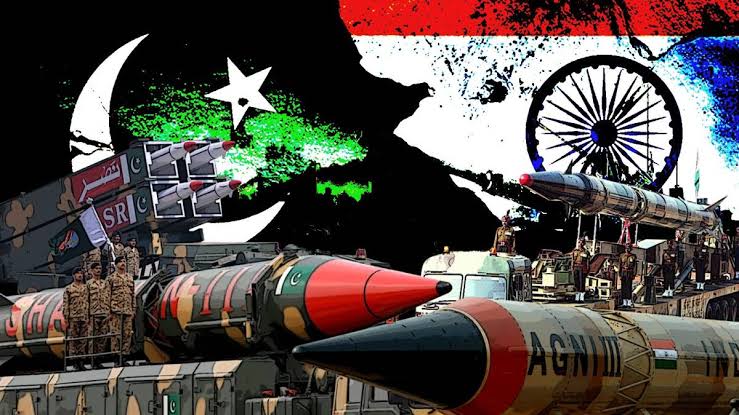
Analyzing India’s clandestine May 2026 Agni-VI/Advanced Agni MIRV test, the post-May 2025 shift toward offensive postures, and the regional implications for deterrence.
Something unusual happened over the Bay of Bengal in early May 2026. A large missile was launched from the Integrated Test Range at Abdul Kalam Island off Odisha’s coast and arced silently into the Indian Ocean. However, New Delhi did not make any announcements regarding designation or range specifications. The Ministry of Defence, typically quick to advertise its ballistic successes, offered only a terse line about an “Advanced Agni missile with MIRV system.” With the Agni-V test touted by PM Modi as a personal triumph, there was no such political optic on the recent test. Nevertheless, it raises several questions in the strategic circles, concerning India’s increasingly offensive missile posture and its implications for South Asian strategic stability.
Open-source telemetry analysis placed the May 2026 test corridor beyond 3,500 kilometres, a profile suggestive of a longer-range airframe than Agni-V. Several defence analysts have cautiously identified it as a probable Agni-VI technology demonstrator. DRDO chief Samir Kamat recently stated that India possesses the technological readiness for an Agni-VI, with a range of around 12,000 km, and is only awaiting government sanction. The May 2026 test’s anonymity suggests one of two things: either the flight did not fully meet its objectives or the government is managing the political optics of an ICBM programme it has not yet officially sanctioned. However, neither explanation is particularly reassuring for a region already sitting on a volatile deterrence architecture.
India’s official rationale for its MIRV programme positions China’s expanding missile arsenal as the primary justification. India argues that Beijing’s nuclear arsenal is expanding from an estimated 600 warheads to 1,500 by 2035, the PLA Rocket Force operates the DF-41 at ranges between 12,000 and 15,000 km and with confirmed MIRV capability, and China’s hardened silo expansion across Gansu and Xinjiang represents a qualitative shift that India’s earlier generation of Agni variants cannot possibly address.
This makes the case for a multi-warhead, longer-range deterrent a logical response to an adversary that has structurally outpaced India’s missile and nuclear modernisation. Nevertheless, there still exists a significant operational gap and capability asymmetry between India and China. China maintains a highly diversified deterrence architecture, with road-mobile launchers spread across vast distances, a steadily expanding fleet of ballistic missile submarines in the South China Sea, and a force sufficiently redundant that no plausible Indian second-strike can neutralise.
This makes it imperative to question whether the China narrative fully explains the acceleration. The timing of India’s MIRV testing surge, multiple flight validations between March 2024 and May 2026, maps onto a doctrinal rethinking that has less to do with the eastern than the western adversary. The May 2025 war acted as a critical enabler in this regard. After suffering a humiliating defeat at the hands of the Pakistan Air Force, India has accelerated missile development for strategic adaptation aimed at restoring coercive leverage. There is an increased Indian emphasis on standoff weapons: systems that can deliver strategic effect from outside the defended envelope.
Indian analysts also argue that the Agni MIRV-capable series is an action-reaction response to Pakistan’s Ababeel MIRV programme. However, it is worth noting that ISPR’s press release on Ababeel’s first test explicitly stated that the system was “aimed at ensuring survivability of Pakistan’s ballistic missiles in the growing regional Ballistic Missile Defence (BMD) environment.” As Pakistan does not have a BMD architecture, it makes Ababeel’s logic actually defensive, both in statement and structure. At Pakistan’s end, it highlights a responsible and stabilising response to India’s BMD and missile modernisation.
India, on the other hand, has a two-tier BMD architecture, with its deployment of S-400 Triumf batteries, two of which are in the Punjab sector facing Pakistani trajectories, comprising both exo-atmospheric and endo-atmospheric intercept layers. Together with other developments like the new SSBN commissioning and the SIPRI assessment of 2026, which highlights 12 deployed Indian nuclear weapons for the first time, MIRV-capable missiles appear less as a deterrent and more as prestige-driven.
Such an aggressive capability expansion poses serious consequences for strategic stability in South Asia. In any nuclear dyad, the stability of the nuclear deterrence depends on both sides’ confidence in the survivability of their retaliatory forces and the mutual belief that there is no force that could be enough to make a first strike rational. However, the MIRV accuracy against multiple targets, the new conventional precision-strike depth from standoff platforms and India’s two-tier BMD investment aim to change the equation.
Overall, South Asia’s MIRV era is not simply a result of technological maturation but India’s strengthened offensive posture post-May 2025. The posture has a profound impact on escalation thresholds and weakens the already delicate deterrence dynamic between the two nuclear powers. Any Pakistani counter-response would be to ensure the protection of its sovereignty and prevent India from destabilising the region.