Iran is not a victim of this war. It is a co-author of it.
There is a version of events, widely circulated and emotionally coherent, in which Iran is the wronged party. A sovereign nation, impoverished by sanctions, surrounded by American military infrastructure, finally attacked by a superpower and its regional client after years of provocation. In this version, the missiles Iran is now firing across the Gulf are the desperate response of a cornered state. The sympathies it commands are not entirely unearned.
But sympathy and accuracy are not the same thing. And the version of events that begins on February 28, 2026, when US and Israeli strikes killed Ali Khamenei and opened the current war, is a version that has been carefully edited. The inconvenient chapters come earlier. They come, in fact, from almost every decade since 1979. What those chapters contain is not the story of a defensive power protecting its revolution. They contain the story of a state that spent forty years building a regional architecture designed to destabilize its neighbors, arm their internal enemies, and coerce them into strategic submission. Iran did not stumble into this war. It constructed, methodically and deliberately, the conditions that made it possible.
The Architecture of Resistance
Iran’s foreign policy since the revolution has rested on a single structural idea: that the Islamic Republic could not be secure unless it held leverage over the states around it. This is not a uniquely Iranian instinct. Every major regional power pursues some version of forward deterrence. What distinguished Iran’s version was its chosen instrument: non-state armed groups, deployed across multiple countries, funded and trained by the Islamic Revolutionary Guard Corps, and answerable ultimately to Tehran.
The network Iran built over four decades included Hezbollah in Lebanon, Hamas and Palestinian Islamic Jihad in Gaza, the Houthis in Yemen, various militias across Iraq, and proxy forces embedded throughout Syria. Iran describes these organizations as national liberation movements. Its neighbors, whose territory these groups operate in and whose populations they periodically threaten, have a different vocabulary.
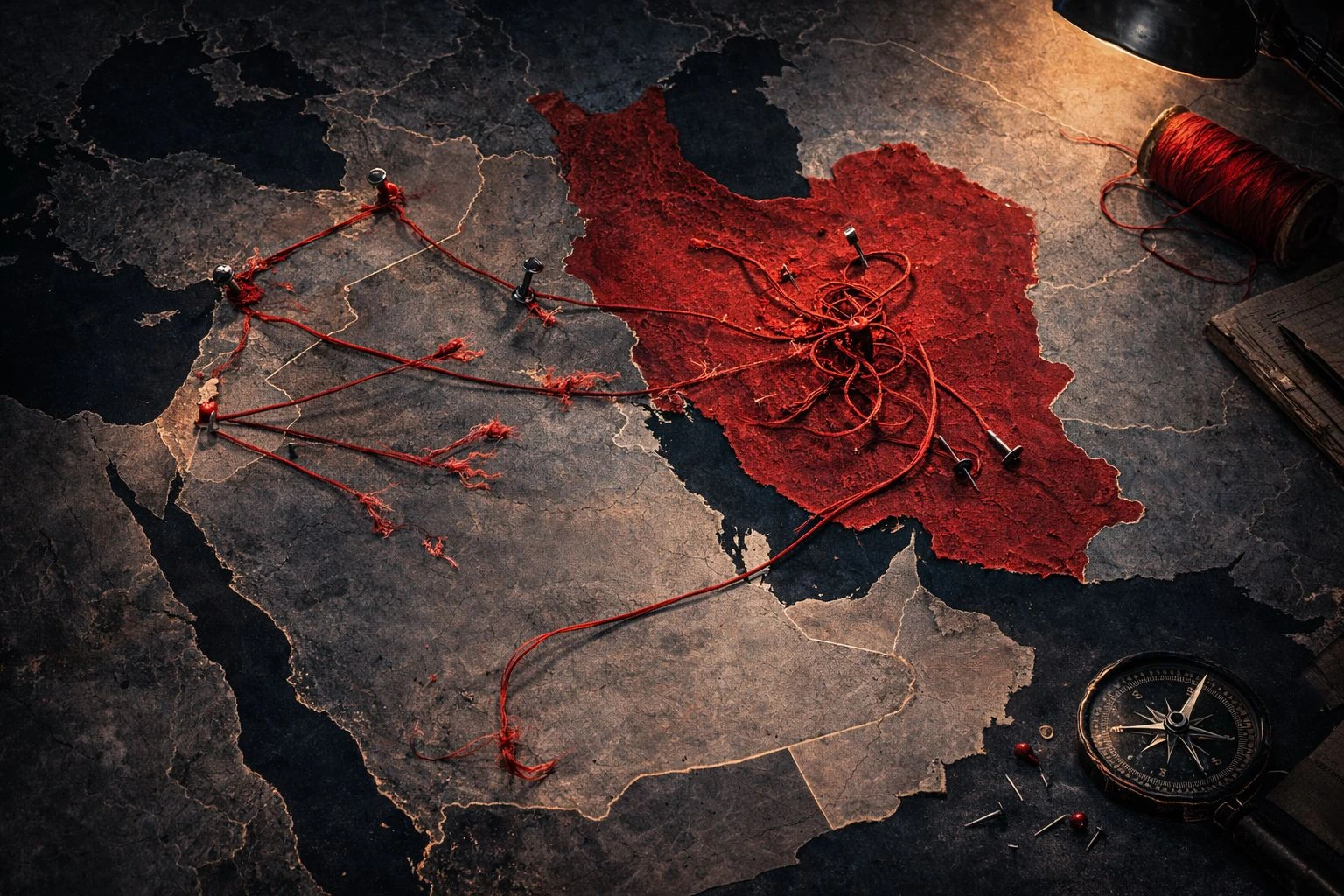
The practical effect was the construction of what Tehran called the Axis of Resistance: a constellation of armed organizations that could be activated, restrained, or redirected according to Iranian strategic priorities. The Houthis disrupted Red Sea shipping. Hezbollah maintained a deterrent posture against Israel from Lebanese territory. Iraqi militias provided Iran with pressure points against American forces and the Baghdad government simultaneously. The system was elegant. It extended Iranian influence without exposing Iranian soldiers. It created costs for enemies without requiring conventional military confrontation.
This was not improvised. In 1995, the IRGC convened a conference in Beirut specifically to provide training and weapons to organizations including the Islamic Front for the Liberation of Bahrain, with the stated purpose of destabilizing Gulf states and replacing their governments with Iran-aligned regimes. Bahrain, which Iran has now struck with over three hundred missiles and drones in a fortnight, was a target of Iranian subversion for thirty years before the first American base there became a justification.
The Neighbourhood it Made
The Gulf states that Iran is currently attacking for hosting American military assets did not make that choice in a vacuum. The United Arab Emirates, Saudi Arabia, Qatar, Kuwait, Bahrain and Jordan each arrived at the decision to formalize American security arrangements through a process shaped substantially by Iranian behaviour over decades.
This is the argument Iran’s apologists consistently elide. They present the American military presence in the Gulf as the original aggression, the provocation that explains and perhaps justifies Iranian hostility. But the sequencing is inverted. The Gulf states did not welcome American forces because they found American power aesthetically appealing. They did so because the alternative, managing their own security against a neighbour that was actively funding organizations designed to overthrow their governments, was a calculation they had already made and found unfavourable.
Iran’s new supreme leader Mojtaba Khamenei, appointed after his father’s assassination, has stated that attacks on Gulf states hosting American forces will continue until those bases are closed. The logic contains its own circularity. The bases exist because of Iran. Iran is attacking the states that host them. The states are being told to expel the forces that protect them from Iran. They are then expected to feel secure.
As of this week, Bahrain has intercepted over three hundred missiles and drones. Jordan’s armed forces intercepted nearly eighty projectiles in a single week, with debris falling across most of its governorates. The UAE reported strikes on Dubai International Airport and civilian hotels. Saudi Arabia has intercepted Iranian drones over its eastern region on multiple consecutive days.
None of these are US military assets. They are civilian infrastructure: hotels, airports, power lines, residential areas. The claim that Iran is exclusively targeting American interests dissolves against the evidence of what Iran is actually hitting.
The Pakistan Exception
There is one country in Iran’s neighbourhood whose experience of Iranian foreign policy has been both more intimate and more systematically ignored by Western commentary: Pakistan.
Pakistan and Iran share a long border, a nominally Islamic identity, a complex history of cooperation and friction, and a relationship that has been quietly corroding for years beneath the surface of diplomatic pleasantries. The corrosion has a specific shape.
When Pakistan’s then-Foreign Minister Shah Mahmood Qureshi directly accused Iran of hosting training and logistical camps for anti-Pakistan militant organizations, it represented the first time an official of that seniority had publicly broken from Islamabad’s longstanding diplomatic caution on the subject. That caution had always been deliberate. Pakistan, managing its own complex internal security environment and conscious of sectarian sensitivities, had consistently chosen restraint over confrontation with Tehran. But the facts had been accumulating regardless.
The Kulbushan Yadav case crystallizes the issue. Yadav, a serving Indian Navy commander operating under a Muslim alias, established a commercial cover in the Iranian port of Chabahar in 2003 and ran intelligence and subversion operations into Pakistan from there for over a decade, before his arrest in Balochistan in 2016. His operations, by his own account during interrogation, included funding Baloch separatists, planning attacks on Karachi and Gwadar, and orchestrating sectarian violence across Sindh.
Even as the full scope of this network became apparent, Pakistani authorities were careful not to directly indict Iran, because Chabahar was Yadav’s operational base. Pakistan’s restraint in this period was not diplomatic naivety. It was a strategic choice made by a state that understood the cost of escalation and had the confidence to absorb provocation without losing composure.
Iran’s relationship with India, its willingness to host Indian intelligence infrastructure pointed at a Muslim-majority neighbour, its tolerance of armed groups conducting cross-border operations into Pakistan, represents a chapter in Iranian regional behaviour that sits awkwardly with the “resistance against imperialism” branding. It is the behaviour of a state pursuing strategic interests, using the language of principle as cover. Pakistan noticed. It said relatively little publicly. It continued managing its own affairs with the strategic discipline of a state that knows its own capabilities and does not need external validation.
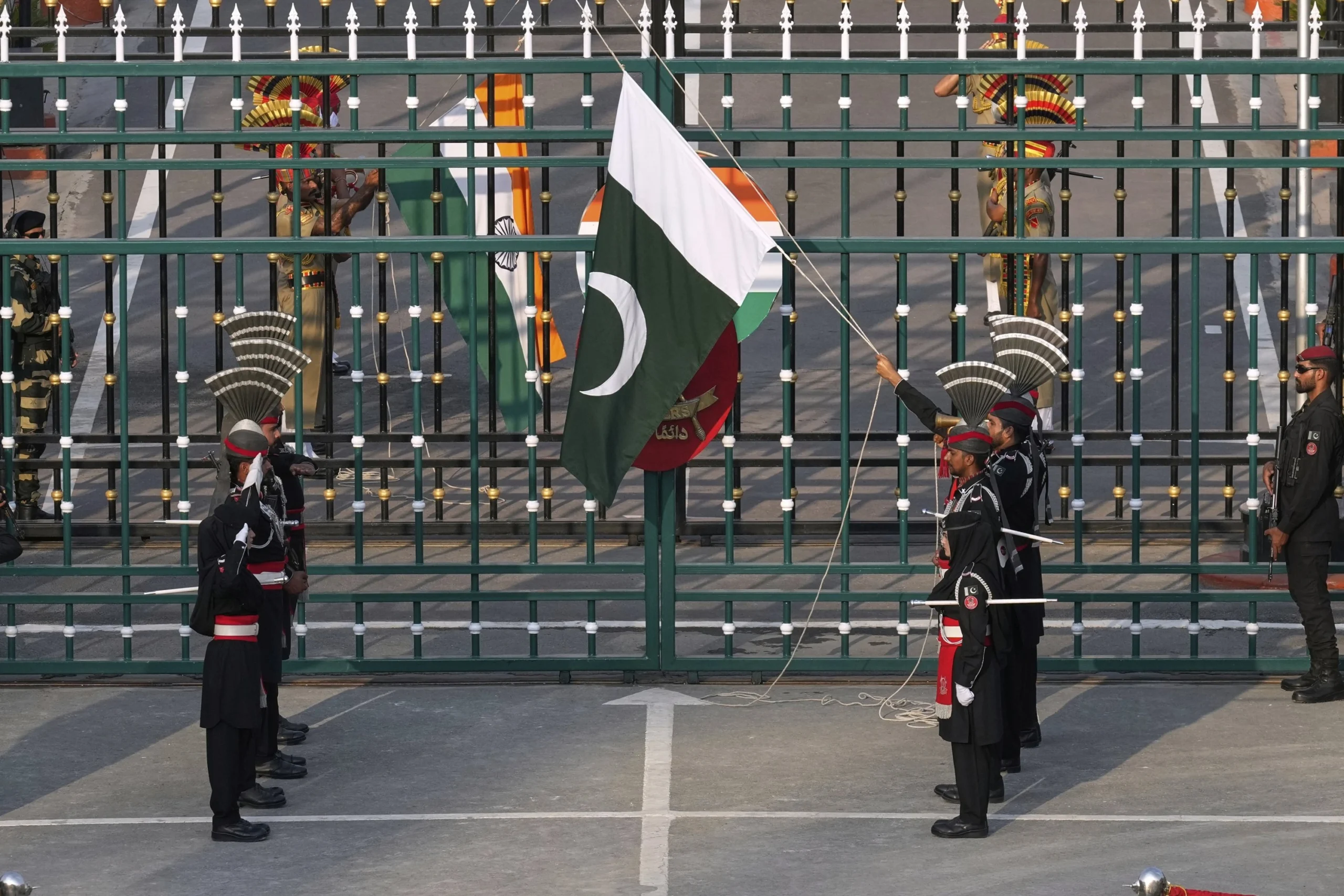
That discipline was visible again in 2025, when Pakistan responded to Indian military adventurism with calibrated force, delivered a clear outcome, and closed the episode on its own terms. A nuclear-armed state with a professional military and institutional coherence does not require foreign bases to feel secure against its neighbors. The GCC states, with smaller militaries and a more immediate Iranian threat, made a different but equally rational calculation. Iran is now punishing them for the rationality of that calculation.
What the Protests Said
Any honest account of how Iran arrived at this war must include what was happening inside Iran before the first American bomb fell. Beginning in late December 2025, Iran experienced the largest nationwide protests since the 1979 revolution, driven initially by economic grievance but escalating into explicit calls for the overthrow of the Islamic Republic. Iranian security forces killed thousands of protesters in January 2026.
A government that massacres thousands of its own citizens for demanding accountability is not a government that has earned the moral authority to position itself as a victim of external aggression. The region’s notable silence when the strikes began, the absence of the popular outrage that Iran might have expected from Muslim governments and populations, was not accidental. It was informed. The people watching from Riyadh, Amman, Abu Dhabi and Islamabad had been watching Tehran govern for a long time. They drew their own conclusions.
Iran’s President Pezeshkian has outlined conditions for ending the war: recognition of Iran’s legitimate rights, reparations, and firm international guarantees against future aggression. These are not unreasonable as the demands of a state that has genuinely suffered. Over 1,400 civilians are confirmed dead. Three million people displaced. The scale of human cost is real and serious.
But the conditions say nothing about the Lebanese civilians living under Hezbollah’s shadow government. Nothing about the Yemeni civilians in a war the Houthis helped sustain. Nothing about the Pakistanis killed by groups operating from Iranian soil. Nothing about the Bahrainis whose political aspirations were subordinated for decades to Iranian strategic interests.
The accounting Iran is demanding runs in one direction only.
The Logic that Ate itself
Iran’s strategic doctrine, the Axis of Resistance, the forward deployment of proxy forces, the cultivation of armed non-state actors across six countries, functioned for four decades because it imposed costs on adversaries without presenting a clear conventional military target. It was genuinely clever. It gave Iran influence vastly disproportionate to its conventional military capabilities and its sanctioned, contracting economy.
Its fatal flaw was the assumption that the environment it created would remain stable indefinitely. That the proxies would remain controllable. That the neighbors would remain divided. That the nuclear file could be managed through perpetual ambiguity. That the domestic population would remain passive. That the United States would absorb the costs of Iranian regional behaviour without eventually deciding that a weakened, isolated, domestically embattled Iran represented an opportunity rather than a deterrent.
Every one of those assumptions proved wrong, and they proved wrong in the same period. The fall of Assad dismantled Iran’s Syrian corridor. Hezbollah was severely degraded in Lebanon. Hamas was shattered in Gaza. The Houthis were contained. The Twelve-Day War in June 2025 damaged Iranian military infrastructure. The January 2026 protests shook the regime’s internal coherence. The United States and Israel calculated that they had greater opportunity to advance their objectives through military means than through diplomacy precisely because Iran’s position was so weakened.
Iran did not arrive at February 28, 2026, because American policy was aggressive. American policy toward Iran has been aggressive for forty years. Iran arrived at February 28 because its own foreign policy, across four decades, had systematically eroded the conditions that made deterrence work.
The Unasked Question
The commentary surrounding this war has largely organized itself into two camps. One frames it as a legitimate act of pre-emption against a nuclear threat. The other frames it as American imperialism and Israeli expansionism destroying a sovereign state.
Both miss the question that actually requires an answer.
How does a state with genuine civilizational depth, a population of eighty million, substantial energy wealth, and a long tradition of sophisticated statecraft end up, in 2026, internationally isolated, domestically fractured, its supreme leader killed in an airstrike, its military infrastructure systematically dismantled, and its missiles falling on the airports of its Muslim neighbors?
The answer is not America. America was always going to be adversarial. The answer is not Israel. Israel was always going to be hostile. The answer is forty years of a foreign policy that prioritized the export of instability over the construction of genuine security, that confused the ability to make neighbors afraid with the ability to make them cooperative, and that mistook the cultivation of armed proxies for the building of strategic depth.
Iran’s neighbors are not celebrating this war. The human cost is too visible and the regional economic disruption too severe for celebration. But neither are they rushing to Iran’s defence. The silence is its own commentary.
States that spend decades making their neighbourhood less stable should not be surprised when their neighbourhood declines to stabilize them in return.
The bill, when it comes, tends to be accurate.