Two decades of Indian diplomatic investment in the Gulf rested on a structural assumption that Gulf states had permanently chosen sides. The September 2025 Saudi–Pakistan Strategic Mutual Defence Agreement reveals that they never had.
A Treaty, a Surprise, and a Misread Decade
It was the third visit of the Indian Prime Minister Narendra Modi to Saudi Arabia when he landed in Jeddah in April 2025. The optics were not accidental: an emerging India developing a new relationship with the Arab world, one that is no longer tied to the baggage of the India-Pakistan rivalry. In half a year, that image had been compromised, perhaps silently but surely, with a signed document in Riyadh. On September 17, 2025, the Strategic Mutual Defence Agreement (SMDA) was inked between Saudi Arabia and Pakistan, which stated that any aggression against one of the countries shall be seen as an aggression against both. New Delhi, which was torn between apparent calm and obvious uneasiness, merely stated that it was conscious of the development.
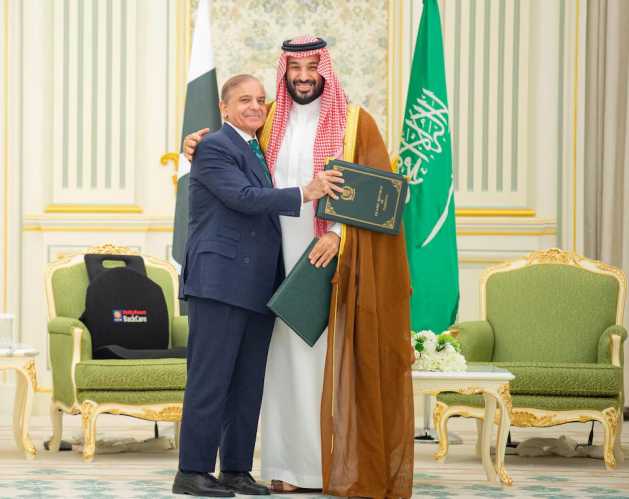
Saudi Crown Prince Mohammed bin Salman and Pakistan Prime Minister Shehbaz Sharif embrace each other on the day they sign a defense agreement, in Riyadh, Saudi Arabia, via REUTERS
The prevailing interpretation of the SMDA in Indian and Western commentary has been that of a break, a loss of momentum in the hard-fought Gulf position of India. This framing, however flattering to the arc of Indian diplomacy, misreads the deeper logic of Gulf statecraft. In seventy-five years of post-colonial regional history, Saudi Arabia and its neighbors have never been prepared to make a permanent decision between India and Pakistan. What appears to be a break is actually a correction-a restoration to the default posture of organized ambiguity of the Gulf. To get to the point of it, it is necessary to retrace the steps back to 1973.
1973 and the Origins of Gulf Strategic Ambiguity
The October 1973 Arab oil embargo plunged both India and Pakistan into a race for the Gulf patronage. Pakistan, with its Islamic identity and Zulfikar Ali Bhutto’s pan-Islamic diplomacy, seemed to be in the best position. The Islamic Summit of 1974, held in Lahore, Pakistan, and attended by thirty-seven heads of state, appeared to establish Islamabad as the most natural South Asian interlocutor of the Gulf. But in a year, both India and Pakistan were exporting laborers to the Gulf in more or less equal surges, their remittance economies tying them both to the same petrodollar handouts. Pakistan had not been chosen by the Gulf. It had chosen utility.
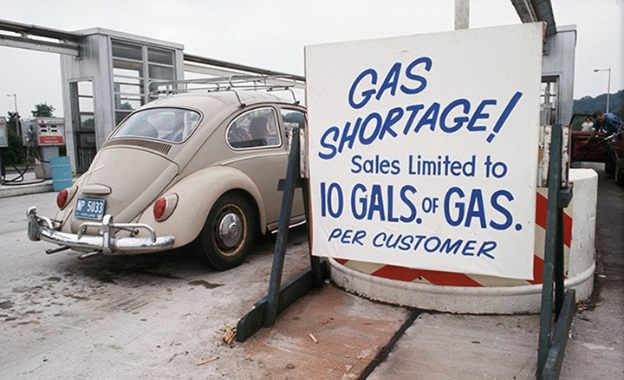
Sign reading “Gas shortage! Sales limited to 10 gallons of gas per customer” posted at a Connecticut filling station during the energy crisis
Such a trend was observed with great regularity into the Cold War decades. The Iran–Iraq War of the 1980s saw Pakistan deploying its troops in Saudi Arabia to strengthen its defence against any Iranian adventurism. At the same time, Indian engineers, teachers, and laborers were creating the physical and institutional infrastructure of Gulf states. In practice, Saudi Arabia was operating on parallel dependencies: Pakistan on security inputs, India on economic ones. The two acted not as substitutes for each other-they fulfilled totally different roles in the strategic calculus of Saudi Arabia.
India’s ‘Look West’ Wager and its Conjunctural Gains
India’s “Look West” policy, which was formally articulated under former Prime Minister Manmohan Singh in 2005 and further advanced during the tenure of Prime Minister Narendra Modi, was built on the expectation that as India’s economic influence expanded, its engagement with the Gulf region would steadily deepen and diversify. Over time, this growing economic and diplomatic outreach was anticipated to broaden India’s strategic partnerships across the region. Certain developments appeared to support this trajectory. In 2012, Saudi Arabia handed over to India a suspect linked to the 2008 Mumbai attacks, a move widely interpreted as reflecting Riyadh’s willingness to respond to India’s security concerns.
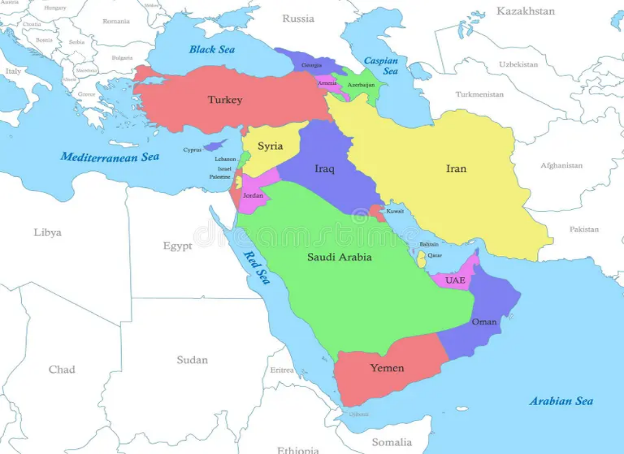
Political map of West Asia
Likewise, in 2015, when Pakistan chose not to participate in the Saudi-led coalition in Yemen, India extended humanitarian assistance in the form of medical aid. During the same period, the Organisation of Islamic Cooperation (OIC), which had historically been vocal on the Kashmir issue, adopted a relatively restrained posture. In subsequent years, high-level exchanges, expanding investment initiatives, and limited defence cooperation—highlighted in statements by India’s Ministry of External Affairs- reinforced New Delhi’s perception that its ties with the Gulf were gradually evolving into a more independent and multidimensional framework.
However, this perception proved to be more contingent than structural. What India interpreted as a lasting strategic shift was, in reality, shaped by a specific set of circumstances that included Pakistan’s economic challenges, a relatively stable security environment in the Gulf, and the strong economic appeal of the Indian market. Once these conditions began to change, the region’s characteristic strategic ambiguity re-emerged.
The emergence of the SMDA, however, was not driven by South Asian dynamics. Rather, it was directly triggered by Israel’s attack on Qatar in September 2025, an event that prompted Gulf capitals to reassess the reliability of long-standing American security assurances. Amid this heightened uncertainty, Saudi Arabia turned to an alternative strategic arrangement capable of offering credible deterrence within an Islamic framework. In that context, Pakistan, by virtue of being the only Muslim-majority country possessing nuclear capability, naturally assumed particular significance. Consequently, the decade of Indian diplomatic engagement in the Gulf, while important in economic and political terms, was not central to the immediate strategic calculations that shaped this development.
The Historical Precedent: Wars and the Gulf’s Consistent Ambiguity
The 1965 and 1971 Indo–Pak wars offer a relevant historical reference point. During both conflicts, Saudi Arabia extended financial and diplomatic support to Pakistan, reflecting the longstanding ties between the two countries. At the same time, Riyadh did not deploy troops and maintained its commercial relations with India. This pattern illustrates the Gulf states’ longstanding approach to external partnerships, which prioritizes strategic diversification rather than exclusivity. In this context, while the SMDA elevates Pakistan–Gulf cooperation to the level of a formalized strategic arrangement, it does not necessarily imply a structural downgrading of the Gulf’s engagement with India. Instead, it reflects the region’s continued preference for maintaining multiple, parallel partnerships within a complex geopolitical environment.
India continues to maintain substantive ties with the Gulf that are underpinned primarily by strong economic ties. For instance, more than 2.9 million Indians are employed in Saudi Arabia alone, collectively remitting around $7 billion annually. Large-scale connectivity initiatives have also reflected areas of shared economic interest. The India–Middle East–Europe Economic Corridor (IMEC), announced during the 2023 G20 Summit in New Delhi, illustrates an effort to link infrastructure and trade networks across India, the Gulf, and Europe.
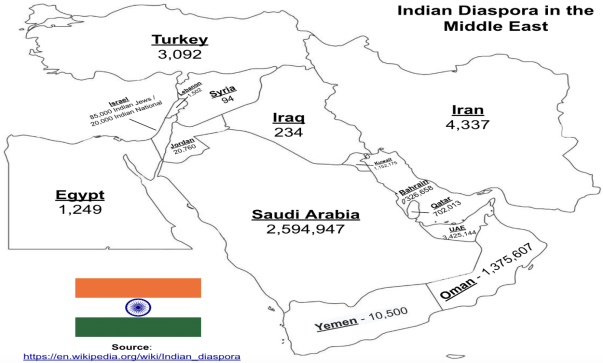
Map depicting the distribution of the Indian diaspora in the Middle East
In addition, defense engagement has also taken place at a limited but visible level; for example, Saudi Arabia and India conducted joint military exercises in August 2025, only weeks before the signing of the SMDA. These developments demonstrate that India’s engagement with the Gulf rests on tangible economic and institutional foundations. At the same time, they should be understood as important components of a broader relationship rather than indicators of exclusive strategic alignment
Pakistan’s Gains and Their Ceiling
The SMDA represents an important moment of strategic and economic reassurance for Pakistan as it navigates a period of financial and geopolitical challenge. In the fiscal year 2025–26, Saudi Arabia is expected to emerge as one of Islamabad’s largest external financial partners, underscoring the depth and continuity of bilateral ties. Beyond financial cooperation, the agreement also reflects renewed recognition of Pakistan’s enduring strategic relevance to the Gulf region. Historically, Gulf states have engaged closely with Pakistan due to its significant role in the broader security architecture of the Muslim world, supported by its large and skilled manpower base, longstanding defense cooperation with Gulf partners, and its status as the only Muslim-majority nuclear power. Within this context, the SMDA formalizes and reinforces a partnership that has long been shaped by mutual strategic utility, highlighting Pakistan’s continuing importance to regional stability and security.
The Hyphen Was Never Removed—Only Deprioritized
In sum, the larger point of the SMDA, and the history that preceded it, is that the strategic ambiguity of the Gulf with regard to India and Pakistan is not a failure of commitment, but rather a well-built policy. Riyadh has never felt an exclusive association with either New Delhi or Islamabad as its interest. It requires Indian economic incorporation in its Vision 2030 diversification project; it requires Pakistani security inputs in its deterrence calculations; and it requires the liberty to play both cards at the same time. The dilemma that Indian strategists now have to face is not how to penalize Saudi Arabia over the SMDA, but how to entrench Indian interests to such a level within the economic and security systems of the Gulf that dehyphenation becomes less a requirement. The reason is that the relationships are too interdependent to be taken out by any unilateral shift.
The Gulf has long functioned within a framework of carefully maintained strategic ambiguity, where states cultivate multiple partnerships simultaneously. Over the past decade, India interpreted the warming of its relations with several Gulf capitals as evidence that this ambiguity had largely dissipated. However, recent developments suggest that the underlying dynamics were never fully altered. Rather than disappearing, the traditional “hyphen” linking India and Pakistan in Gulf strategic thinking had merely receded in priority.
The changing regional circumstances, particularly the security shock generated by Israel’s attack on a Qatari capital and the accompanying questions surrounding the reliability of American security guarantees, have prompted a recalibration of regional alignments. In this evolving environment, the India–Pakistan dimension has once again acquired renewed visibility within Gulf strategic calculations. The more consequential question now is how both New Delhi and Islamabad choose to interpret and respond to this shifting geopolitical reality
The views expressed in this article are the author’s own. They do not necessarily reflect the editorial policy of the South Asia Times.