Trump Criticizes US AI Strategy, Calls DeepSeek a Wake-Up Call for America

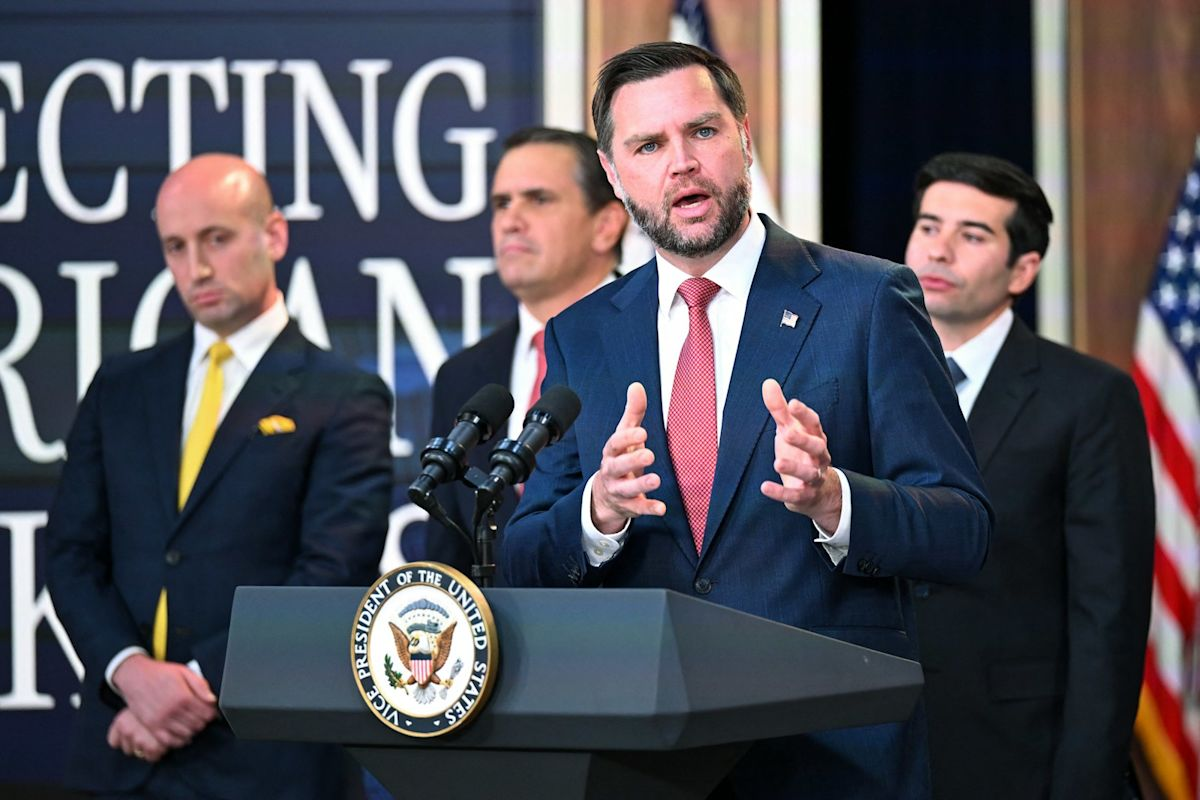
Trump calls China's DeepSeek AI a "wake-up call" for US tech, highlighting its cheaper, efficient, and growing popularity. [Image via The Nation]

US President Donald Trump said Monday that the sudden rise of the Chinese artificial intelligence (AI) app DeepSeek should be “a wake-up call” for America’s tech companies.

“The release of DeepSeek, AI from a Chinese company, should be a wake-up call for our industries that we need to be laser-focused on competing to win,” Trump told House Republicans in Miami, Florida.

DeepSeek has raised alarms among Western tech giants, offering a more efficient and cost-effective alternative to OpenAI’s ChatGPT.

Backed by the Chinese hedge fund High-Flyer, DeepSeek launched its DeepSeek-R1 large language model (LLM) on Jan. 20.

Also See: Why Was India Excluded from U.S. Access to Advanced AI Chips?

Unlike ChatGPT’s subscription-based and closed-source platform, priced at $200 per month, DeepSeek-R1 is entirely open-source and free, allowing users to access and operate it on native hardware without limitations.

“I’ve been reading about China and some of the companies in China, one in particular coming up with a faster method of AI and much less expensive method, and that’s good because you don’t have to spend as much money. I view that as a positive, as an asset,” Trump said.

“I view that as a positive because you’ll be doing that too, so you won’t be spending as much, and you’ll get the same result, hopefully.”

The president said the US has the “greatest” scientists in the world, adding Chinese leaders had told him the US has the “most brilliant” scientists.

“When you hear somebody come up with something, we always have the ideas. We’re always first. So I would say that’s a positive. That could be very much a positive development. So instead of spending billions and billions, you’ll spend less and you’ll come up with, hopefully, the same solution,” he added.

Chinese AI startup DeepSeek triggered a major tech stock selloff Monday with the release of its free AI assistant, which it says uses much less data than its rivals at a fraction of the cost.

The news led to a steep fall in the market value of US chip-maker Nvidia of more than $500 billion.

DeepSeek’s AI model began being used extensively around the world in a short time, leading to deepening selling pressure on technology stocks.

Its AI assistant overtook rivals including OpenAI’s ChatGPT to become the most downloaded free app in the US.

This news is sourced from The Nation and is intended for informational purposes only.

News Desk

Your trusted source for insightful journalism. Stay informed with our compelling coverage of global affairs, business, technology, and more.


Recent

Broken Promises: The Taliban’s Betrayal of Global Commitments

Broken Promises: The Taliban’s Betrayal of Global Commitments

Nearly three years after seizing power, the Taliban’s systematic violation of their international commitments under the 2020 Doha Accord has transformed Afghanistan into a sanctuary for terrorism, entrenched an autocratic regime, and institutionalized gender apartheid. Beyond moral failure, this deceit poses a grave threat to regional stability, international counterterrorism efforts, and the credibility of global diplomacy. Holding the regime accountable is now a strategic necessity, not a choice.

Read More »
Do You Remember 6/11/ 1947?: A Forgotten Jammu Genocide and the Continuing Erasure of Kashmiriyat

Do You Remember 6/11/ 1947?: A Forgotten Jammu Genocide and the Continuing Erasure of Kashmiriyat

On November 6, 1947, one of South Asia’s earliest genocides unfolded in Jammu, where hundreds of thousands of Muslims were massacred or forced to flee. Yet, unlike other global tragedies, this atrocity remains buried in silence. The Jammu Genocide not only reshaped the region’s demography but laid the foundation for India’s ongoing campaign of identity erasure in Kashmir. From demographic engineering to cultural censorship, the spirit of Kashmiriyat continues to face systematic annihilation.

Read More »
India’s Climate Policy after COP28: Net Zero 2070 — A Fair Promise or a Risky Postponement?

India’s Climate Policy after COP28: Net Zero 2070 — A Fair Promise or a Risky Postponement?

India’s Net Zero 2070 target reflects a delicate balance between development equity and climate urgency. While progress in renewables, green finance, and adaptation is visible, the absence of clear interim milestones risks turning ambition into delay. The real challenge lies in translating a distant horizon into measurable, near-term climate action before 2030.

Read More »
The Tehreek-e-Hijrat of 1920 and Its Parallels with Contemporary Refugee Politics

The Tehreek-e-Hijrat of 1920 and Its Parallels with Contemporary Refugee Politics

The Tehreek-e-Hijrat of 1920 saw thousands of Indian Muslims migrate to Afghanistan, only to be turned away when Kabul could no longer cope. A century later, Afghan officials criticise Pakistan’s refugee policies while ignoring their own historical refusal to host Muslim migrants. The parallel reveals not just irony, but the enduring challenge of compassion, capacity, and collective responsibility.

Read More »
Playing the Victim: How the Taliban Endorse and Amplify Online Propaganda Against Pakistan

Playing the Victim: How the Taliban Endorse and Amplify Online Propaganda Against Pakistan

Following the October 2025 border clashes, the Taliban have shifted their battlefield online, using propaganda, selective history, and digital disinformation to paint Pakistan as the aggressor. Through controlled media releases, colonial-era references, and victimhood narratives, Kabul seeks to manipulate regional perception and deflect blame for its own failures.

Read More »