Taliban attack Police HQ in Karachi Pakistan

Taliban attack Police HQ in Karachi Pakistan

Officials say 3 attackers also dead as police and paramilitary forces cleared building in gun battle

Three members of the security forces and one civilian were killed in the Pakistani Taliban attack. The attack targeted the Police HQ in the southern Pakistani city.

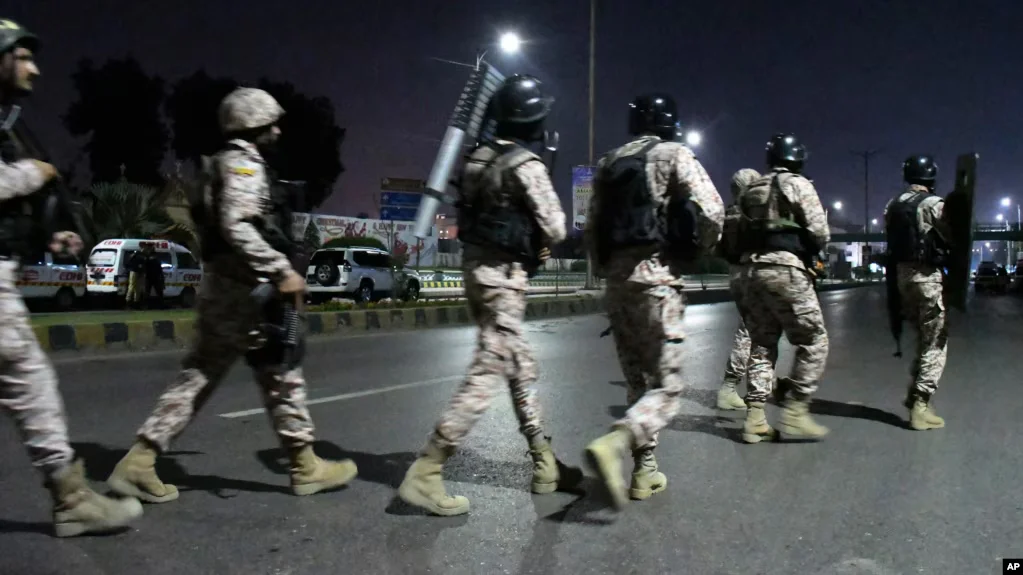
Pakistani Taliban fighters stormed a police compound in the southern Pakistani city of Karachi, killing at least four people.

On Friday, gunfire and explosions erupted outside the premises, which houses several police buildings and officer residences.

Government officials and Ghulam Nabi Memon, the police chief for Sindh province, reported that the Taliban attacked the Police HQ. They confirmed that the attack killed three members of the security forces and a civilian. They also confirmed that several other security force members were wounded.

Officials added that the attack resulted in the deaths of two suicide bombers. They noted that at least one of the bombers blew himself up after entering the police building.

Tehreek-e-Taliban Pakistan (TTP), also known as the Pakistani Taliban, claimed responsibility for the attack.

Murtaza Wahab, a government adviser, confirmed that police and paramilitary forces in a joint operation had cleared the police building within three hours of the attack late Friday.

“I confirm that the operation against the terrorists is over,” said Wahab.

President Arif Alvi condemned the assault in Pakistan’s chief commercial city and Prime Minister Shahbaz Sharif paid tributes to security forces for the successful operation.

SEE ALSO: https://southasiatimes.org/pakistan-embassy-attack-kabul/

When the attack began, a series of smaller blasts occurred, followed by a huge explosion inside the station.

Commandos from the elite police unit, troops from paramilitary  rangers and army snipers took part in the operation to hunt down the attackers that lasted for more than three hours

Pakistan has witnessed a surge in attacks by armed groups since November when the Pakistani Taliban unilaterally ended a months-long ceasefire with the government.

Weeks after a suicide bomber disguised as a policeman killed 101 people at a mosque in the northwestern city of Peshawar, the attackers carried out the assault on Karachi’s police headquarters. Authorities blamed the TTP for orchestrating the bombing.

Original Source: Al Jazeera

News Desk

Your trusted source for insightful journalism. Stay informed with our compelling coverage of global affairs, business, technology, and more.

Recent

Modern Platforms, Evolving Doctrine

Modern Platforms, Evolving Doctrine

The Gulf’s air-power evolution is increasingly shaped by the fusion of advanced platforms with modern doctrine and faster decision cycles. As regional forces adapt to complex threat environments, partners like Pakistan, whose operational experience spans multiple domains, are becoming part of the broader conversation on future air-power thinking.

Read More »
Economic Engagement or Ethical Dilemma? Canada-India Relations and the Nijjar Case

Economic Engagement or Ethical Dilemma? Canada-India Relations and the Nijjar Case

Canada’s renewed trade outreach to India comes at a moment of deep diplomatic strain. As Minister Maninder Sidhu seeks to revive economic cooperation, the unresolved assassination of Sikh activist Hardeep Singh Nijjar, and allegations implicating senior Indian officials, cast a long shadow. The controversy raises critical questions about whether Ottawa can balance economic ambitions with justice, accountability, and the protection of Canadian sovereignty.

Read More »
Zohran Mamdani calls out Modi and Netanyahu as war criminals, linking Gujarat 2002 and Gaza, and demands global justice and accountability.

Zohran Mamdani Stands Up for Justice: Holding Modi and Netanyahu Accountable

Zohran Mamdani, a rising progressive voice in the U.S., has boldly equated Indian Prime Minister Narendra Modi and Israeli Prime Minister Benjamin Netanyahu with war crimes. Drawing on global principles like the Responsibility to Protect (R2P) and ICC indictments, Mamdani challenges the immunity of influential leaders and advocates for accountability for mass atrocities in Gujarat (2002) and Gaza.

Read More »
How Pakistan can benefit from the World Bank’s New Nuclear Policy

How Pakistan can Benefit from the World Bank’s New Nuclear Policy

The World Bank’s decision to lift its decades-old ban on nuclear energy financing marks a turning point for developing nations. For Pakistan, this policy shift offers a rare opportunity to tackle its chronic energy crisis through clean, affordable, and reliable nuclear power. By aligning with the IAEA’s safety standards, engaging with World Bank institutions like IFC and MIGA, and integrating nuclear expansion into its national climate goals, Pakistan can position itself at the forefront of sustainable energy transformation.

Read More »