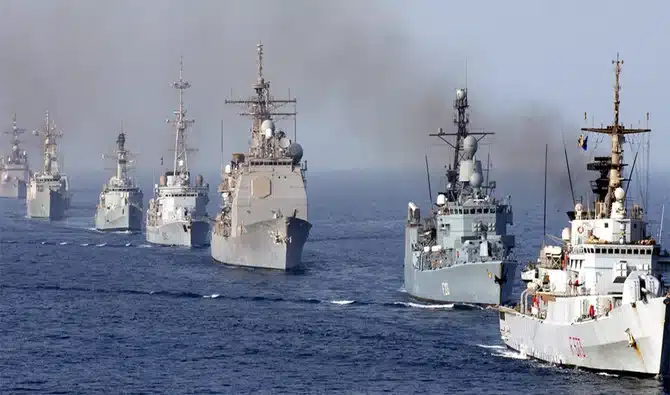
KARACHI: Pakistan Navy warship PNS Yarmook has conducted bilateral exercises with allied navies. This was part of a Regional Maritime Security Patrol (RMSP) deployment in Bahrain. The exercises aimed to enhance naval coordination and improve joint operation capabilities in the region. The military’s media wing reported this on Thursday.
Last month, the Pakistan Navy commissioned an offshore patrol vessel, PNS Hunain, during a ceremony in Romania. This move aims to strengthen regional maritime security in the Indian Ocean. In July, the Pakistan Navy also assumed command of a multinational task force. This task force is responsible for ensuring maritime security in the southeastern waters of the Middle East. It covers the Arabian Sea, Gulf of Oman, and Gulf of Aden.
Regional Maritime Security
“Pakistan Navy warship Yarmook visited Bahrain during a regional maritime security patrol,” the military’s media wing said in a statement. The warship participated in bilateral exercises alongside ships from Bahrain, the US, and Japan.
“The exercises were aimed to develop synergy and mutual understanding among partner navies while rehearsing interoperability to undertake joint operations in the region,” the Navy said in a separate statement.
“Pakistan Navy is maintaining permanent presence in the Indian Ocean to keep the national and international Sea Lines Of Communications (SLOC) under surveillance,” the statement added.
“Pakistan Navy (PN) believes in collaborative efforts for maintenance of rule-based order at sea. PN actively collaborates with regional and international partners deployed in Indian Ocean to counter piracy and to undertake anti-narcotics operations for protecting global common interests.”
During the visit to Bahrain, the commanding officer of the Pakistani ship met with Commander Royal Bahrain Naval Force, Rear Admiral Ahmed Mohammad Ibrahim Al Bin Ali. He also met with Commander Royal Bahrain Coast Guards, Brig Saqib Qamar, and other senior officials of the Bahrain Navy. He also visited the HQ Combined Maritime Forces (CMF) and called on Dy Commander CMF, Commodore Mark Anderson.
“During the interactions, professional matters of mutual interests were discussed and enhancement of bilateral ties in all spheres was reaffirmed,” the navy said.
During the stay at port Mina Salman, the ambassador of Pakistan to Bahrain visited PNS Yarmook. Commander Maritime Coalition Forces and officials of the Bahrain Navy also visited the ship. Prominent businessmen, notables from the Pakistani community, and many diplomats and defense attachés from friendly countries were among the visitors as well.
This news is sourced from Arab News and is intended for informational purposes only.

Your trusted source for insightful journalism. Stay informed with our compelling coverage of global affairs, business, technology, and more.