![Erosion of India's democracy: Mohandas K. Gandhi, India's Prime Minister Narendra Modi and Hindu extremist Nathuram Godse, who assassinated Gandhi. [Washington Post illustration; AP]](https://southasiatimes.org/wp-content/uploads/2024/04/imrs-1.webp)
“If the meanest man in the republic is deprived of his rights then every man in the republic is deprived of his rights.”
—Jane Addams.
A system of contradictions and difficulties beset by India, the most populous democracy globally, threatens to undermine its very foundation. Amid the prevailing political instability and social unrest, domestic and as well as international stakeholders are expressing apprehensions regarding the gradual erosion of India’s democracy, the democratic principles, and the rise of Hindutva fascism under the Modi regime, as the country gears up for elections.
A prominent Hindutva ideologue, Sadashivrao Golwalkar, praised Adolf Hitler’s Nazi Germany for killing a lot of Jews to protect their culture and racial purity. People of non-Hindu descent in Hindustan should give up their separate identities and become fully integrated into Hindu culture, – this was something he strongly believed. Besides that, he refused to give these people any rights, even citizenship.
The Modi administration’s use of the Hindutva idea as a strategy has led to talk about how Indian Muslims are treated like they are less than human. Even though it has gotten a lot of bad press, the Citizenship Amendment Act (CAA) of 2019 goes against the political foundations of the country and weakens the idea of citizenship among Muslims.
In 2022, Narendra Modi, then Chief Minister of Gujarat, unleashed riots that left more than 1,000 people dead. Almost all the casualties were Muslims. The deadly violence has been dubbed the “Muslim pogroms” and Modi the “Butcher of Gujarat” and BBC in its documentary also endorsed that Modi was directly responsible for the massacre of Muslims in Gujrat.

Moreover, the recent tragic but unsurprising events as the inauguration of the Ram Mandir (Temple) with glory and satisfaction, depict a symbolic transformation towards a storyline of epic marginalization, where the core principles of India such as inclusiveness and democracy are overlooked completely under the Modi administration.
As far as the CAA is concerned, a statement made on it effectively captures the fundamental intention behind it, which is the de-legitimization of Muslim citizens. This reflects the widespread sense of marginalization and discrimination faced by minorities.
Also Read: Lok Sabha Elections in India: Complexities and Challenges
Even so, the account of New Delhi’s transition toward Hindutva fascism goes beyond the political realm, examining the deeply rooted cultural mindset characterized by the ongoing religious polarization. The glorification of Nathuram Godse, the murderer of Gandhi, is a notable transition towards a narrative centered on violence, and animosity, which stands in stark contrast to Gandhi’s aspiration for a secular and inclusive India. On the other hand, the normalization of hate speech and the idolization and worship of radical figures highlight a worrying trend in which dissent is suppressed and minorities, especially Muslims, are radically marginalized through state apparatuses.
Apart from all these anti-democratic traits, India is also facing pertinent challenges. A study conducted by the World Inequality Lab reveals that Delhi is already struggling with the existing issue of increasing socio-economic inequalities, and these inequalities can impact the national integration of India, which can worsen the existing divisions. Furthermore, the report highlights how the wealth gap in Modi’s India is growing, where the rich get richer, and the poor get poorer.
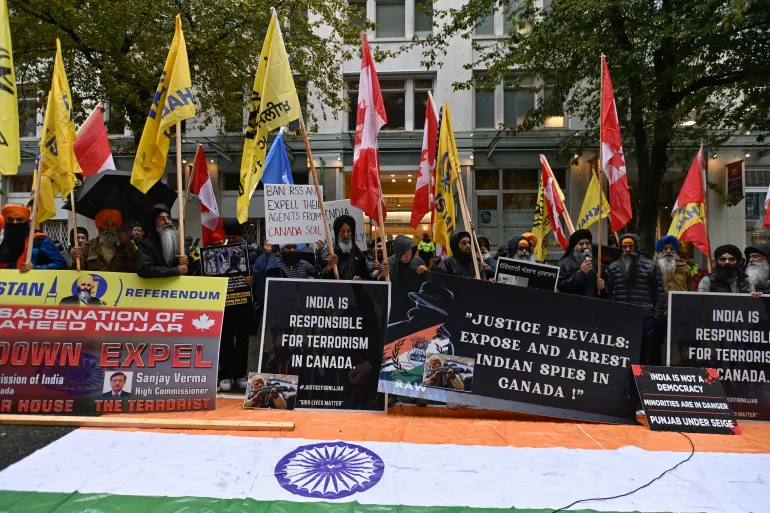
India’s complicated efforts to hide illicit acts were exposed by The Guardian in its ongoing probe into illegal acts of extra-judicial killings in other countries. This makes the situation at home, and abroad in countries such as Pakistan, and Canada, more complicated. The violence that features homicides, which is expressly prohibited in India, to some extent is what negatively portrays India’s image at a global level. These developments will only further deteriorate the fragile political climate in the country.
Also Read: India’s Dream Run Hits a Speed Bump?
Beyond the challenges posed by the complexity of these issues lies the most basic question of what India is and where it is heading.
In the case of India, there is an ongoing debate as to whether traditional diversity can be reconciled with contemporary Indian nationalism. Is it possible or not to survive in a society with fractured freedom and equality under a growing oppressive regime?
Lastly, India has nuclear assets governed by ultra-nationalist leaders such as Modi, who has an expansionist agenda based on the Hindutva ideology and the dream of Great India is bound to give further doubts and perhaps in the future, it might pose a threat to the states of South Asia.
On this trip from a full-fledged democracy to the one with flaws, there are several hurdles. However, Indian people must not forget their right to vote and to use their reasoned judgment in elections, and thereby make decisions according to the integrity and unity of the nation rather than Hindu nationalism, which could let the rift between different people emerge. The survival of democracy and equality requires a choice between preserving religious, and ethnic diversity, and rejecting the forces that cause disharmony.
The views expressed in this article are the author’s own. They do not necessarily reflect the editorial policy of the South Asia Times.