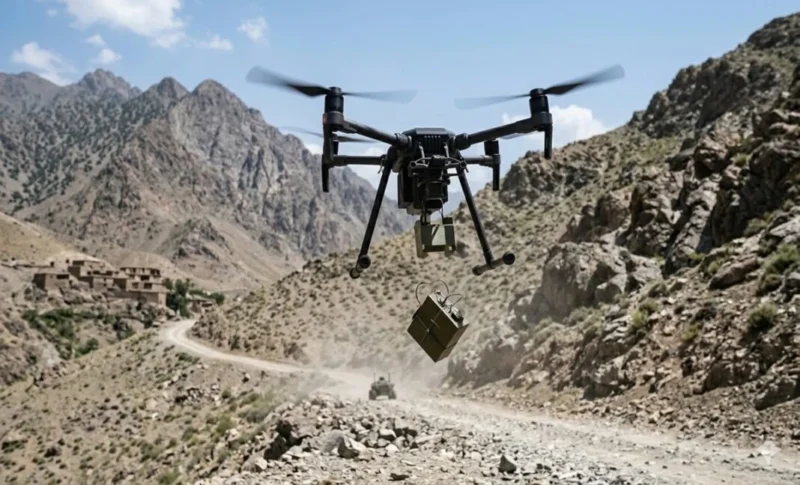
![Taliban deny Trump’s claim that China has control of Bagram Air Base, asserting their sole authority over the former U.S. facility. [Image via AP]](https://southasiatimes.org/wp-content/uploads/2025/03/01000000-0aff-0242-54ee-08db12afab03_w1023_r1_s.webp)
Islamabad — Taliban officials have denied President Donald Trump’s recent assertions that China holds control over the crucial former U.S.-operated Bagram military base in Afghanistan.
The sprawling Bagram Air Base in question, situated about 44 kilometers north of the national capital of Kabul, served as the central command for the 20-year U.S.-led military campaign in the country until all U.S. and NATO troops withdrew in August 2021 and Taliban insurgents reclaimed power
“They should refrain from making emotional statements based on unsubstantiated information,” Taliban spokesman Zabihullah Mujahid told their official broadcaster when asked for a response to Trump’s claims that China currently controls the air base.
“Bagram is controlled by the Islamic Emirate [Taliban regime], not China. Chinese troops are not present here, nor do we have any such pact with any country,” Mujahid said in the interview broadcast on Saturday night. “We request that Trump’s team [of advisors] explain to him and correct his information about Afghanistan.”
Trump negotiated the troop withdrawal deal with the Taliban insurgency in February 2020 during his previous term in office, but it was executed under President Joe Biden.
Trump claimed during his election campaign speeches that Bagram was under the control of China’s People’s Liberation Army, and he reiterated it before his first Cabinet meeting last Wednesday, saying Biden should have kept control of the former U.S. base.
Beijing has increased cooperation with Taliban-run Afghanistan since the U.S. troop exit but vehemently denied any military presence in the country.
“We were going to get out, but we were going to keep Bagram, not because of Afghanistan but because of China, because it’s exactly one hour away from where China makes its nuclear missiles,” Trump stated in his Wednesday remarks. “And you know who’s occupying it right now? China. Biden gave it up,” he said.
The U.S. president criticized the previous administration for what he described as the “badly handled” military withdrawal, saying the departing troops left behind billions of dollars’ worth of equipment.
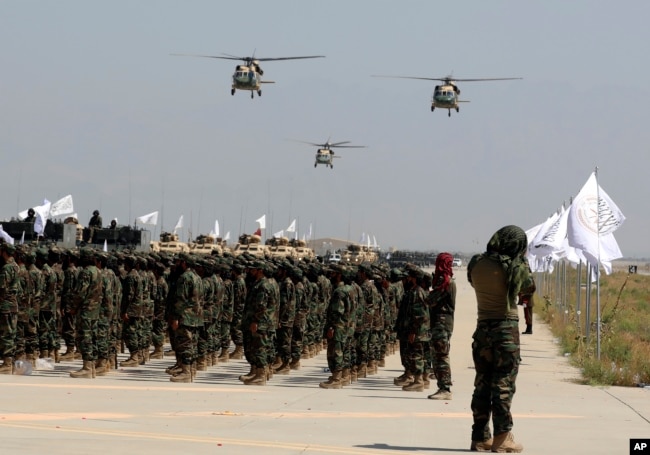
Trump stated that the Taliban were selling U.S.-made gear, making Afghanistan “one of the biggest” sellers of military equipment in the world.
“Can you believe it? They’re selling 777,000 rifles, 70,000 armor-plated …trucks and vehicles — 70,000 … This is 70,000 vehicles we had there, and we left it for them. I think we should get it back,” the president said.
Trump pledged to reclaim U.S. military equipment from the Taliban if Washington were to allocate “billions of dollars” in humanitarian aid to Afghanistan.
“And if we’re doing that, I think they should give our equipment back. And I told Pete to study that,” the president said, pointing to Secretary of Defense Pete Hegseth sitting beside him.
Also See: Will Trump Dial Up America’s ‘Do More’ Policy for Afghanistan?
Mujahid responded to Trump’s claims on Saturday, stating that the military equipment had been provided to the U.S.-backed former government in Kabul and now belongs to the Taliban as “spoils of war.”
Mujahid added that the Taliban use the weapons to defend Afghanistan and will be utilized to counter any intervention aimed at taking them back. Mujahid stated that if the United States insists on reclaiming military equipment, Kabul will rightfully expect substantial war reparations for the consequences Afghans have endured over the past two decades of conflict.
A U.S. Department of Defense report found that Washington provided $18.6 billion of equipment to the Afghan National Defense and Security Forces from 2005 to 2021. About $7 billion worth of hardware remained in Afghanistan during the troop exit, including aircraft, air-to-ground munitions, military vehicles, weapons, communications equipment, and other materials.
John Sopko, the former U.S. Special Inspector General for Afghanistan Reconstruction, dismissed the idea of retrieving American military equipment as “pointless.”
He spoke at a security dialogue regarding the ongoing Afghan political and social crisis, stating that a significant amount of U.S. weaponry had been provided to former Afghan national defense forces, but much of it has either been destroyed or is now in disrepair.
“The cost of retrieving this equipment would exceed its actual value,” Sopko told the two-day event, organized by the independent Afghan Institute for Strategic Studies in Spain.
This news is sourced from VoA and is intended for informational purposes only.

Your trusted source for insightful journalism. Stay informed with our compelling coverage of global affairs, business, technology, and more.