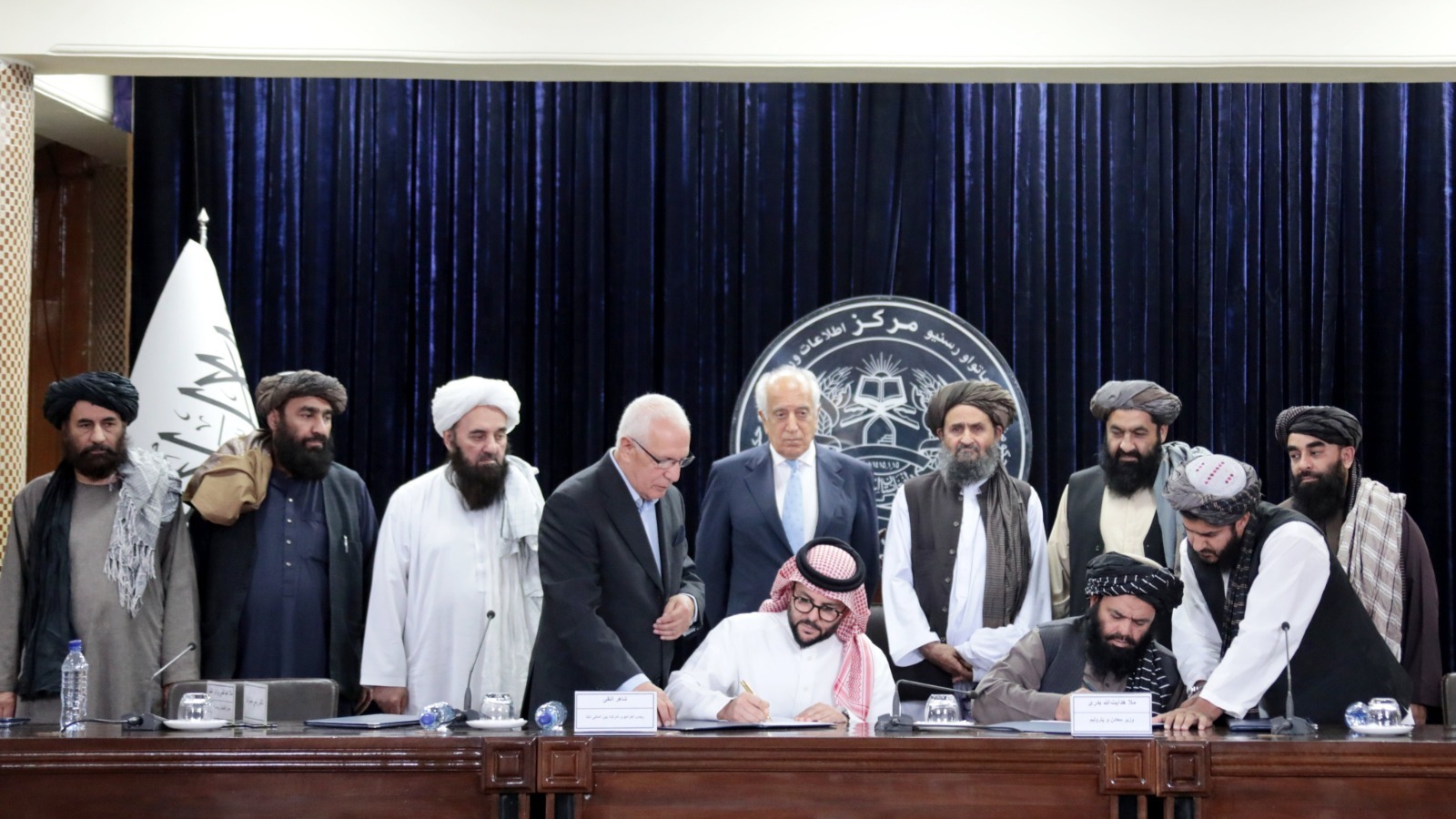
Taliban’s rise to power in August 2021 would give impetus to a new debate: whether the Taliban have changed or not, whether it would be appropriate to brand them as Taliban 2.0, or is it a bit early for the said entitlement? Given the interactions of the Taliban with the International community since they took over Kabul last year, at the moment, it would suffice to say that the Taliban have changed to a greater extent on the foreign policy front. The organization is making overtures and signing deals with countries around the world. The security pact signed with Qatar is a recent illustration of the Taliban’s Internationalism.
Taliban-Qatar Security Pact
Weeks ago, the acting defense minister of Afghanistan, Mullah Yaqoob paid a visit to Qatar where he met with the higher officials of the Qatari government, including the Emir Tamim bin Hamad Al Thani, the Defence Minister, Foreign Minister, and the Qatari Chief of Army Staff. During the meetings, various issues came under discussion among which one issue stood out in prominence: the issue of defense and security cooperation. The visit was ensued by speculations that both countries intended to sign a security pact. And now just recently, the news is doing rounds that both the countries have signed an agreement on security cooperation, whereby the Qatari officials would provide uniforms, salaries, and military equipment to the armed forces of the Islamic Emirate of Afghanistan.
The development has evoked the attention of political analysts and many raised questions: what are the interests of Qatar in Afghanistan, why has it signed a security pact with the pariah Islamic Emirate, and what the Taliban have conceded to Qatar in return for the said cooperation?
The details of the agreement are yet to be disclosed, however many opined that by the virtue of being a strategic partner and a “protecting power” of the US interests in Afghanistan, Qatar is mainly pursuing the interests of the United States under the garb of its own, through the said security pact.
Taliban Pragmatism
In the post-withdrawal phase, the key interest of the United States in Afghanistan remains to prevent the latter to turn into a bastion of terrorism that may haunt the former once again. Thus, the best strategy to avoid such a doomsday scenario would be to strengthen the Islamic Emirate armed forces against Al-Qaeda and Islamic State (ISKP). The security pact is exactly doing the same.
Furthermore, the security cooperation along with the sanctions can also be understood as a part of the carrot and stick strategy of the United States to get the Taliban to respect human rights and initiate a series of reforms.
There are already reports doing rounds that in return for the cooperation Taliban are supposed to initiate a series of reforms as demanded by the International community since August 2021. As far as the motives of the Taliban are concerned owing to which they signed the pact, the primary motive in this regard happened to be the fragile economic situation exacerbated by the sanctions and the recent earthquake.
Moreover, the deal also bespeaks of Taliban’s pragmatism on the foreign policy front. The concerned deal could have been made with other countries, namely: Saudi Arabia, United Arab Emirates, or Iran. However, the Taliban opted for Qatar, the country with whom the Taliban had historical relations, and also enjoy a neutral status while being the United States front-state to deal with the Taliban. To put it bluntly, the concerned deal could have been sealed with any aforementioned countries but it would have come at the expense of estranging one or the other country. Thus, so far, the Taliban have tread carefully in the complex geopolitical landscape of the region, which is indicative of the aspirations of the group toward a ‘moving-forward’ approach that is indeed crucial for the stability and development of post-war Afghanistan.

Your go-to editorial hub for policy perspectives and informed analysis on pressing regional and global issues.