With Iran and the United States once again engaged in fighting, the world is mesmerised by guessing what happens next. This is broadly the third round of regular kinetic engagement between the two countries, albeit one in which the world is plunged into hopes for peace and not war. It is because of several factors that come into play when one analyses an ongoing situation and predicts the outcome. History is one such important factor which needs to be consulted before arriving at the conclusion for outcome of a situation. The historical facts in the Middle East interestingly reflect a somewhat different picture than what is evident prima facie.
The US has been seen adamantly active in the Gulf region since 1973 oil crisis. Although it now has only a two percent dependence on this region, yet the “Petro Dollars” or oil trading in US dollars forms the mainstay of its economy. To ensure that the Arab countries continue trading in US dollars, it is but mandatory for the US to remain physically present in the region. It therefore needs a valid security pretext, which must provide the basis for its existence leading to investment by the Arab countries in US security paraphernalia, thus contributing to its economy.
A strong pretext is in the form of Iran. The US has been convincing regional countries that their actual enemy is Iran and not Israel, and that they must resort to US protection against it. For that, of course a permanent US presence in the area and the employment of US weapons and platforms is mandatory. For at least the last five decades, US has been the primary arms supplier for Gulf countries. It was only during the period from 2020 to 2024, that Europe surpassed the Gulf region in weapons purchase from the US. There are multiple bases of US and its allies. As per some estimates, the US alone maintains around 19 bases in the region. With China’s rise in the offing, US is not going to leave this space at any cost.
This is also evident from the US National Security Strategy (NSS) 2025, which clearly states that the US is not going to allow any power to take control of the natural resources of this region and the waterways through which they pass through. It is, in fact, one of the core foreign policy interests stipulated in the US NSS 2025. Before the US waged war against Iran on February 28, 2026, it conducted Operation Absolute Resolve in Venezuela on January 3, 2026, which served two purposes. Control of critical oil supplies to China and building the confidence required to wage war with Iran. The US has come to the Middle East to also wrest control of resources over which China has a thirty three percent dependence. Its determination to seek control of the Strait of Hormuz from Iran hints conformance of the core strategic interest stipulated in the US NSS 2025.
For Iran, it has become mandatory to retain control of the Strait, else it will be dominated by others under the garb of ensuring safe passage for the ships. Like the US, Iran is also not the member of United Nations Convention on the Law of the Seas (UNCLOS). It is therefore not subjected to the rules and regulations stipulated therein. Iran is handling the matter purely from a geographical point of view which is logical as it has a geographical advantage which no other country has.
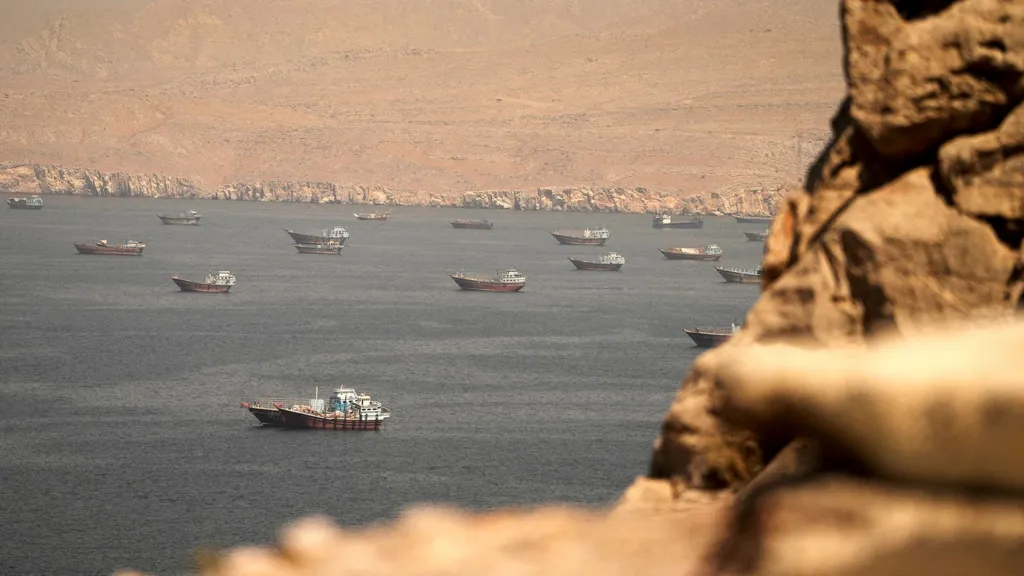
The northern portion of the Gulf of Oman, the Strait of Hormuz and the Persian Gulf is completely formed by Iranian coastline. It is the southern portion that is shared by a number of countries. Iran has made use of its geographical advantage and has established a number of bases all along the coastline as well as on the islands it has under its control. Besides, it has missile batteries and launchers deployed at critical points, which can target traffic flowing through the three water bodies.
Manoeuvring space inthe gulfs and straits is restricted, which constrains the bigger platforms in navigation. Also, in the straits the available depth is at the centre. Hence, the seagoing platforms have to move through pre-decided lanes. Iran wishes all shipping should be via the northern lane only, which passes through Iranian waters, thereby affording effective watch and control to Iran. If Oman does not agree to exercise control over the Strait of Hormuz, Iran is even ready to obstruct the southern lane passing via Omani waters and has, in fact announced the laying of sea mines there. It has also targeted ships passing through southern waters, which has instigated a US response.
Both Iran and the US are blaming each other for breaching the Islamabad Memorandum of Understanding (MoU), yet both have interpreted it according to their own understanding. Point 5 of the Islamabad MoU states that Iran will ensure safe passage for ships moving from the Persian Gulf to the Sea of Oman and vice versa, and shall engage Oman in instituting a mechanism to control the Strait of Hormuz.
Iran may have understood that since the responsibility for the safety of ships lies with Iran, its right to exercise control over the Strait has been accepted. The US, on other side, may have believed that they had, in fact, cautioned Iran not to fiddle with shipping. For instance, even if the US may have allowed Iran to exercise control over the Strait, the second part Point 5 stating that Iran would engage Oman on a control mechanism, allows the US to pressure Oman not to agree with the Iranian proposal, so that at least southern portion or lane remains beyond Iranian watch and control.
That is why the US encouraged ships to move through the southern lane when they were attacked after multiple warnings from the Iranian authorities. A charged environment inside Iran because of Ayatollah Khamenei’s funeral may also have played its role in tempting the forces on the ground to take such drastic action. In naval warfare, whenever a ship is to be warned or cautioned it is first engaged via voice messages and then through warning shots across the bows (front portion of the ship). It is presumed that the Iranians hit the ships directly, thereby incurring a disproportionate response from the US.
War in the region is in no one’s interest except that of Israel. Iran and the US have fought with each other before and ultimately came to the table. This time also they will come to the table but the effort is to gain a position of strength through on ground fighting. The approach is however dangerous, which can spiral out of hand into a bigger catastrophe. Pakistan must take the lead again to halt this third round of armed conflict between Iran and the US and prove to be a messiah for the world yet another time.
The views and opinions expressed in this article are solely those of the author and do not necessarily reflect the editorial position of South Asia Times.