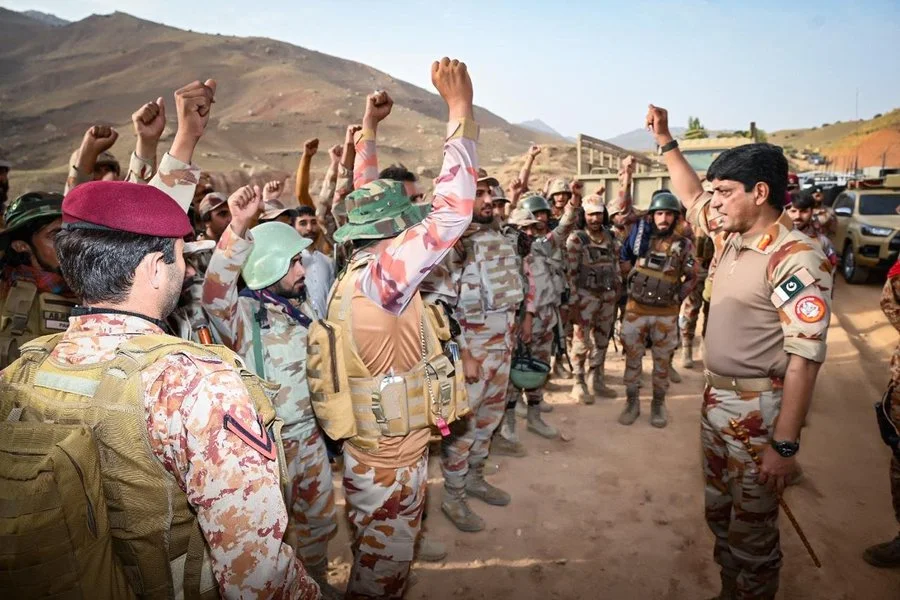
On 5 July 2026, after nine police personnel were martyred and eighteen others abducted and executed at the Mangi Dam police post in Ziarat, the Pakistan Army, the Frontier Corps and the Balochistan Police launched Operation Shaban. This is a joint, province-wide counter-terrorism campaign fought simultaneously on two fronts: against Tehreek-i-Taliban Pakistan (TTP) networks operating out of Afghan sanctuaries in the north, and against the Balochistan Liberation Army (BLA) and its affiliates in the resource-rich south.
Within days the toll of neutralised militants crossed a hundred. By mid-July it had passed 129. Interior Minister Mohsin Naqvi called it a reflection of the state’s resolve to protect national security. What deserves equal attention, however, is not merely that the operation happened, but why it took so long, and what history warns Islamabad against repeating.
A Conflict Older Than the State’s Patience for It
To understand Operation Shaban, one must resist the temptation to read it as a response to a single attack. It is instead the latest chapter in a confrontation that predates most of the institutions now prosecuting it.
The unrest in Balochistan traces to the contested 1948 accession of the Khanate of Kalat, when Prince Abdul Karim’s brief mountain revolt against his brother’s decision to join Pakistan became the seed of a grievance narrative that has since been replanted five times: in 1948, 1958–59, 1963–69, 1973–77, and in the insurgency that began in 2004 and, in its BLA-led form, persists to this day.
Each of these waves carried a different proximate cause. The One Unit scheme in the late 1950s, the dismissal of Balochistan’s elected provincial government by Zulfikar Ali Bhutto in 1973 and the killing of Nawab Akbar Bugti in 2006. But each also shared a common undertow: a province that is Pakistan’s largest by land, richest in gas, copper, gold and coastline, and yet consistently last in human development indicators.
It is this recurring pattern that involves resource extraction without proportional reinvestment, security operations without accompanying political settlement, that has allowed successive insurgencies to survive their own military defeats and re-emerge under new leadership and new branding.
The BLA of 2026, unlike its 1973 predecessor, is not a tribal levy responding to a dismissed government; it is a networked, ideologically hardened organisation that has absorbed decades of unresolved grievance and, per multiple security assessments, external facilitation.
Related: Balochistan: The Black Day That Never Was
The Colonial Inheritance — Context, Not Excuse
Any honest accounting of Balochistan’s underdevelopment must also reckon with what Pakistan inherited in 1947, rather than treating the province’s deficits as purely a post-independence failure. British rule in Balochistan was never administered the way Punjab or Sindh were. Where the colonial state built nine canal colonies and eleven million acres of newly irrigated farmland across West Punjab, and threaded Sindh with railways and settled administration, its approach to Balochistan was governed by the Sandeman system. This was an indirect rule through tribal sardars, designed to secure a strategic frontier against Russian advance rather than to build a functioning economy.
What infrastructure the British did construct, the Bolan and Khojak Pass railways chief among them, was purpose-built for imperial military logistics, not local development, and it left the province with garrisons and transit lines rather than schools, irrigation networks or industry.
This is not offered as an excuse for what followed. The seven decades since independence are Pakistan’s own record to answer for, and the state cannot outsource responsibility for post-1947 policy choices. But an honest assessment must note that Pakistan did not inherit a level playing field in 1947. It inherited a province structurally configured for extraction and control rather than growth, and the failure of successive governments was in perpetuating that configuration rather than in originating it. Any development track paired with Operation Shaban will only be credible if it treats this inherited asymmetry as the baseline to be corrected, not a historical footnote to be waved away.
Why the State Waited
Pakistan’s reluctance to launch a full-spectrum operation in Balochistan for as long as it did was not simple negligence. It reflected a genuine and defensible caution, which should be acknowledged rather than dismissed by critics eager to cast the state as either indifferent or trigger-happy. Three considerations restrained Islamabad:
First, the memory of 1973–77 itself. Bhutto’s deployment of over 80,000 troops in a scorched-earth campaign against the Marri and Mengal tribes did not end militancy in Balochistan. It radicalised the generation that would found the BLA a quarter-century later. Pakistani planners, aware of this precedent, have long feared that heavy kinetic action without a political track manufactures the next insurgency even as it defeats the current one.
Second, the CPEC calculus. With Gwadar and the wider China-Pakistan Economic Corridor (CPEC) threading directly through militant-contested districts, any large operation carried the risk of destabilising the very infrastructure it was meant to protect, and of complicating a strategic partnership Islamabad could not afford to unsettle.
Third, and most significantly, the porous Afghan border. Since the Taliban’s return to Kabul in 2021, Pakistan has watched TTP sanctuaries multiply on Afghan soil largely beyond its reach, forcing Islamabad into a diplomatic balancing act, pressing Kabul for action while avoiding a rupture that could push cross-border militancy further out of control. Every month of restraint was, in effect, a month spent trying the political and diplomatic route before resorting to the military one.
That patience had a cost. It allowed a permissive environment in which abductions in Balochistan alone accounted for the overwhelming majority of the country’s total in the months preceding the operation, and in which coordinated, near-simultaneous assaults, the kind that struck Hanna Urak, Ziarat and Mangi Dam within a 72-hour window in early July, became operationally possible.
The Mangi Dam attack was not the cause of Operation Shaban; it was the moment restraint became untenable.
What Operation Shaban Gets Right
Judged against its stated objectives, dismantling militant sanctuaries, protecting civilian and security infrastructure, and restoring the writ of the state, Operation Shaban represents a necessary and, on current evidence, competently executed correction.
Its dual-front design acknowledges a reality Pakistani security discourse has sometimes blurred that the TTP threat in northern Balochistan and the BLA-driven separatist insurgency in the south are distinct problems with distinct grievances, requiring distinct tactical approaches even under a single command structure. Targeting sanctuaries in Lasbela and Khuzdar separately from operations in Ziarat and Harnai reflects an appropriately differentiated understanding of the threat landscape rather than a blunt, one-size-fits-all sweep.
The use of precision aerial and intelligence-based operations, rather than indiscriminate area clearance, also marks a doctrinal maturation from the province’s bloodier past. State messaging that emphasises “the last militant,” rather than open-ended punitive presence, at least rhetorically commits Islamabad to an exit defined by success rather than occupation.
The Critique the State Should Welcome, Not Resent
Honest analysis owes both its readers and the Pakistani state clarity about what remains unresolved, precisely because it is offered in the service of the operation’s success rather than its delegitimisation.
Kinetic action cannot, by itself, break a sixth cycle.
Every prior wave of insurgency in Balochistan was militarily defeated. None was politically resolved. If Operation Shaban ends the way its four predecessors did, with a battlefield victory and an unaddressed grievance architecture, Pakistan should expect a sixth insurgency within a generation.
The state’s own history is the strongest argument for pairing Shaban with a parallel, well-resourced political and economic track: genuine provincial control over resource royalties, accelerated CPEC-linked employment for Baloch communities rather than imported labour, and a visible, credible mechanism for missing-persons cases that have long fuelled recruitment narratives regardless of who is ultimately responsible for individual disappearances.
The Afghan sanctuary problem cannot be solved by Balochistan operations alone. Degrading TTP networks inside Pakistan while their command-and-facilitation structures persist across the border in Afghanistan risks a cycle of tactical wins and strategic stalemate. Diplomatic pressure on Kabul must intensify in lockstep with Shaban, not trail behind it.
Political mainstreaming of Baloch nationalism, as distinct from its separatist fringe, remains underdeveloped. Nationalist sentiment and armed separatism are not synonymous, and treating them as such risks pushing constituencies that could be reconciled with the federation into the arms of those who cannot be.
None of this constitutes an anti-state argument. It is, rather, the argument for a state confident enough in the legitimacy of its counter-terrorism mandate to pair it with the reforms that make such mandates durable.
Why This Moment Matters Beyond Balochistan
Operation Shaban’s significance extends past the province’s borders. It is a test of whether Pakistan can execute simultaneous counter-insurgency against an ethno-nationalist threat and a transnational jihadist one without conflating the two in ways that alienate the former’s broader constituency. It is a test of whether CPEC-era security guarantees to Beijing can be met without reverting to the scorched-earth reflexes of 1973.
And it is a test, watched closely from Washington, Brussels and Gulf capitals, of Pakistan’s capacity for calibrated, intelligence-led counter-terrorism at a moment when its regional standing is being actively contested in the diplomatic and information domains.
Islamabad delayed this operation for reasons that were, in the main, defensible. Having finally moved, the state’s task now is to ensure that Operation Shaban is remembered not as the sixth military suppression of a recurring grievance, but as the first that was matched, deliberately and visibly, by the political settlement its predecessors never attempted.

Your go-to editorial hub for policy perspectives and informed analysis on pressing regional and global issues.