In the days before the 9th OIC Ministerial Conference on Women opened at Islamabad’s Jinnah Convention Centre, the Ministry of Human Rights released a photograph of the flags lining the entrance, 57 of them, Afghanistan’s tricolor among them. What the photograph could not show was who, if anyone, would stand beneath it.
The Taliban never confirmed a delegation. A resident of Kabul, reached by a wire service that week, asked the ministers gathering in Islamabad not to forget the women and girls of Afghanistan when they took their seats. That single, unresolved image, a flag without a delegate, framed everything that followed: a Muslim world convening in Pakistan’s capital to decide, collectively, what it owes the women some of its own members still leave behind.
That is the conference worth telling properly, not as a routine diplomatic gathering, but as a genuine test of whether the Muslim world’s largest bloc can turn shared language into shared accountability, with Pakistan now holding the pen.
What Islamabad Delivered
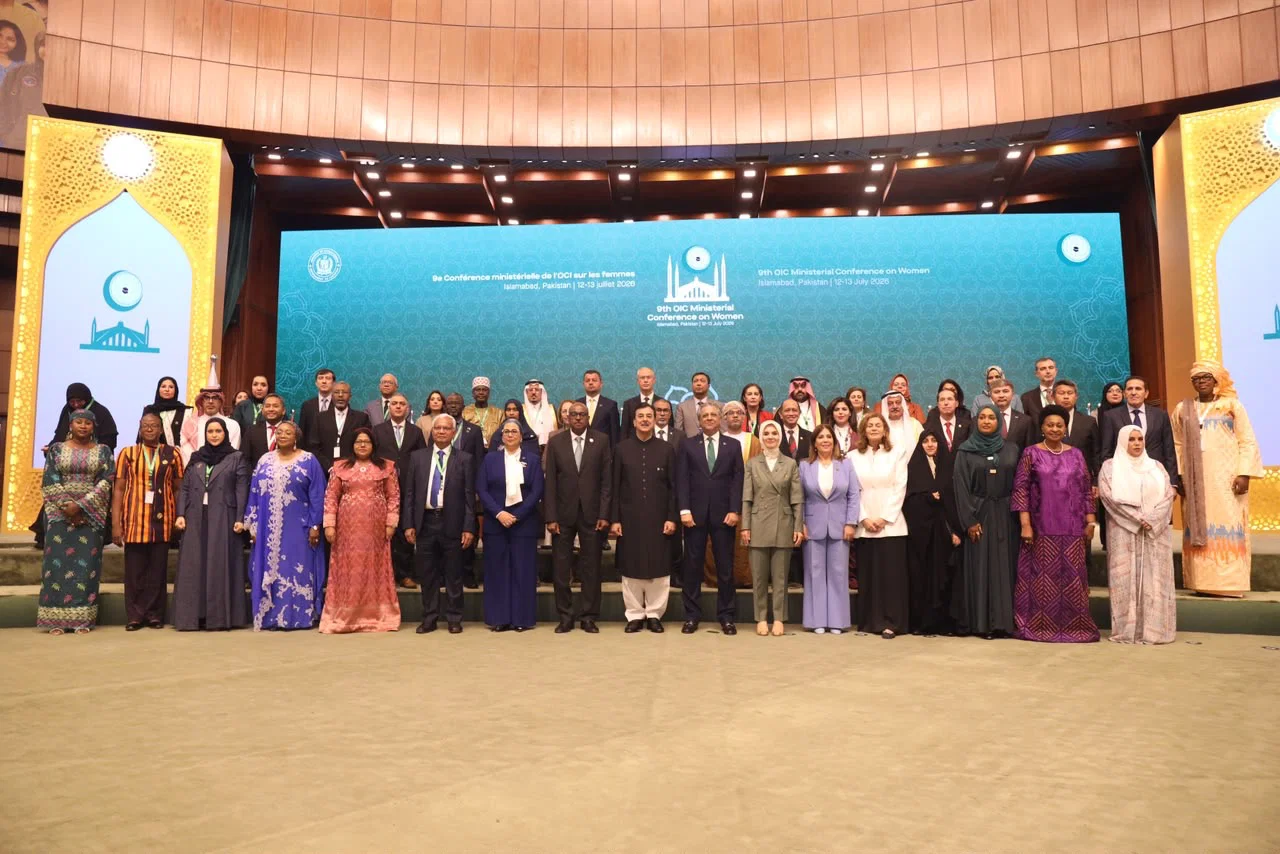
Over two days, nearly 190 delegates from all 57 OIC member states, ministers for women and family affairs, senior officials, representatives of the OIC’s own institutions and international development partners, negotiated and adopted the Islamabad Ministerial Declaration, alongside a comprehensive omnibus resolution.
The declaration commits member states to removing barriers to women’s education and employment, expanding technical and vocational training and leadership pipelines, and improving women’s access to jobs, financial resources, entrepreneurship support and social protection. It calls for stronger action against all forms of violence against women and girls, including the newer, technology-enabled forms including but not limited to cyber harassment, online exploitation, algorithmic abuse, that older frameworks were never built to address. And it explicitly commits OIC states to countering Islamophobia, xenophobia and discrimination targeting Muslim women specifically, a provision with real resonance for diaspora communities from Toronto to Berlin who have raised exactly this concern for years.
Alongside the declaration, Pakistan launched the Islamabad Initiative on Women’s Digital Inclusion, a new OIC platform built around digital literacy, entrepreneurship, STEM education, AI skills and cybersecurity training for women and girls, open to member states, OIC institutions and development partners who want to contribute scholarships, mentorship or technical expertise. And in a formal handover, Pakistan assumed the two-year chairmanship of the Ministerial Conference on Women from Egypt, with Law and Human Rights Minister Azam Nazeer Tarar presiding and Prime Minister Shehbaz Sharif inaugurating the session, Islamabad’s second major hosting of an OIC gathering on women and girls in as many years, following an earlier conference on girls’ education across Muslim societies.
None of this is trivial. The OIC is the second-largest intergovernmental organization after the United Nations, representing 57 states and roughly a quarter of humanity. A platform of that scale setting even voluntary benchmarks on women’s economic participation, digital access and protection from violence has real agenda-setting power, the kind Track II diplomacy analysts at Chatham House or the Council on Foreign Relations would recognize as normative infrastructure-building, the slow work of making certain commitments harder to walk back from in public.
Why This Sits Inside a Larger Global Architecture
For readers at the UN and in the international women’s-rights community, the value of the Islamabad Declaration is best understood not as a standalone document but as a regional contribution to an architecture they already recognize: the Sustainable Development Goals’ commitment to gender equality under SDG 5, the CEDAW framework that a majority of OIC states have ratified.
The Islamabad Declaration’s language on digital inclusion, financial access and protection from technology-facilitated violence tracks closely with priorities UN Women has pushed at the Commission on the Status of Women for several cycles running. That alignment matters diplomatically. It gives UN agencies and international NGOs a concrete, OIC-endorsed entry point to co-invest in a region, 57 countries, a quarter of humanity, where multilateral gender programming has often struggled to find local political buy-in. Pakistan, as incoming chair, is now the state best positioned to build that bridge.
A Deliberate Use of Convening Power
Pakistan’s decision to host and chair this conference should be read against the backdrop of a genuinely difficult year, a volatile security environment along its western border, a fragile but stabilizing economy under IMF-supervised reform, and a foreign policy bandwidth stretched thin. That a government managing all of that chose to invest diplomatic capital in convening 57 states on women’s empowerment reflects a deliberate strategic choice rather than a symbolic afterthought. And, this is not an isolated gesture.
In January 2025, Pakistan co-hosted, with the Muslim World League, an International Conference on Girls’ Education in Muslim Communities that drew over 150 delegates from 47 countries and, notably, produced its own Islamabad Declaration on education access.
Taken together, the two convenings, eighteen months apart, on adjacent themes, under the same skyline, suggest Islamabad is positioning itself not only as a normative leader within the Muslim world, but as a capital deliberately building a recognizable niche as a convening capital for gender-related diplomacy within the Muslim world, at precisely the moment its hard-power options are constrained. That is soft power exercised through institution-building rather than military or economic leverage.
OIC Assistant Secretary-General Dr. Tarig Ali Bakheet’s closing remarks, thanking Pakistan for its patronage and expressing confidence in Islamabad’s ability to steer implementation, reflected genuine institutional confidence in that leadership, not diplomatic courtesy alone.
The Afghanistan Question and Pakistan’s Position On It
The empty Afghan seat is not incidental to this story. It is arguably the sharpest test of what OIC leadership actually means in practice. Afghan women and girls currently face sweeping restrictions on secondary and university education and public-life participation under Taliban rule, restrictions the OIC has repeatedly and publicly urged the Taliban to reverse, even while maintaining engagement on humanitarian issues.
By hosting a conference that visibly foregrounded Afghan women’s absence rather than quietly omitting it, Pakistan aligned itself with the same position the UN and international women’s organizations have held throughout: that engagement with Kabul on security and humanitarian channels does not require silence on girls’ education.
That is a distinction worth drawing out explicitly for international readers who sometimes conflate Pakistan’s necessary engagement with the Taliban on cross-border security with its actual record on Afghan women’s rights advocacy at multilateral forums, the two are not the same, and Islamabad used this conference to make that clear.
The Work Chairmanship Now Commits Pakistan To
None of this erases the scale of the domestic challenge Pakistan itself still faces. A 2025 Global Gender Gap ranking that placed it last among 148 countries, female labour force participation near 22 percent, and a federal cabinet currently without a woman minister.
Framed honestly, that data is not a contradiction of Islamabad’s hosting role; it is the reason the chairmanship matters. Pakistan now carries a self-imposed, internationally witnessed benchmark against which its own reform trajectory that includes gender-responsive budgeting efforts already underway in the federal PSDP, the National Commission on the Status of Women’s ongoing advocacy, provincial legislation on harassment and violence, will be measured over the next two years.
Used well, external accountability of this kind has historically strengthened the hand of domestic reformers rather than embarrassed the governments hosting it. UN treaty-body reviews function on precisely that logic, and there is no reason the OIC chairmanship should function differently.
The Way Forward
Three things would let Islamabad’s declaration outlast the news cycle.
First, the Digital Inclusion Initiative needs UN agencies, international NGOs and private philanthropic partners to treat Pakistan’s invitation for scholarships and technical partnership as a real one, an opening worth taking rather than a symbolic gesture to note and move past.
Second, Pakistan’s own delivery against the declaration. This means cabinet representation, prosecution rates, budget execution against gender-tagged spending, should be reported transparently at future OIC sessions, giving both domestic advocates and international partners a shared, credible scorecard.
Third, the OIC’s continued public pressure on Kabul over girls’ education should stay loud rather than fade once the conference cycle moves on; that consistency is what will determine whether Islamabad’s framing of the empty Afghan seat was principle or theater.
Pakistan spent two days convening the Muslim world around a single, difficult question that what does empowerment actually require, beyond language. The delegates have gone home with a declaration. Whether Islamabad’s own next two years turn that declaration into the kind of measurable progress the UN, women’s rights organizations and Pakistan’s own citizens can all point to, that will be the real conference review, and it will not be written in a communiqué.

Your go-to editorial hub for policy perspectives and informed analysis on pressing regional and global issues.