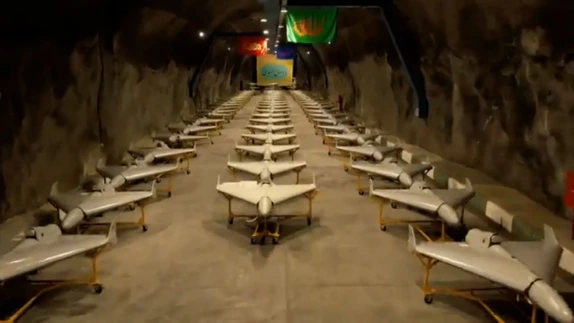
In modern warfare, power is not defined solely by visible military dominance. It is ultimately shaped by advanced technologies resulting from innovation, adaptability, and affordability. The Shaheed drones show this transformation. This article contends that advances in drone technology demonstrate a shift in the nature of power, contributing to the erosion of traditional military monopolies under the pressure of international sanctions and enabled by cost asymmetry.
The metaphor ” A Silent Arrow shaping the Winds of Power ” captures the strategic impact of emerging military technology in the current era of great power competition. The Silent Arrow refers to tools that operate with a far-reaching strategic influence. Unlike ballistic and cruise missiles, which are more destructive and even hard to detect, these unmanned aerial vehicles might not dominate the battlefield, but by imposing economic strain and creating persistent psychological pressure, they can have a massive effect. It illustrates how technology transformed the battlefield, where the large size and loud voice of military capabilities cannot guarantee survival. Still, they can be threatened by the cheap drones. It is also reshaping the dynamics of power not through direct confrontation but through silent disruption and strategic efficiency, restructuring influence and redefining the attributes of strength in the 21st century.
The development of Shahed Drones by Iran, despite several international sanctions, particularly on the acquisition of weapons, reshaped its strategic thinking to confront regional competitors. One of the important features of these “Poor man’s cruise missile” is its costly interception. Its prices are $20000- $35000 per unit, posing a serious financial problem for the adversary. The USA spend one million dollars’ worth of missiles to shoot down a single drone, and even sometimes responds with air defence missiles, which cost $4 million per interceptor. One of the former US Air Force officers and security analysts says, “it seems that the US has one million answers for just 20000 questions at the time”. This model of innovation under constraint also challenges the United States’ drone monopoly, which used these drones in North Africa, South Asia, and the Middle East. It demonstrates that today access to advanced military equipment is no longer restricted to dominant states, but middle powers and even non-state actors can also use drones and advanced military tools for their objectives.
The Shahed drones have two models (Shahed 136 and Shahed 131), which are not only used by Iran but also by Russia in the Ukraine war to target infrastructure and other strategic facilities, underscoring their strategic importance. As an instance, in October, 2025, Russia targeted Ukraine’s energy infrastructure in Kyiv, which affected the normal life of about 28,000 families and damaged 800 business industries in the region. Russia has used more than 57000 drones targeting cities in Ukraine in the last four years of conflict.
These suicide drones have proved how technological innovation can produce meaningful operational and psychological effects. As they are known for their terrifying sound and buzzing engines, it spreads fear among people, which disturbs the routine life of people, increasing psychological stress and anxiety. The drones are not just military equipment but a strategic game-changer in modern warfare. Its design, capabilities, and affordability make it an attractive option for both state and non-state actors to attack stationary targets and for swarm attacks. Their effectiveness is further strengthened by its mass production. When deployed in large numbers simultaneously, they can overwhelm the advisory’s air defence system. Iran uses such drones in large numbers, targeting the US bases across the Middle East. For instance, Iran targeted the Erbil Airport in the Kurdish region of northern Iraq, Ali al-Salem Air Base in Kuwait, key UAE oil depots and Dubai airport with a swarm of drones.
The rise of low-cost military equipment like Shahed drones demonstrates a significant shift in countries’ military strategies, moving towards affordable mass production and prioritising large quantities of relatively cheap systems, showing that technology quietly but decisively shifts the distribution of power. It recommends that future conflicts cannot be defined only by technological dominance but by the ability to innovate efficiently, stabilise our production, and impose costs on adversaries. For example, the impact of these “flying mopeds” can be seen in the US adaptation of the strategy of affordable mass. On July 16, 2025, the US introduced a new type of Kamikaze, LUCAS (Low-Cost Unscrewed Combat Attack System), which costs between $20,000 and $30,000 per unit, developed as an alternative to the US’s high-priced defence and traditional missile-based strategy of war against Iran. This was the threat of defence cost to force the US under the Trump administration to change its drone policy from traditional aircraft to the new, cheap drones to increase the pace of drone acquisition, reduce regulatory burdens, and scale production of expendable systems.
Ultimately, the metaphor in this op-ed not only reflects the importance of Iran’s drones but also represents a broader change in the logic of war. It reveals that in the 21st century, power is not defined solely by the largest military and the loudest, most expensive weapons. It does not matter whether you are the hegemon of the time or a global leader. Still, the power lies with those who master the art of quiet disruption and are committed to innovation adaptable to the current era, like the Shaheed drones made by the Iran Aircraft Manufacturing Industrial Company. It demonstrates that the supremacy in warfare is no longer driven by noise and visibility, but by the quiet force of innovation.