There is a pernicious irony at the heart of Pakistan’s water crisis—that a country born of the Indus, cradle of one of history’s great hydraulic civilisations, should now find itself gasping for every precious drop. Beneath the political din and the daily tumult of governance, a far more consequential drama is unfolding: the systematic depletion and contamination of the very water reserves upon which 250 million souls depend. Pakistan is, by every recognised metric, a water-stressed nation, hurtling inexorably towards catastrophic water scarcity. The per capita availability of water has plummeted from 5,650 cubic metres in 1951 to scarcely 1,000 cubic metres today—a precipitous decline that places us well below the threshold of absolute scarcity. What remains is increasingly unfit for purpose.
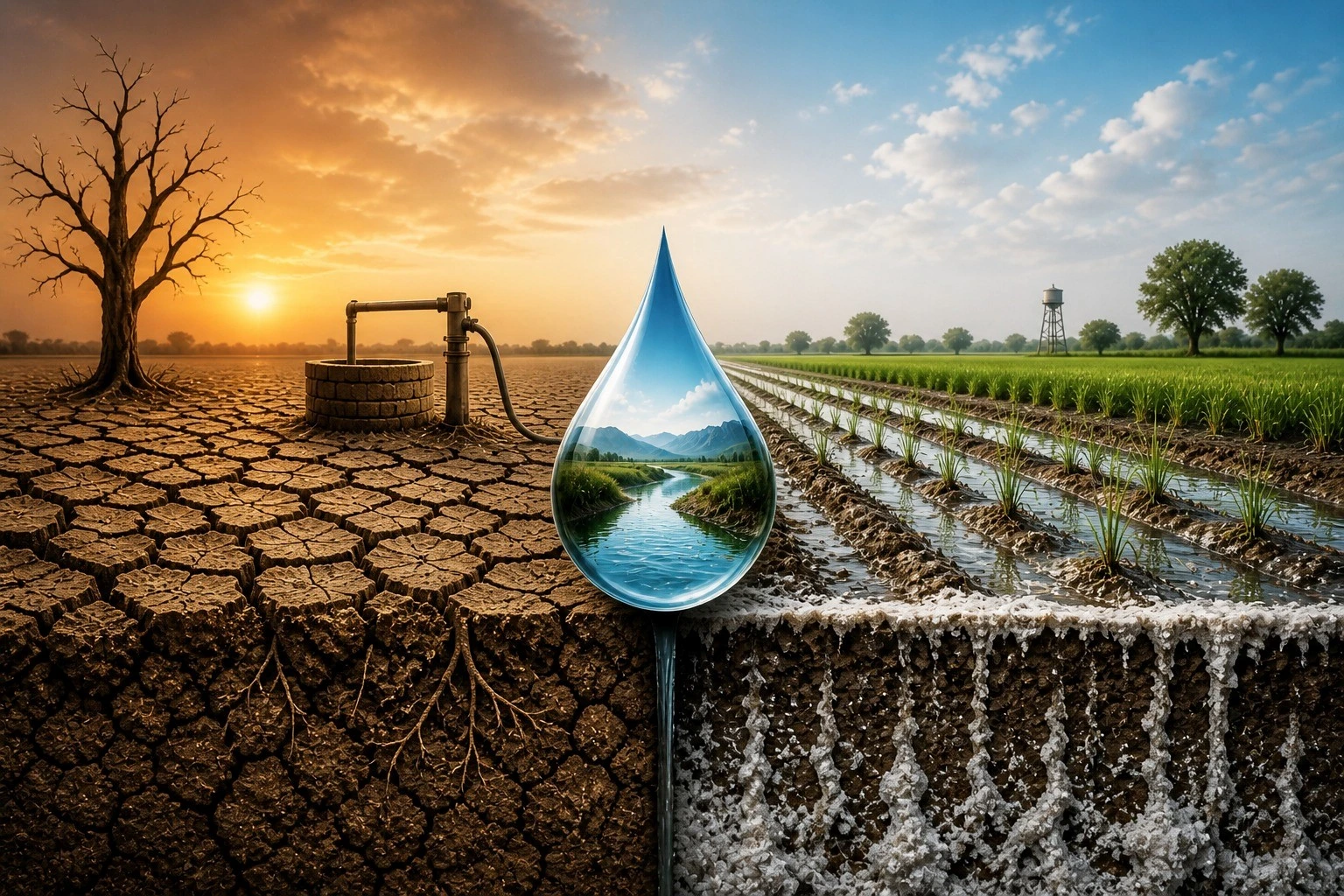
The contamination of our water resources is not merely an environmental concern; it is an existential assault on our agricultural foundations. Across the Indus Basin, groundwater that once sustained bountiful harvests has turned brackish, poisoned by the upward seepage of salts that nature deposited over millennia and human folly has brought to the surface. The nexus between water scarcity and salinity is neither abstract nor distant—it is a direct, causal chain. When surface water grows scarce, farmers turn to tubewells. When tubewells are drilled without regulation, the water table drops. When the water table drops, saline water from deeper formations intrudes upward. And when farmers, desperate to maintain their yields, continue to irrigate with whatever water is at hand—often of deteriorating quality—the salts accumulate in the root zone, silently strangling the soil’s fertility.
This is not a theoretical construct; it is a lived reality across vast swathes of Punjab and Sindh. The twin phenomena of water depletion and salinisation are locked in a deadly embrace, each exacerbating the other in a downward spiral that threatens to reduce millions of acres to agricultural wasteland. The cotton fields of South Punjab, the rice paddies of Central Sindh, the wheat belts that form the backbone of our national food security—all are under siege. A farmer who once drew sweet water from a depth of twenty feet now drills to a hundred feet and more, only to find water that is increasingly saline, increasingly costly to pump, and increasingly destructive to his land.
To grasp the mechanics of this devastation, one must understand how salinity forms—the hydrological alchemy that transforms fertile soil into a barren crust. When irrigation water—whatever its source—is applied to land without adequate drainage, the excess water percolates downward, raising the underlying water table. As water evaporates upward through the soil profile, it leaves behind dissolved salts. Over successive irrigation cycles, these salts accumulate. Crops begin to wilt not from lack of water, but from excess salt that prevents their roots from absorbing the water around them. The soil structure deteriorates; the land turns white with efflorescence; and the farmer, bewildered and destitute, watches his patrimony turn to dust.
Against this backdrop of gathering catastrophe, the importance of salinity research cannot be overstated. It is the beacon of scientific inquiry that must guide us through this labyrinth of hydrological degradation. The Punjab Irrigation Department, through its specialised Water Resources Zone, formerly the Directorate of Land Reclamation, has embarked upon a programme of systematic investigation that represents perhaps the most coherent institutional response to the crisis. The wing of this body, constituted as the Directorate of Salinity Research with its dedicated scientists and engineers, is engaged in the painstaking work of salinity research across the province, conducting soil and water analyses, and proposing site-specific reclamation strategies that acknowledge the heterogeneous nature of the problem.
The Water Resources Zone’s research agenda extends from the laboratory to the field, encompassing soil chemistry, hydrogeological modelling, and the testing of saline-tolerant crop varieties. Its scientists monitor the electrical conductivity and sodium absorption ratios of irrigation water with forensic precision, tracing the pathways of contamination from aquifer to root zone. They are, in essence, the diagnosticians of a landscape in distress—their analyses providing the empirical foundation upon which policy must be built. Without such research, any intervention would amount to little more than well-intentioned guesswork, squandering scarce resources on remedies ill-suited to the pathology.
One amongst the most consequential initiatives currently accomplished is the geo-referenced tagging of tubewells across Punjab—a technological intervention that signals a welcome departure from the era of unchecked, unregulated groundwater extraction. Under this programme, every tubewell is mapped out using global positioning system coordinates, entered into a centralised geographic information system database, and linked to real-time data on water quality, depth, and extraction rates. This geo-spatial inventory is nothing less than a digital nervous system for the province’s groundwater resources, enabling the authorities to monitor extraction patterns, identify zones of critical depletion, enforce pumping restrictions, and redirect farmers away from saline sources toward safer alternatives.
The significance of this geo-referenced tagging system cannot be overstated. For decades, the proliferation of tubewells has proceeded in a regulatory vacuum—anarchic, opaque, and environmentally ruinous. No one knew with any precision how many tubewells existed, where they were located, or what volume of water they were extracting. The aquifers were being mined blind. The geo-referencing initiative changes this fundamentally, bringing transparency and accountability to a sector that has long operated beyond the reach of effective governance. It is, moreover, an indispensable tool for salinity management, enabling the authorities to identify tubewells that are drawing from saline formations and to advise—or compel—farmers to seek alternative sources.
Yet, for all its promise, the Water Resources Zone remains grievously under-resourced, its mandate far exceeding its means. The geo-referencing programme, visionary though it is, requires massive investment in field staff, equipment, and digital infrastructure to achieve province-wide coverage. The salinity research laboratories need modern instrumentation and trained personnel. The reclamation projects require capital on a scale that only a fundamental reordering of budgetary priorities can provide. Pakistan currently spends less than one per cent of its GDP on water resource management.
The path forward demands a paradigm shift in how we conceptualise water security. It is no longer sufficient to view water merely as a commodity to be consumed; it must be recognised as a strategic asset requiring meticulous stewardship. The federal and provincial governments need to increase investment in water resource research and management, with salinity control as a central pillar. The geo-referencing of tubewells must be accelerated and extended across all provinces, integrated with a national groundwater information system. And farmers must be brought into the fold—educated, incentivised, and empowered to become custodians of the land rather than unwitting agents of its destruction.
Pakistan stands at a hydrological crossroads. The choices we make in the coming years will determine whether the Indus Basin remains the breadbasket of the nation or degenerates into a salinized wasteland. Water scarcity and soil salinity are not separate challenges to be addressed in isolation; they are intertwined manifestations of a single crisis of stewardship. To confront one without the other is to fight a fire while feeding its flames. The hour is late, but not yet too late. The question is whether we possess the wisdom to recognise the precipice before us—and the will to step back.