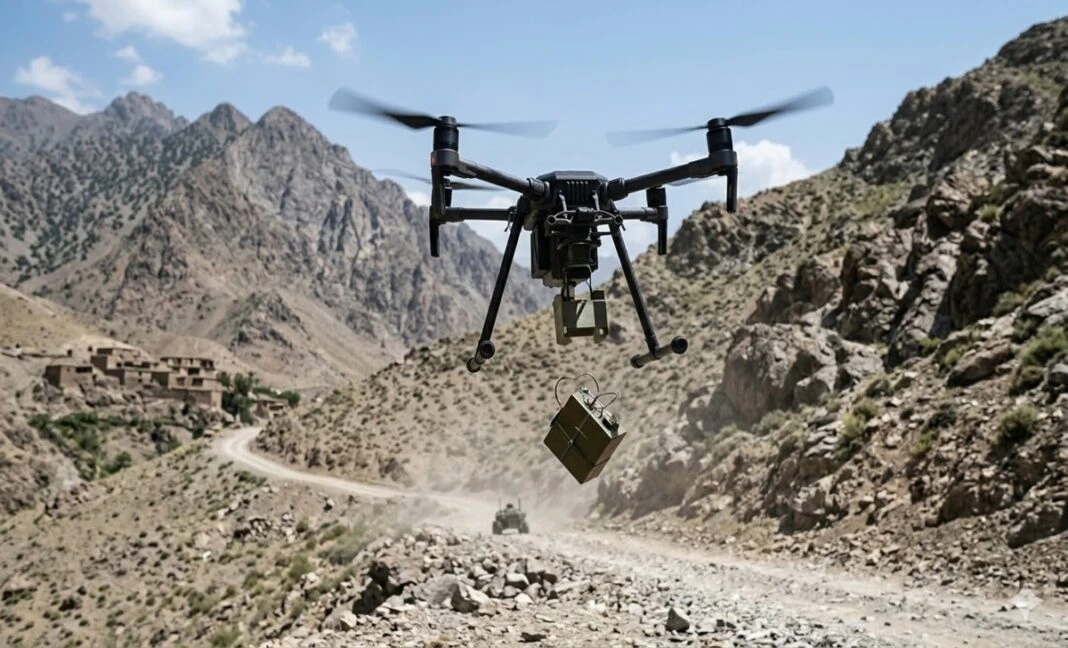
The attempted incursion of rudimentary drones into Islamabad’s airspace by Tehrik-i-Taliban Pakistan (TTP) in March 2026 was not just a failed tactical move; it points to a broader shift in Pakistan’s security landscape. For the first time in this phase of the conflict, the group has shown a willingness to push violence beyond the tribal belt and toward the country’s administrative centre. This comes as Operation Ghazab lil Haq is underway, reflecting both strategic intent and an evolving military approach. Yet, understanding this convergence requires situating it within a global phenomenon of the democratisation of precision warfare, reshaping conflicts from South Asia to the Middle East and Eastern Europe.
The Russia-Ukraine war showed just how rapidly drones could shift from the margins of the battlefield to its very centre. Those lessons did not stay within Europe’s borders. In May 2025, India and Pakistan fought what observers described as the first drone war between nuclear-armed neighbours. Across the Middle East, the same pattern asserts itself in different forms: Houthi barrages directed at Israel, pro-Iranian factions targeting American positions, and Hezbollah’s unrelenting cross-border operations. However distinct these conflicts may be in origin and objectives, they increasingly speak a shared tactical language. Stand-off engagement allows fighters to remain at a distance while extending their operational reach.
Therefore, the TTP’s shift towards drones did not emerge in isolation. The group is internalising the logic of unmanned warfare and adapting it to Pakistan’s internal security context. The intercepted incursion achieved its primary objective, signalling reach. Distance is no longer a reliable buffer, and the national capital can now be psychologically drawn into the conflict.
This is not merely a change in equipment; it is an internal reconsideration of how insurgent violence can be carried out. At previous stages of the conflict, militants were required to physically trespass on their targets, travelling on a hostile ground, avoiding checkpoints, and being exposed to observational scanning or ambush. Drones upend that logic. Operators can now watch from a distance, identify vulnerabilities, and deliver explosives without ever setting foot near the target. Equally important is how well this technology aligns with the TTP’s organisation. The group does not fight as a conventional army with a central command. It operates through autonomous cells spread across rugged and often inaccessible terrain. Commercial drones, widely available and easily adapted, place lethal capability directly in the hands of these cells without requiring approval or logistical backing from a central command. That diffusion of capacity makes the threat far harder to track or dismantle.
Simultaneously, Operation Ghazab lil Haq represents a shift in how Pakistan conducts counterterrorism campaigns. Conceived as a response to sustained militant provocations and cross-border sanctuaries, it aims to impose costs on hostile networks while reinforcing domestic deterrence. Information Minister Attaullah Tarar has made clear that operations will continue until objectives are achieved, targeting infrastructure used by the Afghan Taliban regime to support its terror proxies, including Fitna Al Khawarij. The campaign reflects a state apparatus that has internalised two decades of hard lessons.
While Operation Zarb-e-Azb relied on mass ground penetration to eliminate militant strongholds, this campaign operates under a different logic. Targeting is determined by intelligence, and precision is valued more than mass. This was well exemplified on the night of March 16, and it continues. Pakistani aircraft struck Afghan Taliban-linked military installations in Kabul and Nangarhar, hitting technical infrastructure and ammunition storage points. Secondary explosions after the strikes confirmed that significant weapons caches had been destroyed. Among the sites hit was a drone assembly workshop, the same facility from which drones had been launched into Pakistan. The strikes disclosed something much larger besides the immediate destruction. The drones have been built using components produced in India and Israel, exposing the transnational system that currently supports the capacity of the TTP.
However, the regional picture is more layered than it first appears. Afghanistan has become both a sanctuary and a workshop, where militant groups refine their tactics and connect with transnational networks that accelerate the spread of new methods of warfare. What makes this particularly concerning is what Pakistan’s security agencies have documented: evidence pointing to Indian intelligence operatives funnelling weapons and support to militants operating inside Pakistani territory. It is increasingly clear that New Delhi has pursued a sustained campaign to destabilise its neighbour through proxies.
In conclusion, Operation Ghazab lil Haq marks a clear shift toward cross-domain deterrence, where military action is backed by technological innovation and sharper intelligence. However, while Pakistan adapts, so do its adversaries: a militant network importing tactics from global conflicts, and a regional power fuelling instability for strategic gain. The fight is no longer just about clearing territory or eliminating fighters. It is about dismantling the state sponsorship that sustains them. In modern warfare, victory belongs to the side that adapts fastest. Pakistan intends to be on that side.

Faiza Abid is a Research Assistant at the Centre for Aerospace and Security Studies (CASS), Lahore. She can be reached at info@casslhr.com.