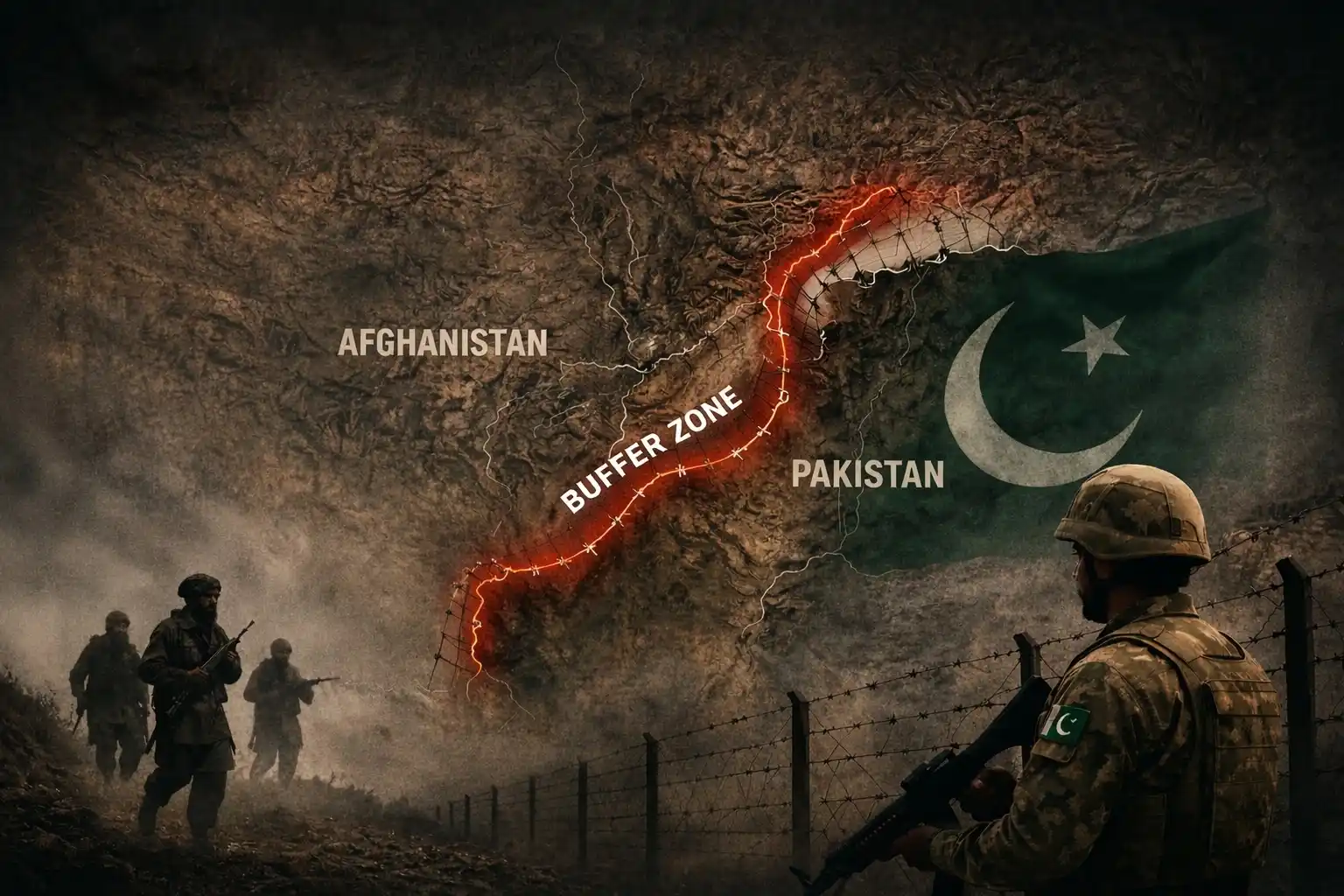
The security architecture of South Asia reached a definitive and historical inflection point in early 2026, as the persistent instability characterizing the borderlands between Pakistan and Afghanistan transitioned from a managed friction into a state of overt military confrontation. This shift, catalyzed by the Taliban’s consolidation of power in August 2021 and the subsequent erosion of regional security norms, has forced a fundamental re-evaluation of Islamabad’s strategic posture. The emergence of the Tehreek-e-Taliban Pakistan (TTP), often referred to by state authorities as Fitna al-Khawarij, as a disciplined military force capable of projecting lethal violence deep into Pakistani urban centers, has now necessitated the proposal of a strategic buffer zone extending from the southern province of Helmand to the northeastern Wakhan Corridor.
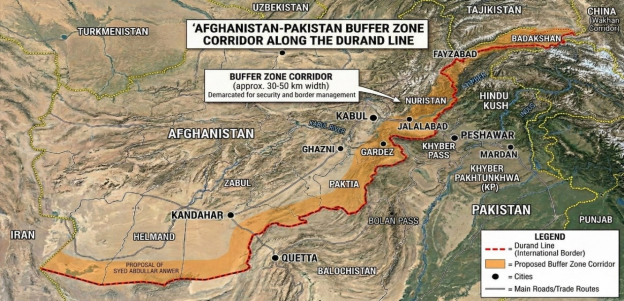
This proposal is not merely a tactical adjustment but a comprehensive paradigm shift modeled after the Turkish military’s “Safe Zone” interventions in Northern Syria, intended to act as a strategic shield pushing hostile militants away from the frontier while facilitating the organized resettlement of the Afghan refugee population.
The legal and strategic viability of such an intervention rests on a complex intersection of international law, United Nations findings, and the collective defense mechanisms of the Islamic Military Counter Terrorism Coalition (IMCTC). As the 36th and 37th reports of the UN Analytical Support and Sanctions Monitoring Team indicate, the Taliban administration has created a “permissive environment” for an array of terrorist groups, including Al-Qaeda and ISIS-K, thereby violating the fundamental counter-terrorism obligations set forth in the Doha Agreements of 2020 (Between US and Taliban) & 2025 (Between Pakistan & Taliban). The failure of over 65 rounds of diplomatic engagement has exhausted the traditional avenues of conflict resolution, leading to the commencement of Operation Ghazab Lil Haq in February 2026. This operation could represent the tactical precursor to a potential permanent buffer zone, utilizing advanced aerial assets and anti-drone technology to dismantle the infrastructure of non-state actors operating with impunity from Afghan soil.
The Durand Line and the Crisis of Sovereign Recognition
The primary obstacle to regional stability remains the chronic and historically rooted dispute over the status of the Durand Line. Established in 1893 as a 2,640-kilometer boundary between British India and the Emirate of Afghanistan, the line was intended to definitively limit the respective administrative spheres of the two powers. However, the transition of the British mandate to the sovereign state of Pakistan in 1947 introduced a permanent point of contention. While Pakistan and the vast majority of the international community recognize the Durand Line as the legitimate international border under the principle of uti possidetis juris, successive Afghan governments, including the current Taliban regime, have steadfastly refused to grant it official recognition.
This refusal is not merely a symbolic nationalist posture; it has profound and longstanding implications for border security. In the absence of a recognized border, the frontier remains a legal and security vacuum, facilitating the movement of non-state actors who utilize the rugged terrain of the Hindu Kush and the southern plains to bypass conventional security measures. The 2025-2026 period saw a marked escalation in border skirmishes, with the Taliban actively dismantling Pakistani border fencing that Islamabad spent over a decade and billions of dollars to complete as a primary defense against infiltration. This dismantling of the physical barrier by regular Taliban units represents an overt challenge to Pakistani sovereignty and is a core component of the “accumulation of events” that legally justifies the potential move toward a forward-defense buffer zone.
The principle of uti possidetis juris posits that newly independent states inherit the administrative boundaries established during the colonial period to prevent precisely the kind of instability currently seen along the Durand Line. Pakistan’s rejection of Afghan claims is rooted in the fact that the 1893 agreement was signed by a sovereign ruler and subsequently confirmed by multiple successors throughout the 20th century. The current Taliban posture views the line as an ethnic divider of the Pashtun heartland rather than a legal international border, effectively creating a zone where they feel no responsibility to curb the activities of groups like the TTP, which they view as ideological brethren. This lack of state responsibility is a key legal driver for Pakistan’s adoption of the “unwilling or unable” doctrine as a basis for extraterritorial intervention.
The Turkish Model: A Strategic Blueprint for Northern Syria and Beyond
The conceptual basis for a Pakistani buffer zone within Afghan territory is heavily influenced by the Turkish military’s “Operation Peace Spring” and subsequent interventions in Northern Syria. Facing a similar threat from the People’s Protection Units (YPG) and the Kurdistan Workers’ Party (PKK), groups Turkey classifies as terrorists, Ankara established a 30-kilometer-deep “safe zone” inside Syrian territory. This zone was intended to act as a strategic shield, pushing hostile militants away from the Turkish border and providing a space for the resettlement of refugees.
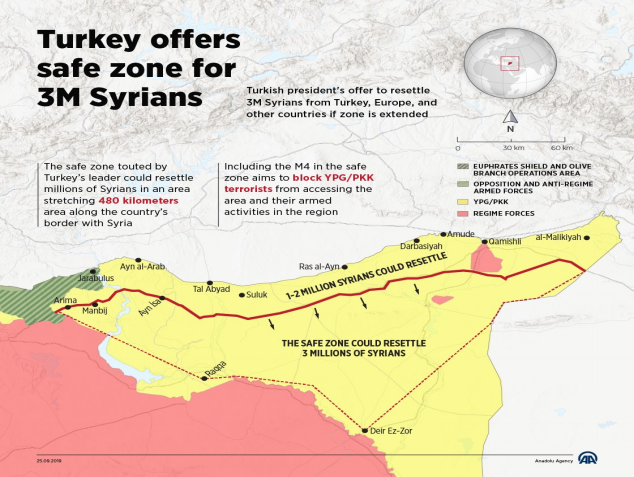
Turkey’s proposal for a “safe zone” in northern Syria aimed at resettling up to 3 million Syrian refugees
The Legal Justification of the Turkish Intervention
Turkey’s justification for this intervention rested on three primary pillars: the right to self-defense under Article 51 of the UN Charter, the “unwilling or unable” doctrine, and the 1998 Adana Agreement. The Adana Agreement, a bilateral treaty between Turkey and Syria, permitted Turkish forces to pursue terrorists up to five kilometers into Syrian territory if Damascus failed to take action. When the Syrian state lost effective control over its northern territories during the civil war, Turkey argued that the scale of the threat necessitated an expansion of this buffer to 30 kilometers.
In the Pakistani context, the TTP utilizes the provinces of Khost, Paktika, and Nangarhar as “safe havens” in a manner strikingly similar to the YPG’s use of Northern Syria. The failure of the Taliban to honor the security guarantees of the Doha Agreement (2020 & 2025), specifically their commitment to preventing Al-Qaeda and its affiliates from using Afghan soil, mirrors the Syrian government’s inability to control the PKK/YPG. Operation Ghazab Lil Haq, launched in February 2026, represents Pakistan’s transition to a forward-defense posture, targeting these sanctuaries to neutralize threats before they reach the Durand Line.
Rules and Mechanisms for Establishing Safe Zones
International Humanitarian Law regulates safe zones through several key instruments:
- 1949 Geneva Conventions (First and Fourth): These explicitly provide for “safety zones” to protect the wounded, sick, and specific categories of civilians from aerial bombardment and other dangers. Such zones must be located far from active fighting, remain undefended by military forces, and focus solely on humanitarian shelter. A draft agreement for establishing these zones is included in the annexes of the Conventions.
- Neutralized Zones (Fourth Geneva Convention): These allow for more flexible, ad-hoc arrangements within or near conflict areas to offer localized protection.
- Demilitarized Zones (Additional Protocol I to the Geneva Conventions): These broader zones aim to protect all civilians in the area from attack and prohibit the use of the territory for military purposes or occupation.
- UN Security Council Authority: Under Chapter VII of the UN Charter, the Security Council can authorize safe areas, as demonstrated in resolutions concerning Bosnia and Herzegovina (1993) and Rwanda (1994). Examples of militarily enforced zones include no-fly zones over Bosnia and northern Iraq, as well as protected civilian sites in South Sudan.
Customary IHL, as reflected in various state military manuals, further prohibits directing attacks against duly established safe zones. Critically, the creation of such zones traditionally requires agreement and consent from all concerned parties to ensure their protected status.
Comparative Strategic Features: Northern Syria vs. Durand Zone
| Precedent Feature | Turkish Northern Syria Zone | Proposed Pakistan-Afghanistan Zone |
| Primary Adversary | PKK / YPG / ISIL | TTP / BLA / ISIS-K |
| Legal Justification | Art. 51 UN Charter; Adana Agreement | Art. 51 UN Charter; Doha agreements 2020 & 2025, Unwilling/Unable Doctrine |
| Strategic Depth | 30 km | Proposed 30-50 km depth |
| External Guarantors | Russia (Sochi Agreement) | Proposed IMCTC joint intervention |
| Governance Model | Local councils overseen by AFAD/Military | Proposed joint military-civilian administration |
| Primary Objective | Counter-terrorism and border stabilization. Refugee return. | Counter-terrorism and border stabilization. Refugee return. |
UN Analytical Support and the Evidence of Terrorist Resurgence
The argument for Pakistan’s inherent right to defend itself is supported by extensive documentation from the United Nations Analytical Support and Sanctions Monitoring Team. The 36th and 37th reports to the Security Council paint a grim picture of Afghanistan as a “permissive environment” for global and regional terrorist organizations under Taliban rule.
Breakdown of Global Terrorist Threats in Afghanistan (2025-2026)
| Terrorist Organization | Estimated Strength | Primary Operational Bases | Threat Profile and Alliance |
| Tehreek-e-Taliban Pakistan (TTP) | Integrated Leadership + fighters | Khost, Paktika, Nangarhar, Kunar | Direct cross-border attacks; sheltered by Taliban. |
| ISIS-Khorasan (ISIS-K) | Integrated Leadership + fighters | Kabul, Kunar, Nangarhar | High-impact suicide bombings; regional spillover. |
| Al-Qaeda | Integrated leadership | Southeastern Afghanistan | Advisory and training support to TTP. |
| Baloch Liberation Army (BLA) | Fragmented units | Bordering Balochistan province | Hybrid warfare targeting economic projects. |
| East Turkestan Islamic Movement (ETIM) | Undisclosed | Badakhshan Province | Targeting Chinese interests; threat to BRI. |
Emerging India-Israel Axis in South Asia
The establishment of a secure buffer zone along the Durand Line has also become a critical strategic requirement for Pakistan to safeguard its western frontier and neutralize the growing joint India-Israel threat through proxies operating from Afghan soil. This urgency has sharpened in the wake of Israeli Prime Minister Benjamin Netanyahu’s announcement of the “hexagon alliance” posture, a framework of regional partnerships that prominently includes India to counter perceived emerging axes, both Shia and Sunni.
Former Israeli Prime Minister Naftali Bennett has explicitly warned of an emerging “hostile Sunni axis” that Turkey and Qatar are attempting to build with nuclear-armed Pakistan, describing Turkey as “the new Iran” and accusing the axis of seeking to encircle Israel and fuel enmity against the Zionist state. Similarly, in a recent high-profile interview with Arnab Goswami, Israeli Ambassador to India Reuven Azar openly categorized Pakistan as a “rogue state” that already possesses nuclear weapons.
Pakistan further faces a direct threat from the so-called “Hummus Trail” in northern India, where locations such as Kasol, Dharamkot, and Parvati Valley have transformed into Israeli enclaves, often dubbed “Mini-Israel”, which serves serving as post-service “detox” destinations for thousands of IDF soldiers, including personnel linked to Unit 8200 cyber intelligence. These areas feature Hebrew signage, Israeli-run businesses (reportedly controlling up to 80% in Kasol), Chabad Houses suspected of functioning as Mossad networking points, and restrictions excluding local Indians, all under the guise of tourism. This presence enables potential intelligence gathering, cyber support, and forward operational collaboration between RAW and Mossad in a strategically sensitive region bordering Kashmir, China, and key Indian military hubs, effectively creating Israeli “settlements” on Indian soil that deepen the Indo-Israeli axis against Pakistan and regional adversaries.
In this evolving multi-front threat environment, the buffer zone serves as an essential forward-defense layer to disrupt cross-border infiltration, dismantle proxy sanctuaries, and prevent external adversarial forces from potentially exploiting Afghan territory.
Strategic Geography: From Helmand to the Wakhan Corridor
The logistical requirement of a buffer zone covering the territory from Helmand to the Wakhan Corridor is immense, involving some of the most challenging terrain on earth. The proposed zone would in its entirety cover roughly 1,500 kilometers of the border, cutting through high-altitude peaks, narrow valleys, and arid plains. A multiple phase approach towards the construction of the buffer zone would be vital in achieving the stated long-term goals.
The Wakhan Corridor and the “Pamir Knot”
The Wakhan Corridor is a narrow strip of land in northeastern Afghanistan, protruding toward China and separating Tajikistan from Pakistan. Historically created as an “imperial buffer zone” during the Great Game, it remains one of the world’s most isolated wildernesses. The “Pamir Knot” features passes over 5,000 meters high, making conventional military movements nearly impossible for much of the year.
However, the corridor is gaining renewed strategic importance due to China’s Belt and Road Initiative (BRI). The Taliban has actively sought to open the Wakhjir Pass for trade with China, a move that Beijing has approached with caution due to fears of ETIM militants entering Xinjiang. Pakistan’s establishment of a buffer in this region would serve the dual purpose of protecting its own northern belt (Chitral and Gilgit-Baltistan) and aligning its security objectives with China’s desire to prevent militant infiltration into its western provinces.
Legality Under International Law: The Self-Defense Argument
The core legal debate centers on whether Pakistan’s actions meet the criteria of “armed attack,” “necessity,” and “proportionality” required by Article 51 of the UN Charter.
The “Armed Attack” Threshold
Traditional international law requires a state to be the victim of an “armed attack” before it can exercise its right to self-defense. Pakistan points to the more than 1,100 deaths in 2025 and the systemic nature of the TTP attacks as evidence that this threshold has been surpassed. Furthermore, the “accumulation of events” theory, where a series of smaller attacks collectively amount to an armed attack, is increasingly accepted in state practice, including by Turkey in its justifications to the Security Council for its Syrian interventions.
The Doctrine of Necessity and Proportionality
Necessity dictates that force must be the only remaining option to neutralize a threat. Pakistan’s case for necessity is built on the exhaustion of diplomatic efforts, including over 65 rounds of talks mediated in Doha, Istanbul, and Saudi Arabia, all of which failed due to the Taliban’s refusal to dismantle TTP sanctuaries or extradite key leaders. Proportionality requires that the scale of the response matches the threat. Pakistan’s Operation Ghazab Lil Haq utilized precision airstrikes aimed at military infrastructure, brigade headquarters, and ammunition depots rather than the civilian population, although the scale of the operation, hitting targets in Kabul, Kandahar, and Paktia, represents a significant escalation.
Basis for Extraterritorial Force
| Legal Pillar | Pakistan’s Argumentative Basis |
| Article 51 (Self-Defense) | Continuous armed attacks by non-state actors (TTP) from Afghan soil. |
| Unwilling or Unable | Taliban administration refuses to curb TTP and lacks capacity to stop ISIS-K. |
| Plea of Necessity | Exhaustion of 65+ rounds of diplomatic talks and regional mediation. |
| Sovereign Integrity | Lack of de jure international recognition of the Taliban regime as a government. |
| Accumulation of Events | Multiple small-scale border incursions collection amount to an armed attack. |
While the “unwilling or unable” doctrine is still debated among international legal scholars, it has been increasingly utilized by states facing non-traditional threats. For a state facing an existential threat from groups like the TTP, the pragmatic application of this doctrine is viewed as the only way to fulfill the primary duty of the state: the protection of its citizens.
The Islamic Military Counter Terrorism Coalition (IMCTC) as a Force Multiplier
The Islamic Military Counter Terrorism Coalition (IMCTC), a 43-member military alliance formed in 2015, presents a potential mechanism for a joint intervention in Afghanistan to create and manage the buffer zone. Pakistan has a historical leadership role in the coalition, with former army chief General Raheel Sharif serving as its first commander-in-chief.
The Munir-Al-Moghedi Meeting: A Strategic Catalyst
In February 2026, IMCTC Secretary-General Major General Mohammed Bin Saeed Al-Moghedi met with Pakistan’s Chief of Army Staff (COAS) and Chief of Defence Staff (CDF) Field Marshal Asim Munir in Rawalpindi. This high-level meeting focused on “regional security dynamics” and “enhanced cooperation in counter-terrorism efforts”.
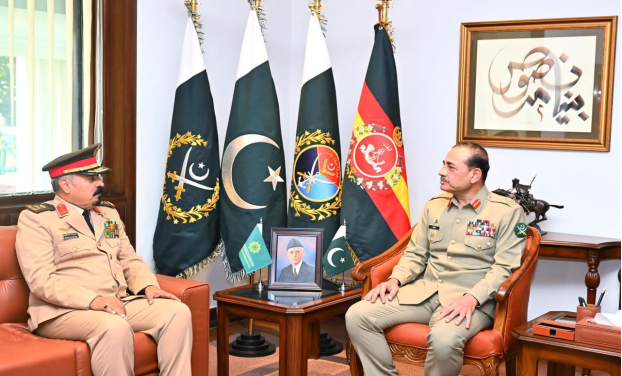
Pakistan’s Chief of Defence Forces, General Syed Asim Munir, in a meeting with Secretary General of the Islamic Military Counter Terrorism Coalition (IMCTC), Major General Mohammed Bin Saeed Al-Moghedi
A joint intervention involving the IMCTC could provide several strategic advantages:
- Multilateral Legitimacy: An intervention involving a coalition of Islamic nations would counter the Taliban’s narrative of “Pakistani aggression” and frame the operation as a collective effort to protect the Muslim Ummah from “Fitna/Khawarij “.
- Capacity Building: The IMCTC’s mandate includes training and capacity building among member states. The coalition’s training on the “Re-integration and Rehabilitation of Extremist Elements” could be scaled into a full-scale deradicalization program within the buffer zone.
- Joint Operations Center: The IMCTC maintains a joint operations center in Riyadh designed to coordinate military and relief support to member countries to enable them to defeat armed terrorist groups.
- Intelligence Sharing: Pakistan and the IMCTC reaffirmed their commitment to intelligence sharing, which is critical for tracking the transnational movements of TTP, Al-Qaeda, and ISIS-K fighters.
The potential for the IMCTC to evolve into an “Islamic Peacekeeping Force” has been posited as a new model for regional stability, capable of operating together on counter-terrorism and peacekeeping duties while bridging sectarian divides. For Pakistan, the IMCTC represents a “soldier-diplomat” tool that elevates its national security imperatives into a broader Islamic framework. Finally, the IMCTC will also be pivotal in generating consensus and consent in the neighboring states of Afghanistan for the establishment of the humanitarian Pak-Afghan Buffer zone.
Refugee Resettlement and Demographic Stabilization
A central pillar of the Turkish model is the utilization of the buffer zone as a “safe zone” for the large-scale resettlement of refugees. By early 2026, Pakistan had already repatriated nearly 2 million Afghans. The proposed buffer zone would potentially serve as the foundation for permanent “humanitarian communities”.
The Strategy of “Humanitarian Communities”
Under the Turkish precedent, Ankara sought to build 140 villages and 10 districts within its 30-kilometer-deep zone to accommodate over one million Syrian refugees. The strategic objective was to replace hostile elements with a “favorable population” overseen by friendly local administrations.
For Pakistan, resettling returnees through voluntary repatriation within the Helmand-Wakhan buffer zone could serve as a mechanism for demographic stabilization. By establishing communities that are economically linked to Islamabad rather than being politically held hostage by the Taliban, Pakistan can facilitate a population that has economic and political interests tied to the security of the buffer zone thereby countering the TTP threat. These villages/towns would serve as a “model” of governance, providing much needed humanitarian services that the Taliban administration has failed to deliver while also ensuring an inclusive and secure governance structure in the buffer zone having two-fold advantages for its population of economic connectivity and political security.
Conclusion and Strategic Outlook
The research indicates that Pakistan’s move toward a strategic buffer zone along the Durand Line is a pragmatic, albeit high-stakes, response to the collapse of regional security norms under the Taliban administration. The legal justifications, grounded in a credible interpretation of the right to self-defense (Article 51) and the “unwilling or unable” doctrine, are supported by a mounting body of empirical evidence from UN monitoring teams regarding TTP and ISIS-K activity.
The atrocities committed by the Taliban and their failure to uphold the Doha Agreements (2020 & 2025) have eroded their claim to absolute territorial sovereignty, creating the necessary space for a “humanitarian and security intervention”. The Turkish model provides a clear blueprint for how a regional power can establish security in on its “direct border” when a neighbor is either unable or unwilling to act.
The transition to a permanent Pak-Afghan Bufferzone represents the final abandonment of the “strategic depth” policy in favor of “forward defense”. While the benefits of this proposal shall be reaped in the long-term, the alternative of a persistent terror campaign projected from an ungoverned neighbor is increasingly viewed as an existential threat to the Islamic Republic of Pakistan. The success of this strategy now depends on Pakistan’s ability to successfully operationalize the buffer zone while maintaining the diplomatic support of regional powers, ensuring that the Durand Line finally ceases to be the focal point of South Asian instability.

The writer is an Advocate of the High Courts of Pakistan and holds an LL.M. in International and Maritime Law. He is currently a Senior Associate at the Global 100 law firm TAHOTA in China.
Previously, Syed Abdullah Anwer served as a Senior Research Fellow at the MANTAQ Center for Research & Legislative Drafting within the National Assembly of Pakistan, where he contributed to legislative review, treaty analysis, and public policy development. He also headed the Maritime Law Department at the Maritime Study Forum (MSF) and worked as a Research Officer at the Institute for Strategic Studies Research & Analysis (ISSRA), National Defence University (NDU).