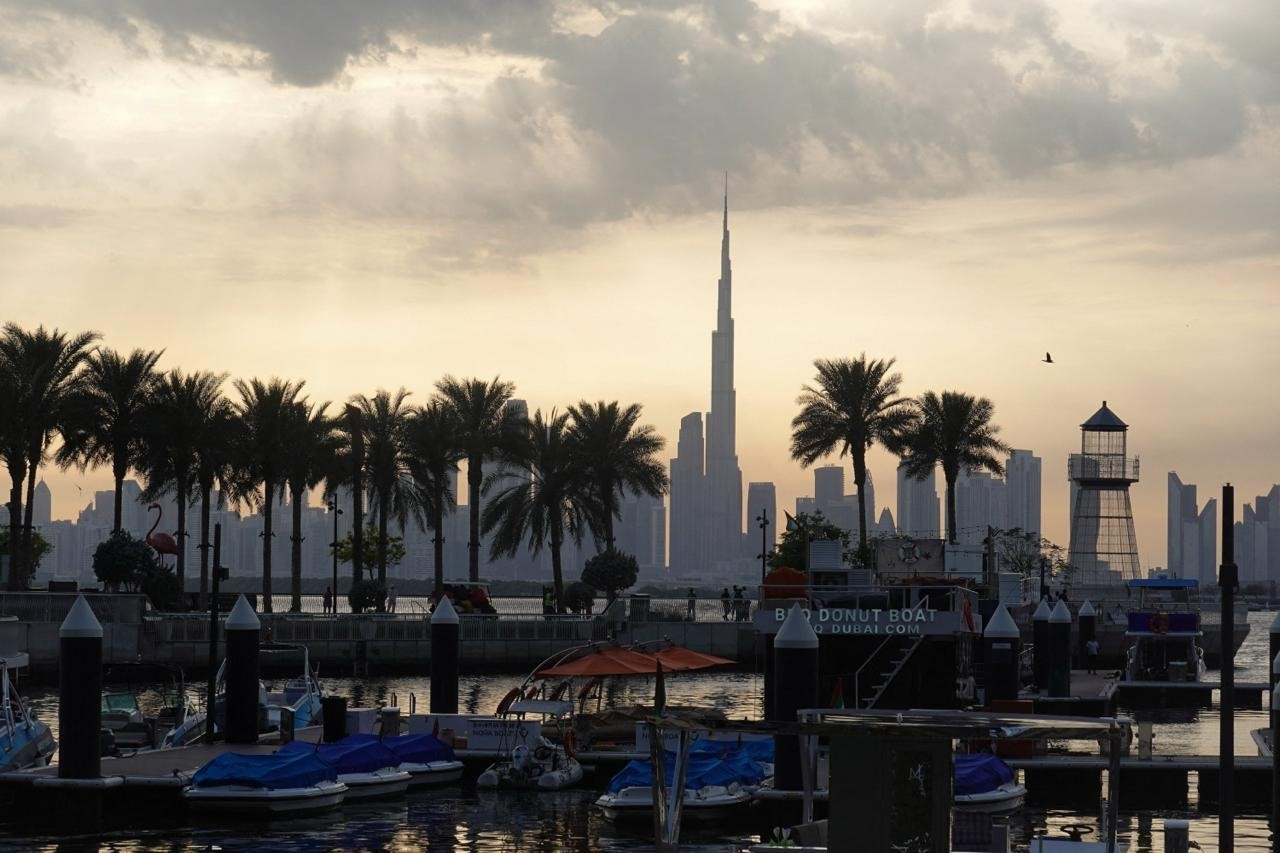
In the eight days since the United States and Israel launched Operation Epic Fury against Iran, the United Arab Emirates has intercepted hundreds of missiles and drones fired at its territory. Civilians have been killed and injured. Dubai International Airport, the busiest in the world, has been forced to suspend operations multiple times. Oil infrastructure has been targeted. And yet the official posture from Abu Dhabi has remained, with remarkable consistency, that everything is essentially fine.
This is not a communications failure. It is a strategic choice. And understanding why UAE made it, and what it reveals about the deeper vulnerabilities that choice cannot conceal, matters well beyond the current conflict.
How The UAE Arrived Here
The Abraham Accords of 2020 were celebrated, correctly, as a significant diplomatic achievement. For UAE, normalization with Israel offered access to technology, intelligence sharing, deepened ties with Washington, and a seat at the table of a new regional architecture that appeared, at the time, to be consolidating around American power.
What the Accords also did, less discussed at the time, was fundamentally alter UAE’s threat profile. By formally aligning with Israel, UAE inserted itself into a bilateral enmity with Iran that predates the Islamic Republic itself and which Israel regards as existential. As part of the security architecture envisioned around normalization, UAE sought to acquire 50 American F-35 fighter jets in a $23 billion deal fast-tracked by the Trump administration. The sale collapsed under the Biden administration amid disputes over UAE’s ties with China and American insistence on operational restrictions Abu Dhabi considered a violation of its sovereignty. The jets were never delivered. The gap between UAE’s political alignment and its military capacity to backstop it was visible from the beginning. The security dimension was, in effect, subcontracted to the United States.
That arrangement worked well enough during peacetime. It has proven considerably more fragile under fire.
Iran’s targeting logic is not punitive toward UAE in the way it is toward Israel. It is functional. Al Dhafra Air Base, located south of Abu Dhabi, hosts the US Air Force’s 380th Expeditionary Wing and has been among Iran’s primary targets since hostilities began, which has been confirmed by IRGC statements, US Central Command, and the UAE’s own defense ministry. From Tehran’s perspective, that makes UAE infrastructure a legitimate military target regardless of what Abu Dhabi’s political leadership intended when it signed the Accords or agreed to host American forces. UAE’s political choices and Iran’s military logic are operating on entirely different tracks, and the population living between them is absorbing the gap.
The Economics of Managed Calm
UAE’s response to this situation, the insistence on normalcy, the official reassurances, the visible efforts to keep commerce and tourism functioning, is not without strategic rationale. UAE’s entire economic model rests on being the region’s indispensable hub. The moment that perception fades away, the consequences cascade: capital flight, talent exodus, tourism collapse, and a contraction of the logistics and financial services that underpin everything else. For a country with no agricultural base, limited hydrocarbons relative to its neighbors, and a population that is roughly ninety percent foreign nationals, the appearance of stability is not merely political. It is existential in an economic sense.
The leadership understands this clearly. It is precisely due to this reason that their communications strategy has prioritized continuity signals over transparency about the actual security situation. This is a rational calculation given the constraints. It is also one that transfers risk from the economy onto the population, including a very large number of low-income migrant workers who have neither the resources to leave nor the political voice to demand better information. The three civilians confirmed killed in the UAE since hostilities began were nationals of Pakistan, Nepal, and Bangladesh. The injured span dozens of nationalities, the overwhelming majority of them South and Southeast Asian workers. The communities with the least institutional protection have carried the highest human cost.
The Geometry of Deterrence
There is a more fundamental strategic problem that the normalcy strategy cannot address, which is that UAE currently presents Iran with a target that carries no retaliatory cost beyond the interceptions themselves.
Deterrence, in its classical understanding, requires the credible threat of a response that the adversary wishes to avoid. UAE’s defense posture, built around American-operated Patriot and THAAD batteries, is capable and has performed well, but interception is not deterrence. It is resilience. This distinction matters. A country that can only absorb attacks, however effectively, sends a signal that the cost of attacking it is bounded and predictable. There is no scenario, under the current doctrine, in which striking UAE produces consequences that Iran’s military planners did not already account for.
This asymmetry is not unique to this conflict. But the current war has made it visible in a way that peacetime obscures. Now compare this with Pakistan, a country that is, if anything, more deeply entangled with the United States than UAE. Pakistan possess US-origin F-16s, has decades of intelligence and military cooperation with Washington, and its Chief of Defence Forces met Saudi Arabia’s Defence Minister in Riyadh just yesterday under the umbrella of a formal mutual defense agreement. Pakistan is not being attacked by Iran.
The reason is not geography and it is not nuclear weapons, though both play a role. It is doctrine. Pakistan’s strategic culture, forged through multiple conflicts and two nuclear-armed standoffs, communicates with clarity that an attack on Pakistani territory produces an immediate, disproportionate, and conventional military response. Iran does not need to test this proposition. Pakistan’s history tests it continuously on its behalf. The deterrence is not declared. It is demonstrated, repeatedly and credibly, over decades.
UAE has no equivalent signal in its strategic history. It has formidable American hardware, significant financial resources, and considerable soft power. None of those assets communicate to Iran’s military planners that attacking UAE will produce consequences they have not already priced in.
The Contours of a Resilient Posture
None of this is to suggest that UAE should have launched retaliatory strikes against Iran. That would be neither proportionate nor strategically coherent for a country of its size, and it would almost certainly trigger escalation beyond anything its defense architecture could manage independently.
The question is not whether UAE should fight Iran. The question is whether UAE’s long-term security architecture is calibrated for the world it actually inhabits rather than the world it was designed for.
A more resilient posture would involve, at minimum, three things. First, honest public communication about the security environment, not panic, but the kind of measured transparency that builds genuine public confidence rather than the brittle confidence that depends on nothing going visibly wrong. Second, a serious internal debate about the relationship between political alignment and military capacity, specifically whether UAE’s foreign policy commitments are matched by the indigenous defense capabilities needed to backstop them. And third, a more active role in the diplomatic architecture being constructed around this conflict, rather than a posture that is purely reactive to events being driven by others.
UAE has enormous assets to bring to that third dimension in particular. Its relationships across the region, its financial leverage, its reputation as a facilitator, are genuinely valuable in a moment when the Middle East’s security order is being renegotiated. Those assets are most effectively deployed from a position of acknowledged reality rather than performed calm.
The Deeper Lesson
The Abraham Accords were built on a reasonable bet: that American power would remain the dominant organizing force in the Middle East, that normalization’s economic dividends would outweigh its security costs, and that Iran’s capacity and willingness to project force would remain constrained. All three of those assumptions are under severe pressure simultaneously.
That does not mean the Accords were a mistake. It means that the security architecture built around them needs to be rethought with the same seriousness and strategic clarity that UAE has consistently applied to its economic development.
The country has demonstrated, repeatedly, that it can build institutions and capabilities that outperform its size. The current conflict is a signal, not a verdict. But signals of this kind, arriving this loudly, tend not to repeat themselves indefinitely before they become something harder to recover from.
The time to read them clearly is now.

Dan Qayyum is a media strategist, writer, and geopolitical commentator with over two decades of experience across the Middle East, South Asia, and Europe. He has worked alongside and within some of the world's leading international media organisations, including The Wall Street Journal, Reuters, The Economist, and the New York Times. He is a former senior executive at major media platforms across the Gulf region and currently leads Captiv8 Strategies, a London-based advisory firm focused on media partnerships and strategic communications. He writes on geopolitics, regional security, and the intersection of media and power.