Kashmir Assembly Demands Restoration of Special Status

Kashmir Assembly calls for the restoration of special status and partial autonomy after recent regional election.

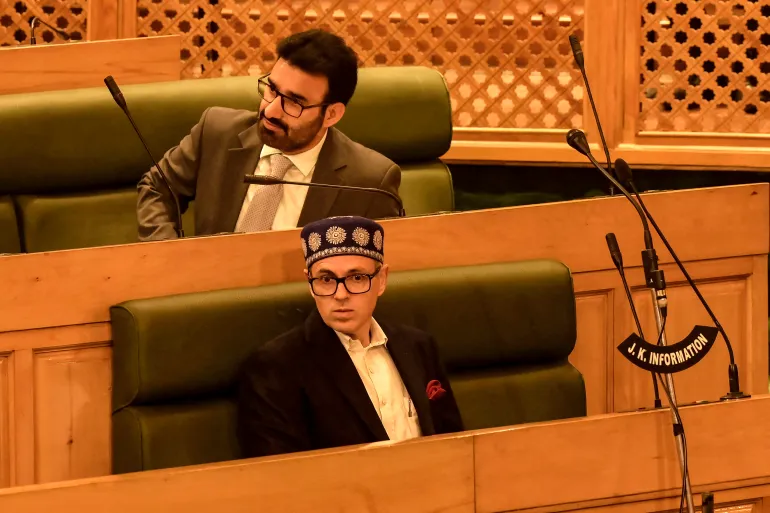
The legislative assembly in Indian-administered Kashmir has passed a resolution demanding the restoration of special status and partial autonomy.

The resolution, passed on Wednesday, comes a month after the Jammu and Kashmir National Conference (NC) won a regional election last month with promises to return self-rule to the disputed Muslim-majority territory.

Prime Minister Narendra Modi’s Hindu nationalist Bharatiya Janata Party (BJP) government cancelled Jammu and Kashmir’s special status in 2019, and the territory has been ruled by a governor appointed by New Delhi since.

“This assembly calls upon the government of India to initiate dialogue with elected representatives of people of Jammu and Kashmir for restoration of special status,” the resolution, passed by a majority vote in the 90-member assembly, read.

It added that it “reaffirms the importance of the special and constitutional guarantees, which safeguarded the identity, culture and rights of the people of Jammu and Kashmir”.

Also See: Elections In IIOJK Cannot Resolve Kashmir Dispute: Mirwaiz

The 29 members of BJP in the legislative body opposed the non-binding resolution, which requires approval from the federally appointed governor.

They said the resolution carried no weight as the parliament had scrapped the special status, and they shouted Hindu nationalist slogans.

Kashmir has been divided between nuclear-armed rivals India and Pakistan since their partition at the end of British rule in 1947, and both countries claim full ownership of the territory.

Tens of thousands of civilians, soldiers and rebels have been killed in the territory during decades of unrest that shows no sign of stopping.

In one of the latest spates of violence, gunmen killed seven people working on a strategic tunnel project near the resort town of Sonamarg last month.

Police claim that rebels fighting against Indian rule in the territory were responsible for the “terror attack”.

Many Kashmiris support the goal of uniting the territory, but India has branded such aspirations “Pakistan-sponsored terrorism”.

This news is sourced from Aljazeera and is intended for informational purposes only.

News Desk

Your trusted source for insightful journalism. Stay informed with our compelling coverage of global affairs, business, technology, and more.

Recent

An analysis of Qatar’s neutrality, Al Jazeera’s framing of Pakistan, and how narrative diplomacy shapes mediation and regional security in South Asia.

Qatar’s Dubious Neutrality and the Narrative Campaign Against Pakistan

Qatar’s role in South Asia illustrates how mediation and media narratives can quietly converge into instruments of influence. Through Al Jazeera’s selective framing of Pakistan’s security challenges and Doha’s unbalanced facilitation with the Taliban, neutrality risks becoming a performative posture rather than a principled practice. Mediation that avoids accountability does not resolve conflict, it entrenches it.

Read More »
An analysis of how Qatar’s mediation shifted from dialogue to patronage, legitimizing the Taliban and Hamas while eroding global counterterrorism norms.

From Dialogue to Patronage: How Qatar Mainstreamed Radical Movements Under the Banner of Mediation

Qatar’s diplomacy has long been framed as pragmatic engagement, but its mediation model has increasingly blurred into political patronage. By hosting and legitimizing groups such as the Taliban and Hamas without enforceable conditions, Doha has helped normalize armed movements in international politics, weakening counterterrorism norms and reshaping regional stability.

Read More »
AI, Extremism, and the Weaponization of Hate: Islamophobia in India

AI, Extremism, and the Weaponization of Hate: Islamophobia in India

AI is no longer a neutral tool in India’s digital space. A growing body of research shows how artificial intelligence is being deliberately weaponized to mass-produce Islamophobic narratives, normalize harassment, and amplify Hindutva extremism. As online hate increasingly spills into real-world violence, India’s AI-driven propaganda ecosystem raises urgent questions about accountability, democracy, and the future of pluralism.

Read More »
AQAP’s Threat to China: Pathways Through Al-Qaeda’s Global Network

AQAP’s Threat to China: Pathways Through Al-Qaeda’s Global Network

AQAP’s threat against China marks a shift from rhetoric to execution, rooted in Al-Qaeda’s decentralized global architecture. By using Afghanistan as a coordination hub and relying on AQIS, TTP, and Uyghur militants of the Turkistan Islamic Party as local enablers, the threat is designed to be carried out far beyond Yemen. From CPEC projects in Pakistan to Chinese interests in Central Asia and Africa, the networked nature of Al-Qaeda allows a geographically dispersed yet strategically aligned campaign against Beijing.

Read More »
The Enduring Consequences of America’s Exit from Afghanistan

The Enduring Consequences of America’s Exit from Afghanistan

The 2021 US withdrawal from Afghanistan was more than the end of a long war, it was a poorly executed exit that triggered the rapid collapse of the Afghan state. The fall of Kabul, the Abbey Gate attack, and the return of militant groups exposed serious gaps in planning and coordination.

Read More »